Host tree matching
Establish the fungus only near compatible hosts such as pine, spruce, or occasionally bearberry, since this mycorrhizal mushroom will not fruit without the correct tree partners.

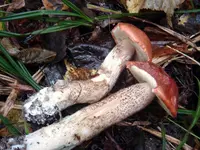
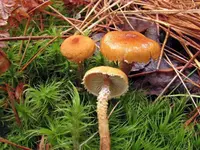
Foxy bolete, Leccinum vulpinum, is a mycorrhizal mushroom that lives in close association with pine roots, rather than a typical foliage houseplant. It forms medium-sized, reddish brown caps with a velvety surface and pale, pore-covered undersides instead of gills. The stout stem shows fine dark scales that become more noticeable with age.
This species occurs naturally in coniferous forests across parts of Europe, especially in sandy or acidic soils. It can be challenging to cultivate because it depends on a living pine partner, so attempts to care for Foxy Bolete at home are usually experimental. In nature it favors moist, well-drained soil and moderate light filtered through tree canopies.

Care Difficulty
Hard Care

Light Preference
Partial Shade

Water Requirements
Regular Water

Temperature Preference
Cool Climate

Hardiness Zone
3–7

Soil Texture
Sandy, Loamy, Organic-rich

Soil pH
Strongly acidic (4.5–5.5), Acidic (5.5–6.5)

Soil Drainage
Moist but well-drained

Fertilization
Minimal (feed rarely)
Scan your plant to receive care tips personalized for your specific plant
Available on iOS and Android
Leccinum vulpinum is a mycorrhizal woodland mushroom that prefers dappled forest light rather than full open sun.
This species depends on naturally moist, well-drained forest soil rather than frequent direct watering.
This woodland fungus favors cool to mild conditions, with fruiting often linked to seasonal temperature shifts.
Humidity plays almost no role in cultivation, as this ectomycorrhizal fungus forms outdoors with natural soil and tree partners.
This mushroom requires specific outdoor soil conditions that support its mycorrhizal partnership with pine roots.
This species is not suitable for container growing because it depends on complex mycorrhizal relationships with pine roots in open soil.
Leccinum vulpinum is a mycorrhizal mushroom that usually does not need fertilization when grown in natural soil with suitable host trees.
Leccinum vulpinum does not require pruning, as it is a wild mycorrhizal fungus rather than a typical garden plant.
Transplanting this mycorrhizal fungus is unreliable, since Leccinum vulpinum depends on living roots of suitable host trees such as pine.
Propagation of Leccinum vulpinum is challenging because it requires a compatible host tree and specific soil conditions.
This woodland fungus is cold hardy in its native range and generally needs no special winter care once established outdoors.

Plant Health Check
Not sure what's wrong with your plant? Check your plant's health inside the app.
This bolete forms ectomycorrhizal partnerships almost exclusively with pine species in the Pinus subgenus Pinus, especially Scots pine, and is rarely found with other trees.
Mature specimens typically show a warm fox-red to reddish-brown cap that contrasts with the paler stem and often helps separate it from similar brown-capped Leccinum species in the field.
The whitish flesh often slowly turns greyish or vinaceous when cut, and the pore surface may discolor slightly, while the spores are relatively narrow and smooth, features used by mycologists to confirm identification.

This species has a strongly northern distribution in Europe and is particularly characteristic of dry, sandy pine heaths and plantations, making it an indicator of certain nutrient-poor, well-drained forest soils where few other fleshy fungi fruit abundantly.
This species is generally regarded as an edible bolete when correctly identified and well cooked, but quality is considered moderate. Misidentification with toxic look-alikes is a real risk, so foraging should rely on expert confirmation.
Keep your plants happy and healthy with plant identification, disease detection, and easy care guidance.