


Select host material
Collect freshly fallen, undecayed hardwood branches or logs 5–15 cm thick, since this fungus develops best on relatively fresh deadwood rather than fully rotted material.

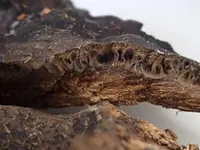
Camarops tubulina is not a typical houseplant but a wood-inhabiting fungus that forms dark, cushion-like fruiting bodies on decaying trunks or large branches. It belongs to a group of saprophytic fungi, which feed on dead wood and help break down tough plant material in forest ecosystems.
This species is usually found in temperate forests, especially on well-rotted hardwood in moist, shaded locations. Its slow, unobtrusive growth and need for consistently decaying wood make it challenging to cultivate, even for specialists.
Those interested in how to care for Camarops tubulina should know it prefers stable moisture, cool to mild temperatures, and undisturbed, decomposing wood rather than conventional potting setups.

Care Difficulty
Moderate Care

Light Preference
Partial Shade

Water Requirements
Moderate Water

Temperature Preference
Warm Climate

Hardiness Zone
Unknown

Soil Texture
Loamy

Soil pH
Slightly acidic (6.5–7.0)

Soil Drainage
Well-drained

Fertilization
Minimal (feed rarely)
Scan your plant to receive care tips personalized for your specific plant
Available on iOS and Android
This wood-decaying fungus prefers shaded woodland light rather than direct, open sun exposure.
Moist, but not stagnant, conditions on decaying wood are essential for consistent fruiting and mycelial health.
This species favors cool to mild forest conditions and is sensitive to both hard frost and strong heat.
Humidity plays a minor role for Camarops tubulina, which usually develops on naturally damp wood outdoors.
In cultivation, focus on creating a consistently moist, wood-rich substrate rather than conventional garden soil for Camarops tubulina.
This fungus is generally unsuitable for traditional container growing, as it naturally colonizes decaying wood in situ rather than conventional potting setups.
This fungus typically grows on decaying wood and usually does not need supplemental feeding in natural or garden settings.
Pruning has no practical role for Camarops tubulina, as it is a wood-inhabiting fungus rather than a managed ornamental plant.
Transplanting is generally unnecessary because this species naturally colonizes dead or dying wood and is not managed like a garden plant.
Propagation of this wood-decay fungus is usually left to natural spore dispersal and is not a standard horticultural practice.
No special winter care is needed, as this fungus tolerates typical outdoor seasonal changes when growing on suitable wood.

Plant Health Check
Not sure what's wrong with your plant? Check your plant's health inside the app.
Camarops tubulina is a wood-decaying ascomycete that shows a strong preference for dead beech wood, especially large, long-fallen trunks that are already in advanced stages of decay.
Its dark, cushion-like stromata often develop partly or almost entirely embedded in the wood, with only small openings at the surface where spores are released from flask-shaped structures called perithecia.
Because it tends to appear on large, long-dead beech logs in humid, undisturbed woodland, this species is often associated with old-growth or long-continuity beech forests in parts of Europe.

The species is regarded as nationally rare or threatened in several European countries, and in some regions its presence is used in fungal red-list assessments to highlight forests of high conservation value due to their long history of deadwood continuity.
Growth is generally slow. As a wood-decay fungus, it expands gradually through dead or weakened wood and forms fruiting bodies over several seasons. Environmental factors like moisture, temperature, and wood quality strongly influence growth rate and visibility.
Keep your plants happy and healthy with plant identification, disease detection, and easy care guidance.

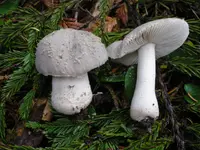
American Floury Amanita
Amanita farinosa
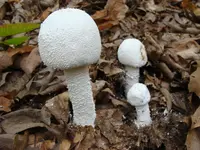
Plateful of Pyramids Lepidella
Amanita polypyramis
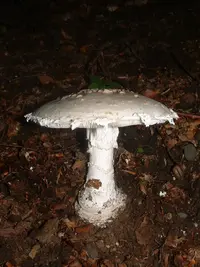
European Pine Cone Lepidella
Amanita strobiliformis
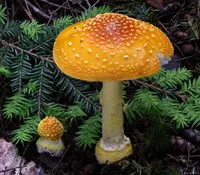
Frost's Amanita
Amanita frostiana
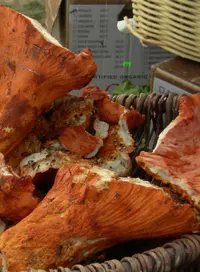
lobster mushroom
Hypomyces lactifluorum
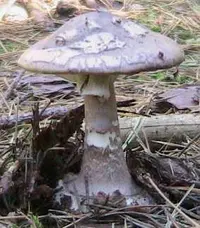
Grey-veiled Amanita
Amanita porphyria
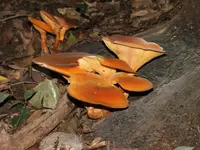
Jack o'Lantern mushroom
Omphalotus olearius
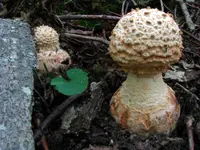
Carrot-Footed Lepidella
Amanita daucipes