Mycorrhizal partner selection
Establish the fungus near compatible conifer hosts, such as pine or spruce, since this ectomycorrhizal species depends on living tree roots rather than standalone substrate beds.

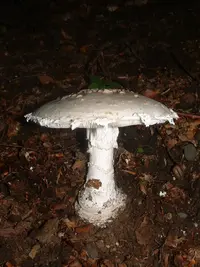
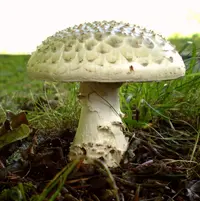
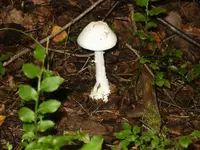
European Pine Cone Lepidella (Amanita strobiliformis) is a large, mycorrhizal mushroom that partners with tree roots rather than growing as a typical houseplant. It forms stout white to pale grey caps dotted with thick warts, giving it a pine-cone-like look, and usually appears singly or in small groups. This species occurs mainly in parts of central and southern Europe, often in light woodlands and calcareous, or lime-rich, soils. It is challenging to cultivate because it depends on a specific relationship with host trees and native soil fungi, so attempts to care for European Pine Cone Lepidella at home rarely succeed.

Care Difficulty
Hard Care

Light Preference
Partial Shade

Water Requirements
Regular Water

Temperature Preference
Cool Climate

Hardiness Zone
6–9

Soil Texture
Loamy, Silty, Organic-rich

Soil pH
Acidic (5.5–6.5), Slightly acidic (6.5–7.0)

Soil Drainage
Moist but well-drained

Fertilization
Minimal (feed rarely)
Scan your plant to receive care tips personalized for your specific plant
Available on iOS and Android
This mycorrhizal fungus prefers woodland-type light rather than open, full sun exposure.
This species relies on consistently moist, well-drained forest-type soil rather than frequent surface soaking.
This woodland fungus prefers cool to mild conditions typical of temperate forests.
This ectomycorrhizal fungus needs consistently moist, high-humidity conditions to fruit reliably.
This species requires a loose, well-aerated substrate that mimics its native forest-floor conditions.
This species is generally unsuitable for container growing because it depends on a living tree root system in natural soil.
Amanita strobiliformis forms a mycorrhizal partnership with tree roots and should not be fertilized directly like a typical garden plant.
Amanita strobiliformis is a wild mycorrhizal fungus and is not pruned in the horticultural sense.
This species is not suited to standard repotting because it depends on a stable mycorrhizal association with host tree roots.
Propagation of Amanita strobiliformis is highly specialized and not practical for typical home cultivation or hobby settings.
This ectomycorrhizal fungus is naturally cold hardy in its native range and needs no special winter care in the ground.

Plant Health Check
Not sure what's wrong with your plant? Check your plant's health inside the app.
This species occurs mainly in scattered localities in central and southern Europe, often considered rare or very infrequent compared with more widespread Amanita species.
It shows a marked preference for alkaline, lime-rich soils and is typically found in oak, beech, or mixed broadleaf woodlands growing on calcareous substrates.
The large, pale cap is covered with thick, irregular, grayish warts that resemble the scales of a pine cone, a feature that helps distinguish it in the field from other pale amanitas.

Molecular and morphological studies indicate that this species forms ectomycorrhizal partnerships specifically with certain broadleaf trees such as Quercus (oak) and Fagus (beech), exchanging mineral nutrients from the soil for sugars produced by the host tree, which makes it an important functional component of forest nutrient cycles where it occurs.
This species is widely regarded as poisonous and should not be eaten under any circumstances. Identification in the Amanita genus is difficult, and confusion with deadly relatives is common. Treat all similar mushrooms as unsafe for consumption.
Keep your plants happy and healthy with plant identification, disease detection, and easy care guidance.