Rotate Fruiting Blocks
Turn bags or blocks 90° every harvest cycle so different sides are exposed to fresh air and light, which helps maintain even pinset and reduces the risk of one side drying out or molding.

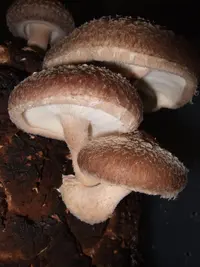
Shiitake, Lentinula edodes, is a wood-decay fungus grown for its edible mushrooms, not a leafy houseplant. It normally grows on fallen hardwood logs, forming firm, brown caps with pale gills underneath.
In nature it is native to East Asia, where it colonizes dead or dying broadleaf trees and fruits in cool, moist conditions. Cultivated shiitake is usually grown on prepared logs or compressed growing blocks.
This species is considered moderately easy to grow once it is established, but it needs consistent moisture, fresh air, and the right temperature range to form quality mushrooms. Understanding how to care for shiitake largely means managing humidity, airflow, and a shaded spot away from direct sun.

Care Difficulty
Hard Care

Light Preference
Shade

Water Requirements
Keep Soil Moist

Temperature Preference
Cool Climate

Hardiness Zone
5–9

Soil Texture
Loamy, Peaty, Organic-rich

Soil pH
Strongly acidic (4.5–5.5), Acidic (5.5–6.5)

Soil Drainage
Moist but well-drained

Fertilization
Minimal (feed rarely)
Scan your plant to receive care tips personalized for your specific plant
Available on iOS and Android
This wood-decay fungus prefers cool, shaded woodland conditions that mimic a forest understory.
Moisture management focuses on keeping the substrate consistently damp but never saturated.
This species performs best in cool, stable conditions, with different ranges for colonization and fruiting.
Lentinula edodes needs consistently high humidity to form healthy, well-shaped fruiting bodies.
Lentinula edodes is a wood-decay fungus that needs a lignin-rich substrate rather than conventional garden soil.
This species can be grown in containers when using bags or buckets filled with hardwood-based substrate rather than potting soil.
Lentinula edodes grown on nutrient-rich hardwood logs or supplemented sawdust usually needs minimal additional fertilizer.
Pruning is not a standard practice for Lentinula edodes, since it is a fungus fruiting from wood rather than a leafy plant.
Shiitake (Lentinula edodes) is usually moved by shifting colonized logs or substrate blocks rather than classic repotting.
Lentinula edodes is commonly propagated using spawn rather than seeds or cuttings.
Outdoor Lentinula edodes on hardwood logs is generally cold hardy and needs only modest winter care in most temperate regions.

Plant Health Check
Not sure what's wrong with your plant? Check your plant's health inside the app.
This species is a white-rot fungus that decomposes lignin in hardwoods, which helps recycle tough woody material back into forest soil nutrient cycles.
Its high content of guanylate and glutamate, two umami-related compounds, makes it a powerful natural flavor enhancer in broths and sauces.
Cultivation records from East Asia date back several centuries, and by the 19th century growers were already managing specific log species, cut timing, and placement to improve yields.

In commercial production, this fungus forms a firm, dark outer rind on colonized logs or blocks, and growers often use a controlled cold or physical shock to trigger synchronous fruiting, allowing harvests to be timed very precisely.
Colonization of fresh logs usually takes 6–18 months before the first flush of mushrooms, depending on wood type, strain, and temperature. On supplemented sawdust blocks, first harvests often occur in 2–4 months under controlled conditions.
Keep your plants happy and healthy with plant identification, disease detection, and easy care guidance.