Parnassus-leaved Water-plantain Care (Caldesia parnassifolia)

Also known as: Caldesia
Parnassus-leaved Water-plantain

About Parnassus-leaved Water-plantain

Parnassus-leaved water-plantain, Caldesia parnassifolia, is an aquatic perennial often found in still or slow-moving freshwater such as ponds, lakes, and ditches. It grows from submerged roots and produces floating or slightly emergent leaves with simple, clean outlines.

In suitable conditions it can form attractive patches, sometimes sending up delicate flowering stems above the water surface. Its growth habit is generally moderate, so it does not usually become overly invasive in small ornamental ponds.

This species prefers full sun to light shade, consistently wet or shallowly flooded conditions, and nutrient-rich, muddy or loamy substrates. Once a stable water level and substrate are provided, it is relatively straightforward to care for Parnassus-leaved Water-plantain in garden water features.

Main Plant Requirements

Care Difficulty

Moderate Care

Light Preference

Full Sun

Water Requirements

Aquatic

Temperature Preference

Cool Climate

Hardiness Zone

5–9

Soil Texture

Silty, Loamy, Organic-rich

Soil pH

Acidic (5.5–6.5), Slightly acidic (6.5–7.0)

Soil Drainage

Waterlogged tolerant

Fertilization

Minimal (feed rarely)

Get Personalized Care Plan

Scan your plant to receive care tips personalized for your specific plant

Available on iOS and Android

How to Care for the Parnassus-leaved Water-plantain

This aquatic plant prefers bright, open conditions but not intense, drying sun all day.

  • Provide 4–6 hours of direct morning sun with light shade or filtered light in the hot afternoon, especially in warmer climates.
  • Tolerates bright partial shade, but flowering of Parnassus-leaved Water-plantain is usually better with at least 3–4 hours of direct sun.
  • In summer, prevent strong afternoon scorch by using taller marginal plants as light shade; in cooler seasons, allow more open sun exposure.

Caldesia parnassifolia is an aquatic species that grows best with consistently high water levels rather than episodic soil watering.

  • Grow in shallow water where the crown is just submerged or up to 10–20 cm deep; the substrate should never dry out at any time.
  • Watch for underwatering signs such as drooping foliage, crisp leaf edges, or shrinking water level; top up ponds or containers before roots are exposed.
  • Overwatering of the substrate is not an issue if the plant is fully aquatic, but foul smell, black anaerobic muck, or rotting rhizomes indicate poor water quality and stagnation.

This species prefers mild to warm conditions and is sensitive to hard freezing, especially in small containers.

  • Aim for 65–80°F (18–27°C) during active growth for strongest foliage and flowering in outdoor ponds or marginal beds.
  • Tolerates short dips to about 40°F (4–5°C) in larger ponds, but repeated freezes or ice around the crown can damage or kill plants.
  • In hot spells above 90°F (32°C), deeper or slightly shaded water helps buffer temperature swings and reduces heat stress on leaves and roots.

This aquatic species prefers constantly moist air around 60–80% but copes as long as water levels are stable.

  • Dry indoor air is less critical than maintaining high water around the roots, yet prolonged air below 40% can slow leaf growth.
  • Humidity stress appears as crisping leaf edges, drooping blades, and slower unfolding of new leaves despite wet substrate.
  • Increase local humidity by grouping water trays, using wide water-filled saucers under baskets, or placing containers in shallow ponds.

This plant grows best in saturated, organic-rich, fine-textured substrates rather than conventional potting soil.

  • Use a heavy loam or clay-loam garden soil mixed with 30–50% well-rotted compost to create a dense, nutrient-holding base.
  • Aim for a neutral to slightly acidic pH of about 6.0–7.0, avoiding strongly alkaline mixes that can lock up micronutrients.
  • Pack the substrate firmly so it does not float, then submerge it under 5–15 cm of water to keep Caldesia parnassifolia continuously saturated.
  • Avoid fast-draining, sandy, or highly aerated potting mixes with perlite, as these prevent stable flooding and reduce rhizome anchoring.

This species is suitable for container growing when the pot can sit permanently in shallow water.

  • Choose a wide, low, heavyweight container so the flooded pot stays stable and does not tip as foliage spreads above the waterline.
  • Use containers without drainage holes or block holes completely to maintain a permanent 5–15 cm water layer above the substrate surface.
  • Select dark-colored, rigid pots that warm slightly in sun and resist bowing, which helps keep water depth and substrate level consistent.

This aquatic species grows well in nutrient-rich, muddy substrates and usually needs only light supplemental feeding in cultivation.

  • Use a diluted balanced aquatic fertilizer (around 10-10-10 NPK) at 1/4–1/2 strength for container-grown Parnassus-leaved Water-plantain.
  • Apply fertilizer every 4–6 weeks during active growth in spring and summer only.
  • Avoid feeding in late fall and winter when growth slows or plants are dormant.
  • Rinse or refresh water after feeding if grown in tubs to prevent nutrient buildup and algae.

Pruning Caldesia parnassifolia is mainly hygienic, keeping the aquatic stand clean and encouraging fresh foliage.

  • Best time is during the growing season, checking plants every few weeks.
  • Remove yellowing, dead, or damaged leaves and flower stalks at the base with clean scissors or snips.
  • Thin out crowded shoots to maintain water circulation and reduce rot.
  • Avoid heavy cutting that would remove most foliage at once and stress the plant.

This aquatic plant is usually grown in ponds or water tubs, so management focuses on dividing and transplanting clumps rather than frequent repotting.

  • Transplant or divide every 2–3 years when clumps are dense or growth slows.
  • Lift containers or clumps in early spring, before strong new growth starts.
  • Check for roots circling baskets and trim lightly, keeping most rhizomes and feeder roots intact.
  • Replant into mesh baskets or pond margins with heavy loam, water thoroughly, and shade slightly for several days.

Propagation of Caldesia parnassifolia is typically done by division of established clumps, with seed used less often in home settings.

  • Divide mature clumps in early spring, keeping several shoots and healthy roots on each division.
  • Plant divisions into shallow water or pond baskets filled with heavy loam, then submerge gradually.
  • Maintain water temperatures around 60–75°F and steady water levels for best establishment.
  • For seeds, sow fresh on saturated substrate and keep consistently warm and bright.

In many temperate regions this aquatic species is fairly hardy in ponds, needing only modest winter preparation.

  • In cold climates, sink containers to the deepest, unfrozen part of the pond before hard frosts.
  • Allow foliage to die back naturally, then remove soft, decaying material to limit rot.
  • Apply a thin mulch of pond-safe material over crowns in very shallow margins in freezing areas.
  • Move small tub-grown plants into a cool, frost-free space with water kept just above the crowns.

Care Tips

Stabilize Container Edges

Use wide, shallow tubs with gently sloping sides or place bricks around the rim so floating rhizomes and leaf rosettes are not shaded or damaged by steep, opaque pond walls.

Control Water Movement

Position the plant away from fountain jets, filters, or strong water inlets, since persistent turbulence can tear leaves and uproot new shoots; aim for calm, slow-moving or still water.

Substrate Capping Technique

After planting in a loamy aquatic mix, add a 1–2 cm layer of clean coarse sand or fine gravel on top to prevent soil from clouding the water and to anchor young roots.

Seasonal Division Practice

Every 2–3 years in early spring, lift and gently divide rhizome clumps with at least 2–3 healthy growth points each, then replant promptly to maintain vigorous stands and prevent overcrowding.

Monitor Water Quality

Use a simple test kit a few times each season to check for extreme nutrient levels or high salts, and refresh part of the water if values drift, as stable, moderate conditions simplify Caldesia parnassifolia care.

Common Pests and Diseases

Aquatic snails

This pest feeds on young leaves and soft tissues, leaving irregular holes and sometimes consuming entire seedlings. Symptoms include ragged leaf edges and slowing growth in shallow water plantings.

Solution

Hand-pick snails from containers and shallow margins, use fine mesh barriers or copper tape on pond edges, and avoid overfeeding fish, which can increase snail populations. In small ornamental ponds, introduce natural predators like certain fish species where appropriate and remove excessive decaying plant matter that shelters snails.

Aquatic leaf beetles

These insects chew round to oval holes in floating or emergent leaves, which can reduce photosynthesis and weaken stands of the plant. This pest is often most noticeable in warm weather when adults and larvae feed heavily on foliage near the water surface.

Solution

Inspect foliage regularly and remove heavily infested leaves to reduce beetle numbers. Encourage natural predators, shake beetles from leaves into a container of soapy water, and avoid nearby broad-spectrum insecticide use that would harm beneficial insects around the pond.

Algal overgrowth

This problem occurs when filamentous or planktonic algae grow thickly around the plant, shading leaves and competing for nutrients. Symptoms include reduced vigor, pale or stunted growth, and leaves smothered by green mats at the water surface.

Solution

Reduce nutrient input by limiting fertilizer runoff, cleaning filter systems, and removing decomposing organic matter from the water. Manually remove algae with a net, provide partial shade if the site is very bright, and maintain balanced planting density and, where appropriate, a modest fish population to help limit algal blooms.

Leaf spot

This disease causes brown to black water-soaked spots on floating or emergent leaves, sometimes with a yellow halo and eventual tissue breakdown. Symptoms include premature leaf death and thinning of the stand if many leaves are affected.

Solution

Remove and discard affected leaves promptly to limit spread and avoid leaving infected debris in the water. Improve water circulation, avoid overhead splashing that moves spores, and, in managed collections, rotate plants or thin dense clumps to allow better airflow over emergent foliage.

Crown and rhizome rot

This disease develops in stagnant, organically overloaded water and leads to soft, dark, foul-smelling tissue at the crown and upper rhizomes. Symptoms include sudden collapse of leaves, poor new growth, and sections of the plant detaching at the base.

Solution

Improve water quality by reducing organic load, increasing circulation, and avoiding accumulation of sludge around the base of the plants. Remove and discard affected crowns, replant only firm, healthy sections into clean, mildly flowing or regularly refreshed water, and avoid planting too deeply in heavy, anaerobic mud.

Interesting Facts

Floating-leaf specialist

This aquatic species forms floating, oval leaves on long petioles from a submerged rhizome, allowing it to capture light efficiently at the water surface while its roots remain anchored in mud.

Three-petaled blooms

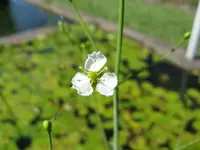
Its inflorescences carry small, white, three-petaled flowers arranged in loose whorls along tall, emergent stalks rising well above the water level.

Fragment-friendly reproduction

Besides producing seeds in winged fruits, the plant can spread vegetatively when pieces of its rhizome or basal parts break off and re-root in soft, shallow sediments.

Botan icon

Did you know?

This species has suffered major declines in parts of Europe and is listed as threatened or endangered in several countries, making the conservation of its shallow, slow-moving freshwater habitats particularly important.

FAQs about Parnassus-leaved Water-plantain

This aquatic species usually blooms from late spring to mid-summer, depending on water temperature and light. Individual flowers are short-lived, often just a few days, but new buds open continuously, extending the overall display for several weeks.

Grow Healthy Plants with Botan Care

Keep your plants happy and healthy with plant identification, disease detection, and easy care guidance.

Botan plant care app — identify plants on mobile

Explore More Plants