Stake In Windy Sites
In exposed gardens, insert a slim stake on the windward side and loosely tie stems with soft ties to prevent lodging or snapping during storms while still allowing natural movement.

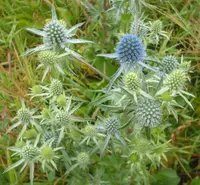
Blue eryngo, Eryngium planum, is a hardy, clump-forming perennial from dry grasslands and steppe regions of central and eastern Europe. It belongs to the carrot family but looks more like a small thistle. Plants produce branching stems with steel-blue cones surrounded by spiky bracts, giving a striking architectural look in sunny borders and dry gardens. Foliage is often bluish-green and remains compact, so it suits smaller spaces and mixed plantings. This species tolerates poor, sandy, or rocky soils and resists drought once established, which makes it relatively easy to maintain. Those traits help explain how to care for Blue eryngo in low-input, water-wise gardens.

Care Difficulty
Easy Care

Light Preference
Full Sun

Water Requirements
Low Water

Temperature Preference
Cold Hardy

Hardiness Zone
4–9

Soil Texture
Sandy, Loamy, Rocky

Soil pH
Slightly acidic (6.5–7.0), Slightly alkaline (7.0–7.5)

Soil Drainage
Well-drained

Fertilization
Minimal (feed rarely)
Scan your plant to receive care tips personalized for your specific plant
Available on iOS and Android
This sun-loving perennial needs strong light to form sturdy, colorful flower stems.
Eryngium planum prefers dry to moderately dry conditions and dislikes sustained soil moisture.
This hardy perennial tolerates a wide temperature range once established in the ground.
Humidity is not a significant factor for Eryngium planum, which thrives in dry conditions.
This species prefers lean, fast-draining soil that mimics dry, open habitats.
This plant can be grown in containers, but only if drainage is excellent and the pot stays relatively dry.
Eryngium planum prefers lean soils and needs only light feeding to stay healthy.
Pruning Eryngium planum is mainly about tidying and managing self-seeding.
Eryngium planum forms a deep taproot and dislikes disturbance, so transplant only when necessary.
Propagation of Eryngium planum is most reliable from seed, with some gardeners also trying careful division.
This species is generally cold hardy and needs minimal winter care in most temperate climates.

Plant Health Check
Not sure what's wrong with your plant? Check your plant's health inside the app.
Although often called blue sea holly, this species is not a true thistle; it belongs to the carrot family (Apiaceae) but has evolved spiny bracts and rigid stems that resemble thistles as an adaptation to dry, open habitats.
Its long-lasting blue flowerheads are rich in nectar and pollen and are particularly attractive to bees, hoverflies, and small solitary wasps, making it a valuable plant for pollinator-friendly gardens.
This species develops a deep taproot and tough, waxy leaves that reduce water loss, which is why it tolerates exposed, windy sites and poor, dry soils better than many other ornamentals.

Eryngium planum is native to steppe and dry meadow regions of central and eastern Europe and western Asia, where wild populations are considered threatened or locally endangered in parts of its native range due to habitat loss and land-use changes.
Lack of flowers usually comes from too much shade, overly rich or wet soil, or plants that are still immature. Ensure full sun, well-drained soil, and avoid heavy fertilizing to support normal flowering patterns when growing Blue eryngo.
Keep your plants happy and healthy with plant identification, disease detection, and easy care guidance.