Blue orchid Care (Vanda coerulea)

Blue orchid

About Blue orchid

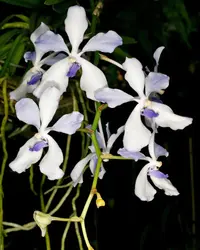
Blue orchid, Vanda coerulea, is an epiphytic orchid that usually grows attached to trees, with long roots exposed to air. It is known for its large, flat flowers in shades of soft to vivid blue, often with a netted pattern on the petals.

In nature, it occurs in parts of the eastern Himalayas and Southeast Asia, where it grows in bright, humid forest conditions. It can be challenging for beginners because it demands high light, warm temperatures, and consistent moisture around its roots.

Those who care for Blue orchid should be prepared to provide strong light, excellent air movement, and a very free-draining growing setup rather than regular potting soil.

Main Plant Requirements

Care Difficulty

Hard Care

Light Preference

Partial Sun

Water Requirements

Regular Water

Temperature Preference

Tropical / Frost Sensitive

Hardiness Zone

11–12

Soil Texture

Sandy, Rocky, Organic-rich

Soil pH

Acidic (5.5–6.5)

Soil Drainage

Well-drained

Fertilization

Heavy (weekly, diluted)

Get Personalized Care Plan

Scan your plant to receive care tips personalized for your specific plant

Available on iOS and Android

How to Care for the Blue orchid

This orchid needs very bright light to flower well without scorching the leaves.

  • Provide 6–8 hours of bright light daily, with direct morning sun and filtered light or light shade from late morning to afternoon.
  • Outdoors, place Vanda coerulea where it receives dappled sun under a tree canopy; indoors, use an unobstructed east or bright south window with sheer curtain.
  • Leaves should be medium green; very dark leaves indicate too little light, while yellowing, hard leaves with brown patches show excess sun stress.

This epiphytic orchid prefers frequent moisture on the roots but fast drying between waterings.

  • Water once roots turn silvery-white and feel dry, often daily in hot weather and every 2–3 days in cooler, humid conditions.
  • Use very free‑draining medium or bare‑root basket culture; fully soak roots for 5–10 minutes, then allow all excess water to drain away.
  • Wrinkled leaves and shriveled roots indicate underwatering, while limp leaves, blackened roots, or a sour smell signal chronic overwatering and poor aeration.

This warm- to intermediate-growing orchid needs stable, frost-free temperatures for reliable growth and flowering.

  • Aim for 70–85°F (21–29°C) by day and 60–70°F (16–21°C) at night for active growth and flowering.
  • Protect from cold; growth slows below 55°F (13°C) and tissue damage can occur near 40°F (4°C), so avoid any frost exposure.
  • In hot spells above 90°F (32°C), increase shade, airflow, and humidity to prevent heat stress while maintaining a slightly cooler night drop for recovery.

This orchid demands high humidity to maintain healthy roots and blooms.

  • Aim for 60–80% humidity, as the Blue orchid is adapted to moist, airy environments.
  • Dry air causes wrinkled leaves, root tip dieback, and stalled growth, indicating humidity stress.
  • Increase humidity with daily misting of roots, humidity trays under baskets, or a room humidifier while keeping air moving.

Vanda coerulea is usually grown without traditional soil and instead needs a very airy, fast-drying support medium.

  • Use coarse orchid bark, large charcoal, and chunky perlite or pumice to create a loose, open structure around the roots.
  • Ensure extremely rapid drainage so water never pools; roots must dry quickly between waterings to prevent rot.
  • Keep pH slightly acidic to neutral (about 5.5–7.0), which suits epiphytic orchid roots and nutrient uptake.
  • Avoid fine potting soil, peat-heavy mixes, or compact organic material that clogs air spaces and suffocates roots.

This species is well suited to containers, especially baskets or slatted pots that allow roots to roam.

  • Choose hanging baskets or slatted containers that let roots grow outside the confines of the pot for better air exposure.
  • Use a heavy or weighted container if not hanging, as tall foliage and exposed roots can make the plant top-heavy.
  • Select wood or plastic baskets based on how quickly mixes dry, with wood retaining slightly more moisture for hot, dry climates.

This orchid benefits from steady, light feeding rather than heavy applications.

  • Use a balanced water‑soluble fertilizer (around 20‑20‑20) at 1/4–1/2 strength for Blue orchid during active growth.
  • Feed every 1–2 weeks in spring and summer, especially in bright, warm conditions.
  • Reduce feeding to 1× per month or stop entirely in cooler, low‑light winter periods.
  • Flush the growing medium with plain water monthly to prevent fertilizer salt buildup.

Vanda coerulea needs only light, targeted pruning to stay healthy and flowering well.

  • Prune at the end of flowering or in early spring when growth resumes.
  • Use sterile, sharp scissors or pruners to remove dead, yellowing, or diseased leaves and spent flower spikes.
  • Cut away dried or damaged roots, keeping firm, silvery or green roots intact.
  • Limit pruning to problem areas to maintain the plant’s natural upright form and future bloom spikes.

This orchid prefers stability and is repotted only when root congestion or decline is clear.

  • Look for roots circling baskets, breaking pots, or a declining, wobbly plant as signs to repot.
  • Plan repotting every 2–3 years at most, in late spring when active root tips are visible.
  • Use a slatted basket or coarse orchid mix, keeping aerial roots as intact and free as possible.
  • Soak roots in lukewarm water before handling, then keep shaded and slightly on the dry side for 7–10 days to limit stress.

This species is usually propagated vegetatively rather than from seed in home conditions.

  • Use stem division by separating mature plants that have developed basal offshoots or keikis with their own roots.
  • Carry out division in late spring or early summer, when growth and root production are strong.
  • Provide bright, filtered light, high humidity (60–80%), and warm temperatures for rooting.
  • Pot divisions in very open orchid mix, securing them so new roots are not disturbed.

This orchid is frost sensitive and requires warm, sheltered conditions in winter.

  • Keep plants above 55°F, ideally 60–70°F, and avoid cold drafts or sudden temperature drops.
  • Move container plants indoors or into a heated greenhouse before nights fall below 55°F.
  • Provide bright, indirect light and good air movement, but water less frequently in low light.
  • Ensure roots dry slightly between waterings to reduce rot risk in cool conditions.

Care Tips

Basket mounting method

Use a slatted wooden or plastic basket and secure the roots loosely with coarse orchid media only around the base, allowing most roots to hang free for better aeration and long-term root health.

Root hydration routine

Before fertilizing, flush aerial roots thoroughly with plain lukewarm water for 5–10 minutes to rehydrate velamen (the spongy root covering) and reduce fertilizer burn risk.

Seasonal light acclimation

At the end of winter, increase light levels over 2–3 weeks by moving the plant gradually closer to bright exposure or reducing shade cloth stepwise, which prevents sun scorch on previously shaded leaves.

Support for heavy spikes

As flower spikes elongate, tie them gently to thin bamboo stakes or a hanging wire using soft plant ties, avoiding tight loops that can damage the spike or restrict sap flow.

Airflow and spacing

Hang the plant where moving air can reach all sides and ensure at least 15–20 cm clearance from walls or other plants, which helps prevent fungal problems and supports stable conditions when growing Blue orchid.

Common Pests and Diseases

Spider mites

This pest causes fine stippling on leaves, silvery patches, and webbing along leaf bases and roots, especially in dry, warm conditions. Symptoms include dull, dehydrated-looking foliage and slowed growth.

Solution

Increase humidity to 50–70%, hose or shower plants thoroughly to remove mites and webbing, and isolate affected plants. Treat leaf undersides and exposed roots with insecticidal soap or a neem-based spray every 5–7 days for 3–4 cycles, and improve air circulation to reduce reinfestation risk.

Scale insects

These insects appear as small, brown or off-white bumps on leaves, sheaths, and aerial roots, often clustered at the base of the leaves. Symptoms include sticky honeydew, sooty mold growth, and a gradual decline in vigor.

Solution

Manually remove visible scale with a cotton swab dipped in isopropyl alcohol and trim heavily infested sheaths. Follow up with a systemic insecticide labeled for orchids or repeated applications of horticultural oil, ensuring good coverage of leaf bases and crevices where scale hides.

Mealybugs

This pest forms white, cottony masses in leaf axils, on roots, and behind old sheaths. Symptoms include distorted new growth, sticky honeydew, and weakening of the plant over time.

Solution

Remove visible mealybugs with alcohol-dipped cotton swabs and rinse the plant thoroughly, including aerial roots. Repeat targeted treatments with insecticidal soap or neem-based products at 7–10 day intervals, and keep new or infested plants isolated until at least 1 month pest free.

Bacterial brown spot

This disease produces water-soaked, translucent spots on leaves that rapidly turn brown to black, often starting at leaf tips or wounds. Symptoms include a soft, sometimes foul-smelling rot that can spread along the leaf blade in warm, humid conditions.

Solution

Immediately remove and discard affected leaf areas with a sterile blade, cutting into healthy tissue, and avoid splashing water between plants. Improve air movement, keep foliage dry, reduce overhead watering, and use a bactericide labeled for orchids if new spots continue to appear.

Anthracnose leaf spot

This disease causes small, sunken, dark spots on leaves that may coalesce into larger dead areas with yellow halos. Symptoms include slow but progressive spotting under conditions of high humidity and poor air circulation.

Solution

Prune out badly spotted leaves and discard them, then adjust growing conditions to provide stronger air flow and faster leaf drying after watering. Apply a copper-based or other orchid-safe fungicide according to label directions and avoid overhead misting directly on foliage as a long-term practice to improve Vanda coerulea care.

Interesting Facts

True blue pigment

The flowers are one of the few naturally blue orchids, with their color produced by structural effects and specific anthocyanin pigments rather than artificial dyes often used in commercial “blue” orchids.

High-altitude epiphyte

This species is naturally found as an epiphyte on tree trunks in cool to mild montane forests of northeastern India, Myanmar, Thailand, and neighboring regions, often at elevations around 800–1,500 m.

Distinct seasonal pattern

In its native habitat it experiences a marked cool, dry winter and warm, wetter summer, a climate pattern that strongly influences flowering and is important to understand for proper Vanda coerulea care instructions.

Botan icon

Did you know?

Vanda coerulea played a key role in orchid breeding as a primary source of true blue coloration, and many modern blue and bluish-purple hybrid vandas trace their distinctive flower color back to this single wild species.

FAQs about Blue orchid

Lack of flowering often comes from insufficient light intensity, too-warm nights, or inadequate nutrition. Provide strong but filtered light, a slight night temperature drop, balanced fertilizer, and stable humidity to encourage regular spike formation and flowering.

Grow Healthy Plants with Botan Care

Keep your plants happy and healthy with plant identification, disease detection, and easy care guidance.

Botan plant care app — identify plants on mobile

Explore More Plants