
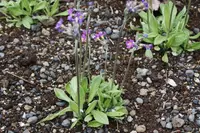
Allegheny monkeyflower Care (Mimulus ringens)

Also known as: square-stemmed monkeyflower, Estuary Monkeyflower
Allegheny monkeyflower

About Allegheny monkeyflower

Allegheny monkeyflower (Mimulus ringens) is a hardy herbaceous perennial native to wet meadows, stream banks, and marshy areas across much of eastern North America. It forms upright clumps with square stems and opposite leaves, topped in summer by tubular lavender to bluish flowers that resemble a small open mouth. The plant spreads gradually by rhizomes and self-seeding where conditions stay consistently moist. It is best suited to rain gardens, pond edges, and other damp spots rather than dry borders. Once established in the right site, it is a reliable, low-maintenance option, and understanding how to care for Allegheny monkeyflower mainly involves providing steady moisture and suitable soil conditions.

Main Plant Requirements

Care Difficulty

Moderate Care

Light Preference

Full Sun

Water Requirements

Aquatic

Temperature Preference

Cold Hardy

Hardiness Zone

3–8

Soil Texture

Loamy, Silty, Organic-rich

Soil pH

Acidic (5.5–6.5), Slightly acidic (6.5–7.0)

Soil Drainage

Waterlogged tolerant

Fertilization

Minimal (feed rarely)

Get Personalized Care Plan

Scan your plant to receive care tips personalized for your specific plant

Available on iOS and Android

How to Care for the Allegheny monkeyflower

This wetland perennial prefers consistent, bright outdoor exposure but not harsh, drying conditions.

  • Provide 4–6 hours of direct morning sun with light afternoon shade; full sun all day is suitable only where soil stays constantly moist.
  • Allegheny monkeyflower tolerates partial shade, but under less than 3–4 hours of sun flowering decreases and stems may stretch and lean.
  • In hot summers, protect from intense afternoon sun to prevent leaf scorch, especially during dry spells, while maintaining open sky exposure in spring and fall.

This species is adapted to very moist to saturated conditions and does not tolerate drying out.

  • Aim for soil that stays consistently wet; in garden beds the surface should feel damp at all times and can even hold shallow standing water around the roots.
  • If Mimulus ringens is grown at the edge of ponds or streams, seasonal rain usually supplies enough moisture; supplement with hose water only when the soil crust begins to lighten or crack.
  • Yellowing, limp foliage with a sour smell suggests waterlogged, stagnant conditions; crisp, browning leaf edges or drooping stems indicate the root zone has started to dry and needs prompt soaking.

This hardy perennial is adapted to temperate climates with cold winters and warm, not extreme, summers.

  • Active growth and flowering occur best around 65–80°F (18–27°C), typical of late spring through early fall in many temperate regions.
  • Dormant crowns survive winter cold to about -20°F (-29°C) under mulch or snow cover, so frost and typical freezes are not a problem in most outdoor plantings.
  • During heat waves above 90°F (32°C), flowering may slow and foliage can wilt; maintain high soil moisture and consider light afternoon shade to reduce heat stress.

This wetland perennial prefers very moist air but adapts to typical outdoor humidity in much of its range.

  • Aim for 60–80% humidity in dense plantings or pond-edge setups to mimic natural marsh conditions.
  • In prolonged dry air, leaf tips may brown and flower buds may drop, indicating humidity stress more than underwatering.
  • Increase humidity outdoors by grouping plants near water features, using shallow trays of water around pots, or mulching heavily to slow evaporation for Allegheny monkeyflower.

Mimulus ringens grows best in consistently wet, nutrient-rich soils that do not dry out.

  • Use a heavy loam rich in organic matter, such as 60–70% garden loam mixed with compost or well-rotted leaf mold.
  • Allow slow drainage only; soil should stay saturated or very moist, making this species suitable for pond margins or bog gardens.
  • A slightly acidic to neutral pH around 6.0–7.0 supports nutrient uptake and healthy root development.
  • Avoid dry, sandy, or sharply drained mixes; if soil is too light, incorporate extra compost and a small amount of clay to improve moisture retention.

This species can grow in containers if the pot is managed like a mini bog or pond-edge zone.

  • Choose a deep, sturdy container that holds a large volume of soil so waterlogging does not cause rapid temperature or moisture swings.
  • Use a solid-sided pot without extra side openings, then stand it in a shallow tray or basin that stays filled with water to keep the root zone saturated.
  • Select heavier materials like ceramic or thick plastic to prevent tipping when the saturated mix and tall stems make the container top-heavy.

Mimulus ringens is a moisture-loving native perennial that benefits from modest feeding in poor soils but often grows acceptably without fertilizer in rich, wet ground.

  • Use a balanced, water-soluble fertilizer (for example 10-10-10) at 1/2 strength for caring for Allegheny monkeyflower in lean or sandy soils.
  • Apply every 4–6 weeks during the active growing season, when plants have strong leaf and stem growth.
  • Avoid feeding in late fall and winter, when the plant is dormant or growth has slowed markedly.
  • Organic compost or a slow-release native-plant fertilizer can be scratched into the top 2–3 cm of soil in early spring.

Mimulus ringens responds well to light, timely pruning that keeps clumps tidy and flowering well.

  • Cut back spent flower stems in mid to late summer to encourage a neater shape and potential rebloom.
  • Remove dead, damaged, or diseased stems at the base using clean, sharp hand pruners to reduce disease spread.
  • Thin out crowded or weak shoots in early spring to improve air flow and support stronger upright growth.
  • Shear stems down to 5–10 cm in late fall or very early spring to refresh foliage and maintain compact clumps.

This species is most often grown in the ground along ponds or wet beds, so transplanting is more common than container repotting.

  • Transplant clumps in early spring or early fall, when temperatures are mild and soil moisture is high.
  • Look for signs such as crowded stems, reduced flowering, or roots circling a pot if Mimulus ringens is container-grown.
  • Divide and replant every 3–4 years to renew vigor, spacing divisions to allow 20–30 cm between clumps.
  • Water deeply before and after moving plants, keep roots shaded and moist during handling, and avoid disturbing the root mass more than necessary.

Mimulus ringens is commonly propagated by seed and by division, both suited to small-scale garden use.

  • Sow fresh seeds in late fall outdoors or in early spring; seeds need light, so press onto the surface of moist seed mix without covering.
  • Maintain consistently moist conditions and cool to mild temperatures (55–70°F) for steady germination.
  • Divide mature clumps in early spring, cutting through the root mass with a sharp spade and replanting sections promptly.
  • Keep new divisions evenly moist for several weeks, and provide light shade in hotter climates until growth resumes strongly.

This hardy perennial usually needs minimal winter care in most temperate climates where it is grown outdoors.

  • Mimulus ringens tolerates typical winter frosts in USDA zones roughly 3–8 once established.
  • Apply a light mulch layer of leaves or straw around the root zone after the ground cools, keeping mulch 2–3 cm from stems.
  • Leave some stems standing over winter in cold, wet sites to mark plant locations and then cut back in early spring.

Care Tips

Edge Moisture Management

In garden beds near ponds or streams, plant slightly above the actual waterline and mulch with a 3–5 cm layer of shredded bark so the roots stay consistently moist without the crown sitting in stagnant water.


Prevent Lodging In Summer

In exposed or windy sites, place low ring supports or discreet peony hoops around young clumps in late spring so tall stems stay upright and flowers remain visible rather than flopping after heavy rain.

Encourage Dense Clumps

Every 3–4 years, lift and divide mature clumps in early spring, replanting the healthiest outer sections at the same depth to maintain vigorous, dense growth and better flowering.

Control Self-Seeding

If volunteer seedlings are not wanted, shear or deadhead spent flower spikes before seeds ripen, leaving only a few stems to mature seed where some natural spread is acceptable.

Streambank Erosion Use

For functional planting along slow-moving water, space plants 30–45 cm apart in staggered rows so the root systems knit together and help stabilize soil while growing Allegheny monkeyflower as a habitat plant.

Common Pests and Diseases

Aphids

These insects cluster on tender shoots and flower stems, sucking sap and causing distortion, yellowing, and sticky honeydew that can attract sooty mold. This pest is often attracted to lush, fast-growing Mimulus ringens plants in moist, nutrient-rich soil.

Solution

Prune or pinch off heavily infested tips, then wash remaining stems and leaves with a strong but controlled stream of water to dislodge insects. For continued problems, use insecticidal soap or a neem oil spray, applied in the early morning or evening and repeated every 5–7 days until populations drop, while avoiding overspray into natural waterways.

Spider mites

These pests thrive in hot, dry weather and can cause fine stippling, a dull or bronzed appearance to leaves, and delicate webbing between stems. Symptoms include reduced vigor and premature leaf drop if populations are high.

Solution

Increase humidity around the planting by keeping soil evenly moist and avoiding prolonged drought stress, then hose down plants thoroughly, including the undersides of leaves, to remove mites and webbing. If needed, apply insecticidal soap or horticultural oil at label rates, repeating at intervals and monitoring closely during hot, dry periods.

Leaf spot

This disease causes small brown to purplish spots on leaves that may enlarge and coalesce, leading to yellowing and premature leaf drop in dense or overwatered stands. Symptoms include more severe damage in crowded patches with poor air movement.

Solution

Remove and discard affected leaves and any heavy leaf litter around the base to reduce spore sources, and thin crowded clumps to improve light and airflow. Water at soil level instead of overhead, and if the problem is persistent, consider a preventive copper or chlorothalonil fungicide labeled for ornamental perennials, applied according to instructions during wet spells.

Powdery mildew

This disease appears as white or gray powdery patches on leaves and stems, sometimes causing distortion and reduced flowering in mid to late summer. Symptoms include infected foliage that may yellow and dry prematurely.

Solution

Improve air circulation by thinning dense growth and avoiding overhead watering in the evening, then remove and discard heavily infected leaves to slow spread. In recurrent cases, use a labeled sulfur or potassium bicarbonate fungicide as soon as the first white patches appear, repeating as directed, while maintaining good site hygiene as part of overall Mimulus ringens plant care.

Interesting Facts

Specialized bee pollination

The flowers are mainly pollinated by bumblebees, which push into the tubular corolla, triggering the stigma lobes to close and helping ensure efficient pollen transfer between plants.

Moisture-loving habitat specialist

This species is naturally restricted to wet habitats such as marshes, stream banks, wet meadows, and ditches, where its rhizomatous roots tolerate periodic flooding but not prolonged drying.

Squared flowering stems

The erect stems are distinctly 4-angled rather than round, a useful field character that helps distinguish this species from many other wetland herbs with similar foliage.
Botan icon

Did you know?

Mimulus ringens produces cleistogamous flowers later in the season, which are tiny self-pollinating blossoms that never fully open, allowing the plant to set seed even when pollinators are scarce or weather conditions are poor.

FAQs about Allegheny monkeyflower

Poor flowering is usually due to low light, nutrient-poor or very dry soil, or plants that are still immature. Ensure consistent moisture, a moderately fertile substrate, and enough sun. Avoid high-nitrogen fertilizer, which promotes leaves instead of flowers.

Grow Healthy Plants with Botan Care

Keep your plants happy and healthy with plant identification, disease detection, and easy care guidance.

Botan plant care app — identify plants on mobile

Explore More Plants