Mounting orientation
Attach plants so the root zone sits slightly below horizontal and the crown tilts downward, which allows water to drain off the leaves and crown quickly and reduces rot in caring for Angraecum eichlerianum.

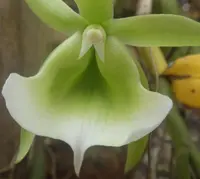
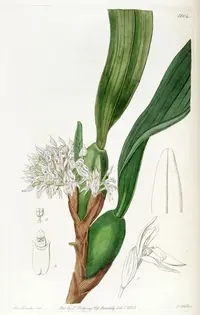
Angraecum eichlerianum is an epiphytic orchid, usually found growing on trees in tropical African forests. It forms slender, upright stems with narrow green leaves and produces star-shaped, often fragrant white flowers on short stalks.
In nature it occupies warm, humid, airy habitats, where roots cling to bark rather than soil. This background makes it somewhat demanding in typical home settings, but manageable for growers who understand its needs.
Light, air movement, and consistent moisture without waterlogging are the main factors that define how to care for Angraecum eichlerianum successfully.

Care Difficulty
Hard Care

Light Preference
Partial Shade

Water Requirements
Regular Water

Temperature Preference
Tropical / Frost Sensitive

Hardiness Zone
12–13

Soil Texture
Sandy, Organic-rich

Soil pH
Acidic (5.5–6.5)

Soil Drainage
Well-drained

Fertilization
Light (every 4–6 weeks)
Scan your plant to receive care tips personalized for your specific plant
Available on iOS and Android
This orchid prefers bright, filtered light that mimics high, tree-mounted conditions near the canopy edge.
Moisture should be frequent but fast-draining, with roots never sitting in stagnant water.
This species prefers warm, stable conditions with only mild drops at night.
This epiphytic orchid needs moderately high, stable humidity to grow well indoors.
This species grows best mounted or in a very airy orchid mix that mimics its natural epiphytic habitat.
This orchid is suitable for containers or baskets when those provide strong aeration and rapid drainage.
Fertilizing should be light and targeted for Angraecum eichlerianum, which is adapted to lean, well-drained epiphytic conditions.
Pruning needs are minimal and focus on cleanliness and maintaining healthy flowering growth on Angraecum eichlerianum.
Repotting aims to refresh the airy orchid medium rather than giving much more root space for this species.
Propagation of Angraecum eichlerianum is possible but slow and usually done by vegetative division rather than seed at home.
Winter care focuses on avoiding cold damage and maintaining stable indoor conditions for this warmth-loving orchid.

Plant Health Check
Not sure what's wrong with your plant? Check your plant's health inside the app.
This orchid releases a strong fragrance at night that specifically attracts long-tongued sphinx moths, which can reach the nectar hidden deep inside its floral spur and pollinate the flowers.
In its native African habitats, this species grows as an epiphyte on tree trunks and large branches in warm, humid forests, anchoring with roots on bark rather than in soil.
The waxy white flowers have a long, narrow nectar spur, an adaptation that matches the proboscis length of its moth pollinators and helps ensure efficient pollen transfer.

Angraecum eichlerianum often forms loose, cascading clumps along tree branches, and over time a single plant can create an extended line of growth several meters long, following light and airflow patterns through the forest canopy.
Lack of flowers usually comes from insufficient night temperature drop, inadequate fertilizer during active growth, or a plant that is still immature. Provide a cooler, stable night period and low-nitrogen orchid fertilizer to support bud formation.
Keep your plants happy and healthy with plant identification, disease detection, and easy care guidance.