Use sturdy supports
Install a solid trellis, wires, or a metal obelisk early and loosely tie new stems with soft ties so the vine can be trained upward without kinking or damaging the young shoots.

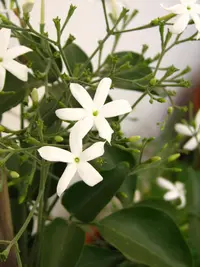
Lemon-scented jasmine (Jasminum azoricum) is a twining evergreen climber valued for its fragrant white flowers and fresh citrus scent. It is often grown on trellises, arches, or in containers with support.
Native to Madeira and nearby Atlantic islands, it prefers mild climates and sheltered spots. The plant has slender stems, small glossy green leaves, and produces clusters of star-shaped blooms over a long season.
It is considered moderately easy to grow for gardeners who can provide bright light, consistent moisture, and well-drained soil. Understanding how to care for Lemon-scented jasmine helps it remain healthy, floriferous, and neatly controlled in home gardens or patios.

Care Difficulty
Moderate Care

Light Preference
Partial Sun

Water Requirements
Moderate Water

Temperature Preference
Tropical / Frost Sensitive

Hardiness Zone
9–11

Soil Texture
Sandy, Loamy, Organic-rich

Soil pH
Acidic (5.5–6.5), Slightly acidic (6.5–7.0)

Soil Drainage
Moist but well-drained

Fertilization
Light (every 4–6 weeks)
Scan your plant to receive care tips personalized for your specific plant
Available on iOS and Android
This jasmine prefers bright conditions with gentle sun rather than harsh exposure.
This species prefers evenly moist, well-drained soil that never stays saturated for long.
This jasmine grows best in warm, frost-free conditions with mild seasonal shifts.
This jasmine prefers moderate humidity and reacts if air stays too dry for long periods.
This jasmine needs loose, well-draining, organic-rich soil that avoids waterlogging around the roots.
This species grows well in containers when given adequate root room and stable support.
Jasminum azoricum responds well to moderate feeding that supports steady growth and flowering without encouraging overly soft, weak shoots.
Pruning Jasminum azoricum helps maintain a compact shape, support flowering, and remove weak growth.
Container-grown Jasminum azoricum benefits from periodic repotting to refresh soil and give the root system adequate space.
Jasminum azoricum is commonly propagated from semi-ripe cuttings, which root reliably under warm, humid conditions.
This subtropical jasmine is frost-sensitive and requires protection in regions with cold winters.

Plant Health Check
Not sure what's wrong with your plant? Check your plant's health inside the app.
This species is native to Madeira and nearby Macaronesian islands and is listed as Critically Endangered in the wild due to its very restricted natural range and habitat loss.
Unlike many ornamental jasmines that drop most foliage in cooler seasons, this vine is semi-evergreen in mild climates and can flower for extended periods under warm, stable conditions.
Its leaves are characteristically trifoliate, meaning each leaf is divided into 3 distinct leaflets, which helps distinguish it from many other commonly grown jasmine species.

Although it is highly threatened in its native habitats, this jasmine has been preserved and distributed globally through horticulture, so cultivated plants in gardens and collections now play an important role in safeguarding its genetic line.
Poor flowering usually comes from insufficient light, heavy pruning at the wrong time, or low nutrients. Avoid cutting young shoots late in the season, feed with a balanced fertilizer, and provide a short, cool rest period in winter.
Keep your plants happy and healthy with plant identification, disease detection, and easy care guidance.