Root barrier management
Install a deep physical root barrier (30–40 cm) along beds or fences to confine underground spread and inspect its edges twice a year to cut back any rhizomes that try to cross.

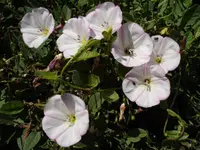
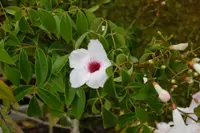
Field bindweed, Convolvulus arvensis, is a perennial vining plant in the morning glory family. It is often seen as a weed in gardens, fields, and roadsides. The plant has slender twining stems, arrow-shaped leaves, and small white to pale pink funnel-shaped flowers that open in sunlight. It spreads by both seed and deep, persistent roots. This species occurs widely across Europe, Asia, and North America, especially in disturbed or cultivated soils. Once established, it is difficult to remove due to its vigorous underground network and rapid regrowth. It prefers full sun, dry to moderate moisture, and well-drained soils, so care for Field Bindweed focuses mostly on control rather than encouragement.

Care Difficulty
Easy Care

Light Preference
Full Sun

Water Requirements
Low Water

Temperature Preference
Cold Hardy

Hardiness Zone
3–9

Soil Texture
Sandy, Loamy, Clay

Soil pH
Slightly acidic (6.5–7.0), Slightly alkaline (7.0–7.5)

Soil Drainage
Well-drained

Fertilization
Minimal (feed rarely)
Scan your plant to receive care tips personalized for your specific plant
Available on iOS and Android
This vigorous perennial thrives in strong sun but adapts to slightly lower light in many temperate regions.
This deep-rooted species prefers drier conditions once established and is sensitive to prolonged soil saturation.
This hardy perennial tolerates a wide temperature range and persists in many temperate climates.
This species is highly tolerant of low humidity and does not require special moisture in the air.
This plant thrives in poor, dry soils and usually does not need enriched substrates.
This species can grow in containers but tends to become invasive and needs strict containment.
This vigorous wild perennial usually needs no fertilizer, as Field Bindweed thrives in poor soils.
Pruning Convolvulus arvensis is mainly about containment and removing unwanted growth.
Transplanting Convolvulus arvensis is seldom recommended, as it is an aggressive, deep-rooted spreader.
Propagation of Convolvulus arvensis is more a management concern than a goal, due to its invasive habit.
Convolvulus arvensis is very cold hardy and normally needs no special winter care in temperate climates.

Plant Health Check
Not sure what's wrong with your plant? Check your plant's health inside the app.
Field bindweed develops a deep taproot that can reach several meters into the soil and a wide network of lateral roots, which allows it to access water and nutrients far below many crop roots and survive long dry periods.
The stems coil around nearby plants or structures in a counterclockwise direction, using a twining habit to climb toward light and sometimes smother neighboring vegetation.
Its seeds have a very hard coat and can remain viable in the soil seed bank for decades, which makes long-term management difficult in agricultural and garden settings.

Field bindweed is believed to have been introduced from Eurasia to North America in the 18th or 19th century, and is now listed as a noxious or invasive weed in many US states due to its strong competitive ability in crops and pastures.
This species spreads very aggressively through deep, extensive roots and long creeping stems. Fragments of root can regenerate new shoots, so even small pieces left in soil may form new plants and quickly colonize large areas.
Keep your plants happy and healthy with plant identification, disease detection, and easy care guidance.