Use movable supports
Grow vines on lightweight, freestanding trellises or mesh panels that can be moved, which allows you to rotate or relocate the plant seasonally without disturbing the root system.

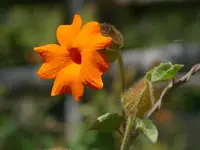
Orange clock vine, Thunbergia gregorii, is a fast-growing evergreen climber valued for its vivid orange, tubular flowers and dense green foliage. It is typically grown on trellises, fences, or hanging structures where its stems can scramble and trail.
This species is native to eastern Africa, where it grows in warm, sunny conditions with regular moisture. In gardens, it is often used as a decorative screening plant or bright accent in mild climates.
Its vigorous growth, long flowering season, and relatively low pest pressure make it moderately easy to grow, provided it gets enough light and frost protection. Understanding how to care for orange clock vine starts with giving it sun, evenly moist but well-drained soil, and shelter from cold conditions.

Care Difficulty
Moderate Care

Light Preference
Full Sun

Water Requirements
Regular Water

Temperature Preference
Tropical / Frost Sensitive

Hardiness Zone
9–11

Soil Texture
Sandy, Loamy, Organic-rich

Soil pH
Acidic (5.5–6.5), Slightly acidic (6.5–7.0)

Soil Drainage
Moist but well-drained

Fertilization
Light (every 4–6 weeks)
Scan your plant to receive care tips personalized for your specific plant
Available on iOS and Android
This fast-growing vine performs best with strong, direct light in most climates.
This species prefers evenly moist but not saturated soil for reliable growth and flowering.
This vine thrives in warm, frost-free conditions with stable seasonal temperatures.
This species grows best in moderately humid air but copes with typical household levels.
Thunbergia gregorii prefers a loose, well-drained, organic-rich substrate that still holds some moisture.
This vine is suitable for container growing outdoors on patios, balconies, or in mild climates.
Thunbergia gregorii responds well to moderate feeding during its active growing season.
Pruning Thunbergia gregorii helps maintain a compact shape and encourages abundant flowering.
This vine adapts well to both ground planting and containers but dislikes frequent disturbance.
Thunbergia gregorii is commonly propagated from softwood cuttings and fresh seed.
This species is frost-sensitive and needs specific winter management in cooler climates.

Plant Health Check
Not sure what's wrong with your plant? Check your plant's health inside the app.
Although often confused with the related Thunbergia alata, this species naturally lacks the dark central eye in its flowers and shows a more uniform deep orange corolla, which makes it useful in plantings where a solid color block is desired.
In many mild, frost-free climates, this vine tends to flower most heavily during the cooler months, providing bright color in late fall to spring when many other ornamentals are less active.
This species often produces fewer viable seeds than some other Thunbergia species and is commonly propagated by cuttings, which helps reduce the risk of it spreading aggressively in gardens.

The species was named in honor of the Kenyan plant collector John Walter Gregory, and it is native to the highland regions of East Africa, where it naturally scrambles over shrubs and rocky slopes rather than climbing very tall forest trees.
Poor flowering usually comes from insufficient light, low nutrients, or heavy pruning at the wrong time. Ensure strong sun exposure, use a balanced fertilizer during active growth, and avoid cutting stems that carry developing buds.
Keep your plants happy and healthy with plant identification, disease detection, and easy care guidance.