Use protective gear
Always wear thick gloves and long sleeves when handling plants to avoid injury from sharp spines and irritating sap, and use tools instead of bare hands when removing seedlings or spent stems.

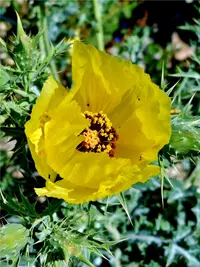
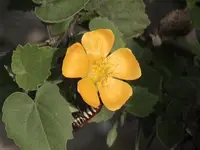
Golden pricklypoppy (Argemone aenea) is a spiny, annual wildflower known for its bright yellow, poppy-like blooms and bluish green, prickled foliage. It forms a bushy, upright clump that stands out strongly in dry, open landscapes.
This species is native to arid and semi-arid regions of the southwestern United States and northern Mexico, where it thrives in disturbed, rocky, or sandy soils. Its strong drought tolerance and preference for full sun make it relatively low-maintenance once established.
Because it self-seeds easily and bears sharp spines, it suits more naturalistic or xeric plantings rather than high-traffic areas. Understanding how to care for golden pricklypoppy mainly involves matching its dry, sunny native habitat and avoiding overly rich or wet soil conditions.

Care Difficulty
Easy Care

Light Preference
Full Sun

Water Requirements
Low Water

Temperature Preference
Warm Climate

Hardiness Zone
8–11

Soil Texture
Sandy, Loamy, Rocky

Soil pH
Slightly acidic (6.5–7.0), Slightly alkaline (7.0–7.5)

Soil Drainage
Well-drained

Fertilization
Minimal (feed rarely)
Scan your plant to receive care tips personalized for your specific plant
Available on iOS and Android
This sun-loving desert annual thrives in strong light typical of open, exposed sites.
This species is highly drought-tolerant and prefers infrequent, deep watering once established.
This plant is adapted to hot, dry climates and performs best in warm to very warm conditions.
This species is adapted to dry, arid air and rarely needs special humidity management.
This plant prefers lean, very well-drained, sandy soil that mimics dry, open habitats.
This species can be grown in containers if the pot is set up to drain and dry quickly.
Argemone aenea is adapted to nutrient-poor soils and usually needs no fertilizer when grown in the ground.
Pruning needs for Argemone aenea are light and mainly hygienic.
This species is most often grown in situ, so transplanting is more relevant than container repotting.
Argemone aenea is typically propagated from seed rather than by cuttings or division.
This species is generally cold tolerant in mild to warm climates and often needs little specific winter care.

Plant Health Check
Not sure what's wrong with your plant? Check your plant's health inside the app.
This species is naturally restricted to arid regions of the Sonoran Desert in northwestern Mexico, where it grows on dry, open slopes and disturbed ground with very low organic matter.
Its flowers have distinctive metallic copper to orange petals, which set it apart from the more common yellow-flowered Argemone species and make it straightforward to identify in the field.
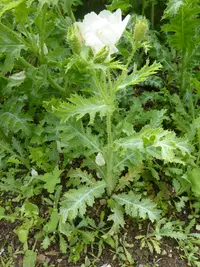
The foliage forms a bluish-green rosette with prominent white veins and stout spines along the leaf margins, an adaptation that discourages large herbivores in its open desert habitat.
This species self-seeds heavily. Seed capsules release many seeds that germinate in open, disturbed ground, so populations can expand quickly. Deadhead spent flowers and remove unwanted seedlings if you need to limit spread in a small garden.
Keep your plants happy and healthy with plant identification, disease detection, and easy care guidance.