Encourage Compact Growth
Lightly pinch back the soft tips of overly leggy shoots in early growth to keep plants low, compact, and better able to withstand wind in exposed, dry sites.

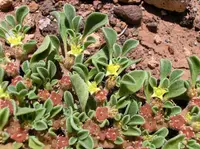
Purslane-leaved aizoon (Aizoon canariense) is a low, spreading succulent herb from arid and semi-arid regions, especially in the Canary Islands and parts of North Africa. It forms mats of fleshy, narrow leaves that help it store water and tolerate drought.
Stems often creep along the ground, rooting at the nodes, and carry small, unobtrusive yellowish flowers. The plant’s tough, water-storing tissues and modest nutrient needs make it relatively undemanding in dry, open conditions.
It generally prefers full sun, well-drained, sandy or rocky soils, and sparse watering. These traits make it helpful to understand how to care for Purslane-leaved aizoon in xeric or low-maintenance plantings.

Care Difficulty
Easy Care

Light Preference
Full Sun

Water Requirements
Low Water

Temperature Preference
Warm Climate

Hardiness Zone
9–11

Soil Texture
Sandy, Loamy, Rocky

Soil pH
Slightly acidic (6.5–7.0), Slightly alkaline (7.0–7.5)

Soil Drainage
Well-drained

Fertilization
Minimal (feed rarely)
Scan your plant to receive care tips personalized for your specific plant
Available on iOS and Android
This sun-loving succulent thrives in bright, open sites typical of arid and semi-arid regions.
This drought-adapted species prefers infrequent, deep watering and fast-drying soil.
This plant is adapted to warm, dry climates and tolerates considerable heat once established.
Humidity is not a significant factor for this drought-adapted species in typical home or outdoor conditions.
This species prefers very free-draining, sandy soil that mimics dry, rocky habitats.
This species can be grown in containers if the potting setup prevents waterlogging and mimics a dry, stony substrate.
This drought-tolerant succulent needs only light feeding, as Purslane-leaved aizoon is adapted to poor, sandy soils.
Aizoon canariense needs minimal pruning, mainly to maintain a tidy, low mat of growth.
This species is usually grown in the ground, but young or container plants may need occasional transplanting to maintain vigor.
New plants are most often raised from seed, making Aizoon canariense straightforward to increase for dry, sunny sites.
This plant is adapted to mild, dry-winter climates and usually needs little intervention where frosts are light.

Plant Health Check
Not sure what's wrong with your plant? Check your plant's health inside the app.
This species is a fast-growing annual adapted to arid and semi-arid habitats, completing its life cycle quickly after rainfall in North Africa, the Canary Islands, and parts of Southwest Asia.
It often grows on disturbed, sandy, or saline soils, acting as a pioneer species that stabilizes loose substrates and can tolerate conditions that exclude many less-adapted plants.
The plant produces very small seeds enclosed in dry capsules; these seeds are easily carried by wind or surface water, helping the species colonize open, sparsely vegetated ground.
Growth is relatively quick in warm, bright, dry conditions, especially during the active season. In lean, sandy soil it often forms noticeable new shoots within a few weeks, though overall size remains modest compared with larger landscape succulents.
Keep your plants happy and healthy with plant identification, disease detection, and easy care guidance.