Deep root establishment
During the first 1–2 years after planting, give the plant occasional slow, deep soaks that penetrate 30–45 cm into the soil to encourage a robust taproot and drought resilience.

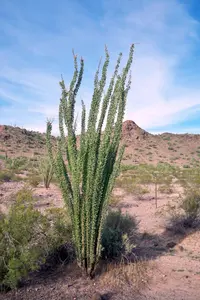
Ocotillo, Fouquieria splendens, is a woody desert shrub native to the Sonoran and Chihuahuan deserts of the southwestern United States and northern Mexico. It forms tall, narrow canes that rise from a central base, often reaching several meters in height. These canes are lined with sharp spines and small leaves that appear quickly after rainfall and drop again during dry periods. The plant produces bright red tubular flowers at the stem tips, which attract hummingbirds and other pollinators. It suits gardeners who can provide intense sun, fast-draining soil, and very low moisture, but it can be challenging in wetter climates. Understanding how to care for ocotillo starts with respecting its extreme drought adaptation.

Care Difficulty
Moderate Care

Light Preference
Full Sun

Water Requirements
Low Water

Temperature Preference
Warm Climate

Hardiness Zone
8–11

Soil Texture
Sandy, Loamy, Rocky

Soil pH
Neutral (7.0), Slightly alkaline (7.0–7.5)

Soil Drainage
Well-drained

Fertilization
Minimal (feed rarely)
Scan your plant to receive care tips personalized for your specific plant
Available on iOS and Android
This desert shrub thrives in intense, direct light that mimics full sun in arid landscapes.
This species is highly drought-adapted and must dry thoroughly between waterings.
This desert plant prefers hot, dry conditions and is sensitive to prolonged freezing.
Humidity is not a significant factor for Fouquieria splendens, which is adapted to very dry air.
Fouquieria splendens needs very fast-draining, mineral soil to prevent root rot.
This species can be grown in containers if the pot and medium prevent prolonged moisture around the roots.
This desert shrub needs very little feeding, so focus on light, occasional support rather than routine fertilization when caring for ocotillo.
Fouquieria splendens needs minimal pruning, mainly to maintain safety and a natural form.
This species is seldom repotted long-term, as it performs best when transplanted young into a permanent, very well-drained site.
Propagation of Fouquieria splendens is possible but slow and often challenging for home growers.
This desert shrub is fairly cold hardy when established but still benefits from thoughtful winter care in cooler regions.

Plant Health Check
Not sure what's wrong with your plant? Check your plant's health inside the app.
Ocotillo can quickly produce small leaves along its thorny stems after rainfall, then shed them again during drought, allowing it to reduce water loss in its desert habitat.
The tubular red flowers provide abundant nectar and are a key early-season food source for migrating hummingbirds in North American deserts.
Although it has spines and grows in arid regions, ocotillo is not a cactus but a woody shrub in its own family, Fouquieriaceae, with true leaves and a different stem structure.

Individual ocotillo plants can live for many decades, and long-lived specimens slowly expand by producing new stems from the base, forming large clumps that can mark the same desert location for a human lifetime or more.
Lack of flowers usually comes from insufficient age, poor light, or inadequate winter chill. This species often needs several years to mature. Avoid heavy fertilizing and overwatering, and keep it in very bright, unshaded, arid conditions.
Keep your plants happy and healthy with plant identification, disease detection, and easy care guidance.