Staggered Succession Sowing
Sow small patches every 2–3 weeks in early spring or late summer so flowering and biomass production are spread over time and you can mow or incorporate sections in stages instead of the entire stand at once.

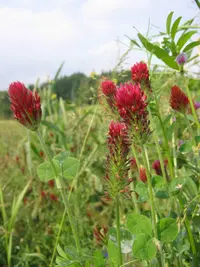
Crimson clover, Trifolium incarnatum, is an annual clover grown mainly as a cover crop and forage plant. It forms low, bushy clumps with soft, trifoliate leaves and dense, upright crimson flower spikes.
This species originates from southern Europe but is now widely used in North America in fields, orchards, and wildlife plantings. It is valued for fixing nitrogen in the soil, supporting pollinators, and establishing quickly from seed.
The plant is generally easy to grow in well-drained soil, with full sun and consistent moisture. Understanding how to care for crimson clover helps it perform reliably in both garden beds and larger landscapes.

Care Difficulty
Easy Care

Light Preference
Full Sun

Water Requirements
Moderate Water

Temperature Preference
Cool Climate

Hardiness Zone
7–9

Soil Texture
Sandy, Loamy, Silty

Soil pH
Acidic (5.5–6.5), Slightly acidic (6.5–7.0)

Soil Drainage
Well-drained

Fertilization
Minimal (feed rarely)
Scan your plant to receive care tips personalized for your specific plant
Available on iOS and Android
This species performs best with abundant direct light but tolerates some shade in hot climates.
Trifolium incarnatum prefers evenly moist, well-drained soil rather than constant saturation.
This cool-season legume grows best in mild conditions and struggles in extreme heat or deep cold.
This species is typically grown outdoors and does not have strict humidity requirements.
Trifolium incarnatum prefers well-drained, moderately fertile mineral soil for reliable establishment.
This species can be grown in containers outdoors with careful attention to root space and drainage.
This annual legume fixes its own nitrogen, so crimson clover usually needs only minimal supplemental fertilizer in average garden soil.
Pruning Trifolium incarnatum focuses on tidying plants and encouraging a tidy stand rather than shaping individual specimens.
This species is most effective when direct-sown, but small transplants of Trifolium incarnatum can be moved carefully if needed.
Trifolium incarnatum is most often propagated from seed, which is simple and reliable under the right conditions.
As a cool-season annual, Trifolium incarnatum usually needs little winter care in regions with mild to moderate cold.

Plant Health Check
Not sure what's wrong with your plant? Check your plant's health inside the app.
Crimson clover forms root nodules with Rhizobium bacteria that fix atmospheric nitrogen, leaving soils richer in plant-available nitrogen after the plants are incorporated or die back.
This species is adapted as a cool-season annual in many temperate regions, growing best in mild fall–spring conditions and often failing in hot summers where other clovers can persist.
Crimson clover has been widely adopted as a forage and cover crop because livestock generally accept it readily, and its flowering stems can provide substantial biomass when cut at early bloom.

Crimson clover was one of the earliest European clovers deliberately introduced and trialed in the southeastern United States in the 1800s, and its success as a winter cover crop in that region helped popularize the broader use of leguminous cover crops in American agriculture.
This species is highly attractive to bees, butterflies, and other beneficial insects. Dense flower stands provide nectar and pollen early to mid-season, supporting pollinator populations and improving pollination in nearby fruit trees, vegetables, and flowering ornamentals.
Keep your plants happy and healthy with plant identification, disease detection, and easy care guidance.