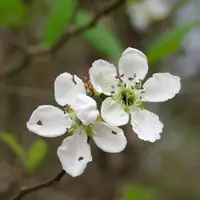
Davidson's plum Care (Davidsonia jerseyana)

Also known as: Mullumbimby plum
Davidson's plum

About Davidson's plum

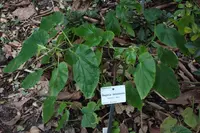
Davidson's plum (Davidsonia jerseyana) is a small to medium rainforest tree known for its deep purple, sour, plum-like fruits. It has a slender trunk, soft, divided foliage, and an upright, narrow crown that suits sheltered garden spaces. Native to subtropical rainforests of eastern Australia, it naturally grows under taller trees with filtered light and consistent moisture. The species prefers rich, well-drained soil and protection from hot, dry winds, which can make it a little demanding in exposed gardens. With suitable shade, moisture, and frost protection, it is a manageable choice for gardeners who want to learn how to care for Davidson's plum.

Main Plant Requirements

Care Difficulty

Moderate Care

Light Preference

Partial Shade

Water Requirements

Keep Soil Moist

Temperature Preference

Tropical / Frost Sensitive

Hardiness Zone

10–11

Soil Texture

Loamy, Sandy, Organic-rich

Soil pH

Strongly acidic (4.5–5.5), Acidic (5.5–6.5)

Soil Drainage

Moist but well-drained

Fertilization

Minimal (feed rarely)

Get Personalized Care Plan

Scan your plant to receive care tips personalized for your specific plant

Available on iOS and Android

How to Care for the Davidson's plum

This subtropical rainforest tree prefers bright, gentle light that mimics a high‑canopy forest edge.

  • Provide 3–5 hours of soft morning sun with light or dappled shade for the rest of the day; avoid harsh west-facing exposure.
  • In hot summers, protect Davidson's plum from intense midday sun to prevent leaf scorch and pale, crispy margins.
  • If new growth is sparse, internodes stretch, or leaves darken and thin, the site is likely too dim; move to a brighter but still sheltered position.

This species prefers consistently moist, cool soil without sitting in stagnant water.

  • Allow the top 2–4 cm of soil to lose surface sheen between waterings, then water deeply so moisture reaches the full root zone.
  • In warm, dry periods, expect to water more often, guided by soil feel; in cooler or rainy seasons, extend intervals to avoid waterlogging.
  • For Davidsonia jerseyana, watch for drooping, curling leaves and dry soil as signs of underwatering, and yellowing leaves or sour-smelling soil as overwatering warnings.

This rainforest tree performs best in mild, frost-free conditions with stable temperatures.

  • Aim for 65–80°F (18–27°C) for active growth, with steady humidity and shelter from drying winds.
  • Protect from temperatures below 40°F (4°C); light frost can damage young foliage, and hard frost may kill shoots or small trees.
  • In heat above 90°F (32°C), provide extra shade and mulch to keep roots cool, and avoid planting in exposed frost pockets or heat-reflective sites.

This species prefers consistently moist air and reacts quickly to dry indoor conditions.

  • Aim for 60–80% humidity, using a humidifier or grouping plants if home air stays below 40%.
  • Leaves curling, browning at edges, or developing crispy tips signal humidity stress rather than underwatering.
  • Keep the pot on a pebble tray with water below pot base and avoid strong airflow from heaters or air conditioners drying Davidson's plum.

Davidsonia jerseyana grows best in deep, moisture-retentive but well-drained, organic-rich soil.

  • Use a loamy mix of roughly 50% high-organic compost, 30% fine pine bark, and 20% coarse sand or perlite for structure and drainage.
  • Aim for slightly acidic soil, around pH 5.5–6.5, avoiding lime-based amendments that push pH higher.
  • Improve aeration by blending in chunky bark or coarse perlite so roots receive oxygen even when the mix is moist.
  • Avoid heavy clay, waterlogged spots, or compacted ground that causes standing water and root rot.

This species can be grown in containers if the pot allows for deep, stable root development.

  • Choose a tall, heavy-based pot so the developing tree stays stable and does not tip in wind.
  • Select a container material with moderate porosity, such as thick-walled terracotta, to balance moisture loss and root cooling.
  • Ensure a large central drainage hole plus side holes so excess water exits quickly and does not pool around the taproot.

This subtropical rainforest tree benefits from modest, targeted feeding when grown in gardens or containers.

  • Use a balanced slow-release fertilizer (for example 10-10-10) or well-rotted compost mixed into the topsoil in spring.
  • Feed Davidson's plum every 8–10 weeks during the warm growing season if growth or fruiting is weak.
  • Apply fertilizers at half the label strength for container plants to avoid salt buildup in the root zone.
  • Reduce or stop feeding in late autumn and winter when growth slows, especially in cooler regions.

Pruning Davidsonia jerseyana is mainly done to maintain a sound framework and remove problem wood.

  • Carry out structural pruning in late winter or early spring before active growth resumes.
  • Remove dead, diseased, crossing, or storm-damaged branches using clean, sharp bypass pruners or a pruning saw.
  • Thin congested inner growth lightly to improve airflow and light penetration, keeping the natural upright form.
  • Limit heavy cuts; instead, shorten long shoots to an outward-facing bud to guide size and shape over time.

This species is usually grown in the ground, so transplanting young trees correctly matters more than frequent repotting.

  • Transplant in late winter to early spring when soil is moist and temperatures are mild, minimizing stress.
  • Shift container plants only when roots circle the pot, growth slows, or watering becomes difficult, typically every 2–3 years.
  • Move into a container just 1–2 sizes larger, using a deep, free-draining, slightly acidic mix enriched with compost.
  • Reduce root stress by watering thoroughly before and after planting, keeping the root ball intact, and shading for 1–2 weeks.

Propagation of Davidsonia jerseyana is possible from both seed and semi-hardwood cuttings but requires patience and controlled conditions.

  • Collect ripe seed, clean the pulp, and sow in a moist, free-draining, slightly acidic mix in warm conditions around 70–77°F.
  • Provide bright, indirect light and consistent moisture; germination can be slow and uneven over several weeks or months.
  • Take semi-hardwood cuttings in late spring to summer, 10–15 cm long, from healthy, non-flowering shoots.
  • Dip cut bases in rooting hormone and place in a humid propagator or covered tray with bottom heat to encourage rooting.

This subtropical tree dislikes frost, so winter care focuses on insulation and temperature management in cooler climates.

  • In-ground plants in mild areas usually cope with brief light frosts but benefit from 5–8 cm of organic mulch over the root zone.
  • In regions with regular freezes below about 28°F, grow Davidsonia jerseyana in large containers for flexibility.
  • Move container plants into a bright, frost-free space before the first hard freeze, such as a sunroom or unheated greenhouse.
  • Avoid heavy pruning or high-nitrogen feeding late in the season so new growth has time to harden before cold weather.

Care Tips

Wind protection

Install temporary windbreaks such as shade cloth or mesh on exposed sites for the first 2–3 years to prevent leaf shredding and reduce stress on young trunks.

Mulch for shallow roots

Apply a 5–8 cm layer of coarse organic mulch out to the dripline, keeping it 5–10 cm away from the trunk, to protect this shallow-rooted species from drying and temperature swings.

Gentle understory planting

Plant low, non-competitive groundcovers beneath the canopy to mimic its natural rainforest understory habitat and help retain soil moisture without crowding the root zone.

Fruit load management

On young or weak trees, thin developing fruit clusters by about one-third after fruit set to reduce limb strain and improve overall fruit size and quality.

Cold event preparation

Before forecast cold snaps, water the root zone thoroughly and cover small plants with breathable frost cloth supported on stakes to protect tender foliage and new growth when growing Davidson's plum.

Common Pests and Diseases

Fruit piercing moth

This pest attacks ripening fruit, piercing the skin and sucking out juice, which causes soft, sunken patches and rapid breakdown of the plums. Symptoms include premature fruit drop and an increase in rotting fruit on the ground.

Solution

Use fine insect-exclusion netting over trees before fruit begins to color, and promptly remove and destroy fallen or damaged fruit to break the life cycle. In larger plantings, monitor with light traps or pheromone traps and keep nearby rank vegetation trimmed to reduce shelter sites.

Queensland fruit fly

This pest lays eggs under the skin of developing fruit, leading to small sting marks that later become soft, brown, and full of maggots. Symptoms include distorted, dropping fruit and very poor usable yield.

Solution

Hang baited traps around trees before flowering and maintain them through the fruiting period, and collect and solarize or deeply bury infested fruit to prevent larvae from pupating in the soil. In high-pressure areas, use fine fruit fly netting and avoid leaving ripe fruit on the tree for long periods; this is especially important when growing Davidson's plum.

Scale insects

These insects attach to stems and leaf petioles, sucking sap and excreting honeydew that encourages sooty mold growth. Symptoms include sticky leaves, black sooty coating, yellowing foliage, and reduced vigor, especially on shaded or sheltered trees.

Solution

Prune and destroy heavily infested twigs, then wash remaining stems and leaves with a mild horticultural soap solution to remove scales and honeydew. For persistent problems, apply a light horticultural oil spray to thoroughly coat stems and leaf undersides, and improve light and airflow to reduce reinfestation.

Anthracnose

This disease is a fungal infection favored by high humidity and frequent rain, causing dark, sunken lesions on leaves, young shoots, and fruit. Symptoms include leaf spotting, premature leaf and fruit drop, and blemished fruit that splits or rots near maturity.

Solution

Remove and dispose of infected leaves and mummified fruit from the tree and ground, then improve spacing and pruning to increase airflow and speed drying after rain. In very wet climates, use a protectant copper-based fungicide at early flowering and during periods of prolonged rain, always following local label directions.

Leaf spot complex

This disease involves several fungi that create small brown or purple spots on foliage, which can merge into larger dead patches under persistent moisture. Symptoms include thinning foliage, reduced growth, and an overall sparse canopy, especially on nursery or potted plants with overhead watering.

Solution

Switch to drip or low-level watering to keep foliage as dry as possible and promptly remove badly spotted leaves. Space plants to prevent leaf overlap, prune lightly to open the canopy, and if needed use a broad-spectrum fungicide labeled for leaf spots on native trees during extended wet periods.

Interesting Facts

Endemic rainforest understory

This species is naturally restricted to subtropical lowland rainforests of northeastern New South Wales, where it grows as a small understory tree in moist, shaded gullies and along creek lines.

Deep purple, sour fruit

The tree produces clusters of dark purple, plum-like drupes that have a strongly acidic, tart pulp, which is used commercially in Australia for jams, sauces, and specialty foods rather than for fresh eating.

Compound, soft foliage

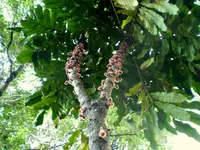
Its foliage consists of large, soft, pinnate leaves with many leaflets, giving the tree a fern-like, tropical appearance that contrasts with the heavy, fleshy fruit hanging beneath the canopy.

Botan icon

Did you know?

Davidsonia jerseyana is listed as vulnerable in its natural range due to extensive historical clearing of lowland rainforest, and much of the current cultivation of this species in Australia helps reduce harvest pressure on the remaining wild populations.

FAQs about Davidson's plum

Growth is moderately fast in warm, frost-free climates, often adding 30–60 cm per year once established. Young plants grow slower until roots expand. Rich soil, consistent moisture, and shelter from harsh wind noticeably improve growth rate.

Grow Healthy Plants with Botan Care

Keep your plants happy and healthy with plant identification, disease detection, and easy care guidance.

Botan plant care app — identify plants on mobile

Explore More Plants