Secure Wind Protection
Install a low, open lattice or use sturdy stakes with soft ties on the windward side to keep the pseudostems from snapping in strong gusts, especially in exposed gardens or balcony sites.

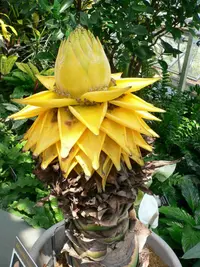
The golden lotus banana, Musella lasiocarpa, is a compact, cold-tolerant banana relative grown mainly for its striking, lotus-like yellow flower structure. It forms a short, sturdy pseudostem with broad, banana-style leaves, giving a tropical look even in cooler regions.
This species is native to mountainous areas of southwestern China, where it experiences cool temperatures and seasonal moisture. Its resilience to brief cold and its clumping growth habit make it suitable for patios, small gardens, and large containers.
Understanding how to care for golden lotus banana starts with providing bright light, consistently moist but well-drained soil, and shelter from strong drying winds.

Care Difficulty
Moderate Care

Light Preference
Full Sun

Water Requirements
Regular Water

Temperature Preference
Warm Climate

Hardiness Zone
7–10

Soil Texture
Loamy, Silty, Organic-rich

Soil pH
Acidic (5.5–6.5), Slightly acidic (6.5–7.0)

Soil Drainage
Moist but well-drained

Fertilization
Moderate (every 2–4 weeks)
Scan your plant to receive care tips personalized for your specific plant
Available on iOS and Android
This hardy banana relative needs strong light to flower and stay compact.
This species prefers evenly moist but not waterlogged soil throughout the growing season.
This plant grows best in warm, stable temperatures and dislikes hard frost.
Musella lasiocarpa prefers moderately humid air but usually adapts to typical indoor and outdoor household levels.
Musella lasiocarpa grows best in deep, loose, moisture-retentive but fast-draining soil.
This species is suitable for container growing if the pot is large, stable, and drains very efficiently.
Musella lasiocarpa responds well to modest, consistent feeding during the warm growing season.
Pruning Musella lasiocarpa is mainly about removing spent or unhealthy growth to keep the clump tidy.
This species is often grown in the ground, but container-grown plants benefit from occasional transplanting to maintain vigor.
New Musella lasiocarpa plants are most reliably produced by division of basal offsets rather than seed.
This hardy banana relative tolerates light freezes but needs some winter preparation in colder climates.

Plant Health Check
Not sure what's wrong with your plant? Check your plant's health inside the app.
The showy yellow “lotus flower” is actually a tight cone of specialized leaves called bracts that can persist for several months, while the true flowers are small, short‑lived structures tucked between these bracts.
Unlike most bananas, this species evolved in cool, high‑elevation habitats in Yunnan, China, and can survive brief frosts and light freezes that would kill many other banana relatives.
Genetic and morphological studies place this species close to the base of the banana family tree, making it useful for research on the evolution of bananas and their relatives.

In its native range in Yunnan, China, the plant’s thick pseudostem and underground corm help it resprout after damage from cold, grazing, or cutting, allowing local communities to periodically harvest leaves and stems for wrapping and fiber without killing the clump.
Lack of blooms usually comes from immaturity, insufficient light, or stress from cold or root disturbance. This species often needs several years of stable growth and a cool but frost-free winter rest before initiating a flower.
Keep your plants happy and healthy with plant identification, disease detection, and easy care guidance.