tomato plant Care (Solanum lycopersicum)

Also known as: tomato, tomato plant
tomato plant

About tomato plant

Tomato, Solanum lycopersicum, is a fast-growing, warm-season fruiting plant commonly grown as an annual in home gardens and containers. It has a branching, often sprawling habit with medium green, slightly hairy leaves and clusters of yellow flowers that develop into fleshy, colorful fruits.

The species originates from western South America but is now cultivated worldwide in many climates. It grows best in full sun, with consistently moist but well-drained soil and regular feeding.

Tomato is considered moderately demanding, as it is sensitive to cold, irregular watering, and some common diseases, but good basic knowledge of how to care for tomato plant makes it manageable for most home growers.

Main Plant Requirements

Care Difficulty

Moderate Care

Light Preference

Full Sun

Water Requirements

Regular Water

Temperature Preference

Tropical / Frost Sensitive

Hardiness Zone

10–11

Soil Texture

Sandy, Loamy, Organic-rich

Soil pH

Acidic (5.5–6.5), Slightly acidic (6.5–7.0)

Soil Drainage

Moist but well-drained

Fertilization

Moderate (every 2–4 weeks)

Get Personalized Care Plan

Scan your plant to receive care tips personalized for your specific plant

Available on iOS and Android

How to Care for the tomato plant

Full sun is essential for strong growth and fruiting in this species.

  • Provide 6–8 hours of direct sun daily, ideally with strong morning sun and lighter afternoon exposure in very hot climates.
  • Tomato plant can handle brief light shade, but consistent shade longer than 3–4 hours reduces flowering and fruit production.
  • In mid-summer, monitor leaves for scorch or rolling; use light shade cloth or adjacent taller plants to filter harsh afternoon sun if foliage pales or crisps.

Consistent, deep moisture supports healthy roots and fruit quality.

  • Water when the top 3–5 cm of soil feels dry, soaking the root zone rather than giving light surface splashes.
  • Use well-drained soil and avoid standing water; yellowing lower leaves, wilting despite moist soil, or sour smell indicate overwatering.
  • In hot, dry periods, expect more frequent deep watering; in cool or rainy weather, wait longer, and watch for drooping leaves and dry soil as signs to water.

Stable warm conditions are critical for growth, flowering, and fruit set.

  • Aim for daytime temperatures of 70–85°F (21–29°C) and nights of 60–70°F (16–21°C) for best development.
  • Protect plants from frost; tissue damage occurs near 32°F (0°C), and growth slows sharply below 50°F (10°C).
  • During heat above 90–95°F (32–35°C), flowers may drop and fruit set declines, so use mulch, afternoon shade, and consistent moisture to limit stress.

This species prefers moderate humidity and usually adapts well to typical outdoor air levels.

  • Aim for 40–60% humidity; very dry air during hot winds can accelerate blossom drop and leaf curl.
  • Mild dry-air tolerance is present, but extended humidity below 30% with heat can cause wilting and flower loss.
  • Increase local humidity by mulching soil 5–8 cm deep and using windbreaks rather than misting foliage, which can promote foliar diseases.

Solanum lycopersicum performs best in deep, loose, organic-rich mineral soil with strong drainage.

  • Use a loamy mix with 40–60% high-organic topsoil, 20–30% compost, and 10–20% perlite or coarse sand to keep pores open for roots.
  • Target soil pH around 6.0–6.8 to optimize nutrient availability and reduce blossom-end rot risk.
  • Improve drainage and aeration by avoiding compaction, forming raised rows or beds, and incorporating well-decomposed compost rather than raw manure.
  • Do not plant in heavy, waterlogged clay or very sandy soil without amendment, as both extremes restrict root function and nutrient uptake.

This species is suitable for container growing when given ample root volume and stable support.

  • Choose a container at least 30–40 cm deep for determinate types and 40–50 cm for indeterminate types to prevent root restriction and rapid drought stress.
  • Use a heavy, wide-based pot or add weight (such as stones at the bottom) to reduce tipping from tall, fruit-laden vines and wind.
  • Select slightly porous materials like unglazed clay outdoors to reduce waterlogging, but monitor moisture closely because they dry faster than plastic.

Consistent nutrition is important for Solanum lycopersicum to produce healthy foliage and abundant fruit.

  • Use a balanced NPK or tomato-specific fertilizer, or well-rotted compost, starting 1–2 weeks after planting.
  • Feed every 1–2 weeks during active growth and fruiting, using liquid fertilizer at 1/2–3/4 label strength.
  • Apply slow-release granules at planting for steady background nutrition, avoiding direct contact with roots.
  • Reduce feeding sharply in late season or winter when growth and fruiting naturally slow.

Targeted pruning helps Solanum lycopersicum direct energy into fruit production and maintain airflow.

  • Begin light pruning once plants are established in late spring or early summer, avoiding very hot or wet days.
  • Remove dead, yellowing, or diseased leaves first, then crowded interior shoots that shade fruit clusters.
  • Pinch out vigorous side shoots on indeterminate stems to control size and focus growth on main trusses.
  • Use clean, sharp pruners or scissors, disinfecting blades when cutting any suspect or diseased tissue.

Tomatoes are typically transplanted outdoors from smaller pots once seedlings outgrow their initial containers.

  • Transplant when roots lightly circle the pot or growth slows despite adequate light and water.
  • Move plants after frost risk has passed in spring, usually once night temperatures stay above 50°F.
  • Shift up 1 pot size or into the ground every 3–5 weeks for seedlings, burying stems deeper to encourage rooting.
  • Water thoroughly before and after moving, handle roots gently, and shade plants for 1–2 days to limit transplant shock.

New Solanum lycopersicum plants are commonly started from seed and short stem cuttings.

  • Sow seeds indoors 6–8 weeks before the last frost, in a sterile seed-starting mix kept at 70–80°F.
  • Provide bright light and slight air movement to produce sturdy seedlings with short, thick stems.
  • Root 8–12 cm side shoots in moist, well-drained medium at warm temperatures for quick new plants.
  • Maintain even moisture but not saturation to prevent damping-off, a fungal disease that kills young seedlings.

Tomato is a warm-season annual in most climates and does not tolerate freezing conditions.

  • Plants are usually discarded after frost; even light freezes damage foliage and fruit.
  • In mild climates, mulch the root zone 5–8 cm deep to moderate soil temperature and retain moisture.
  • For container-grown tomato plant indoor care, move pots indoors or into a greenhouse before nights drop below 45°F.

Care Tips

Early staking system

Install sturdy stakes, cages, or trellis lines at planting time so the plant grows upright from the start and stems are not damaged later by forcing them into support.

Consistent blossom support

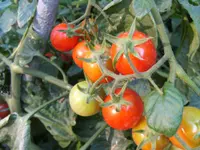
Use gentle tapping of flower trusses or an electric toothbrush held briefly against the stem on calm days to improve pollination and fruit set, especially in sheltered or greenhouse conditions.

Targeted lower pruning

Remove the lowest 2–3 leaf branches once the plant is established to improve airflow, reduce soil splash, and lower the risk of foliar diseases such as early blight.

Mulch to prevent splash

Apply 5–8 cm of clean straw or other inert mulch under the canopy after the soil has warmed to reduce weed competition and limit disease spores splashing onto lower leaves when it rains or when you water.

Cluster ripening strategy

When a fruit cluster begins to color, reduce foliage shading that specific truss and avoid heavy watering swings so the tomatoes ripen more evenly and are less prone to splitting during growing tomato plant in outdoor beds or containers.

Common Pests and Diseases

Tomato hornworm

This pest is a large green caterpillar that rapidly defoliates plants and can chew holes in both leaves and fruit. Symptoms include missing foliage, large dark droppings, and camouflaged caterpillars along stems and leaf veins.

Solution

Hand-pick caterpillars in the early morning or evening and drop them into soapy water, then inspect plants daily during peak season. Encourage natural predators such as parasitic wasps, avoid broad-spectrum insecticides, and use floating row covers on young plants if hornworms are a recurring problem when growing tomato plant outdoors or in raised beds.

Early blight

This disease causes brown leaf spots with concentric rings and yellowing that usually starts on older, lower leaves. Symptoms include progressive leaf drop, weakened plants, and reduced yield, especially in warm, humid weather.

Solution

Remove and discard affected leaves, keep foliage dry by watering at soil level, and improve spacing and airflow. Use mulch to limit soil splash, rotate crops for at least 3 years, stake plants to keep leaves off the ground, and apply a labeled copper or biofungicide preventively when conditions favor disease.

Late blight

This disease produces dark, water-soaked lesions on leaves and stems that can quickly turn black, with white fungal growth at lesion edges in humid conditions. Symptoms include rapid plant collapse and brown, firm lesions on fruit.

Solution

Immediately remove and bag or destroy all infected plant material and do not compost it, as the pathogen spreads easily. Avoid overhead watering, increase spacing, choose resistant cultivars where possible, and apply appropriate fungicides preventively if late blight is reported in the local area.

Septoria leaf spot

This disease causes many small, circular spots with dark borders and gray centers on lower leaves, leading to yellowing and early leaf drop. Symptoms include plants with bare lower stems and foliage concentrated only at the top.

Solution

Prune off and dispose of affected leaves as soon as spots appear and avoid wetting the foliage. Use crop rotation, stake plants, increase airflow, apply mulch to reduce soil splash, and use labeled fungicides if the disease recurs annually.

Tomato russet mite

These insects are microscopic mites that feed on stems and leaves, causing bronzing, curling, and a dry, russeted appearance, often starting from the lower plant upward. Symptoms include leaf drop and rough, dull skin on fruit without obvious visible pests.

Solution

Remove heavily damaged foliage and dispose of it away from the garden, then treat remaining plants with a sulfur-based miticide or insecticidal soap labeled for mites. Improve plant vigor with consistent watering, avoid excessive nitrogen, and monitor nearby nightshades regularly, as these mites spread easily between hosts.

Interesting Facts

Berry, not vegetable

Botanically, the tomato fruit of this species is a true berry, formed from a single ovary with multiple seeds, even though it is treated as a culinary vegetable in most cuisines.

Self-pollinating flowers

Its yellow flowers are primarily self-pollinating, with both male and female structures in the same flower, and vibration from wind or insects helps release pollen within the floral cone.

South American origin

This cultivated tomato traces its wild ancestors to the coastal and Andean regions of present-day Peru, Chile, Ecuador, and northern Bolivia, and was later domesticated and diversified in pre-Columbian Mesoamerica.

Botan icon

Did you know?

All modern cultivated tomatoes of this species descend from introductions brought to Europe in the 16th century, and centuries of selection by farmers and breeders have produced thousands of distinct heirloom and modern cultivars that differ in color, shape, size, flavor, and growth habit.

FAQs about tomato plant

Leaf curl usually comes from heat or water stress, excess nitrogen, or pest damage, especially aphids and whiteflies. Check soil moisture, avoid overfertilizing, improve airflow, and inspect leaf undersides regularly to catch pests early.

Grow Healthy Plants with Botan Care

Keep your plants happy and healthy with plant identification, disease detection, and easy care guidance.

Botan plant care app — identify plants on mobile

Explore More Plants