Black Spots on Basil Leaves: What Your Herb Is Trying to Tell You
Basil is easy to grow, but small mistakes like overwatering or cold damage can cause black spots. If you notice them, diagnose the cause and use BotanApp for quick care instructions.

Basil is often recommended as a beginner-friendly herb. It’s actually very easy to grow, but there's one thing no one usually warns you about. Even tiny mistakes, such as overwatering or cold damage, can quickly lead to trouble.
Still, if you notice your basil leaves have black spots, it’s not a death sentence. You just need to diagnose the cause correctly and treat the plant accordingly. You can use BotanApp to get all the necessary information and instructions in seconds, but if you want to learn more about spots, their reasons, and ways to prevent them, read on. We’ll share many useful insights below.
Common Causes of Black Spots on Basil Leaves
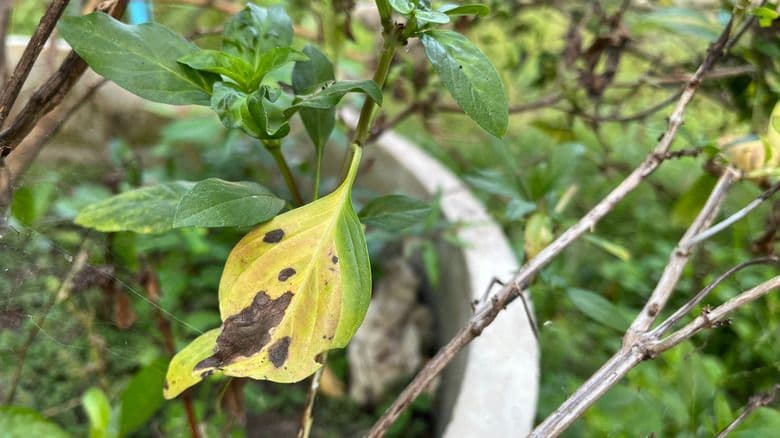
Black spots aren’t a diagnosis. They are a symptom. It may signal one of these problems:
- Fungal infections
- Bacterial infections
- Overwatering
- Pests
- Sunburn or cold damage
The differences between these problems can be dramatic. Spots from sunburn or cold damage don’t spread. They are just injuries. Some fungal infections are lethal, and some are not. That’s why it’s so important to consider all the nuances.
Fungal Infections from Excess Moisture
Fungal spores, carried by wind, can germinate on basil and spread through the plant. It usually happens when the plant is vulnerable, and the conditions are just right:
- Humidity is very high (85-90%)
- The temperature is also high enough (65-83 °F or 18-28 °C)
- Air circulation is poor
- The plant is stressed overall
The most common infections that cause dark spots are basil downy mildew and cercospora leaf spot. They look slightly different.
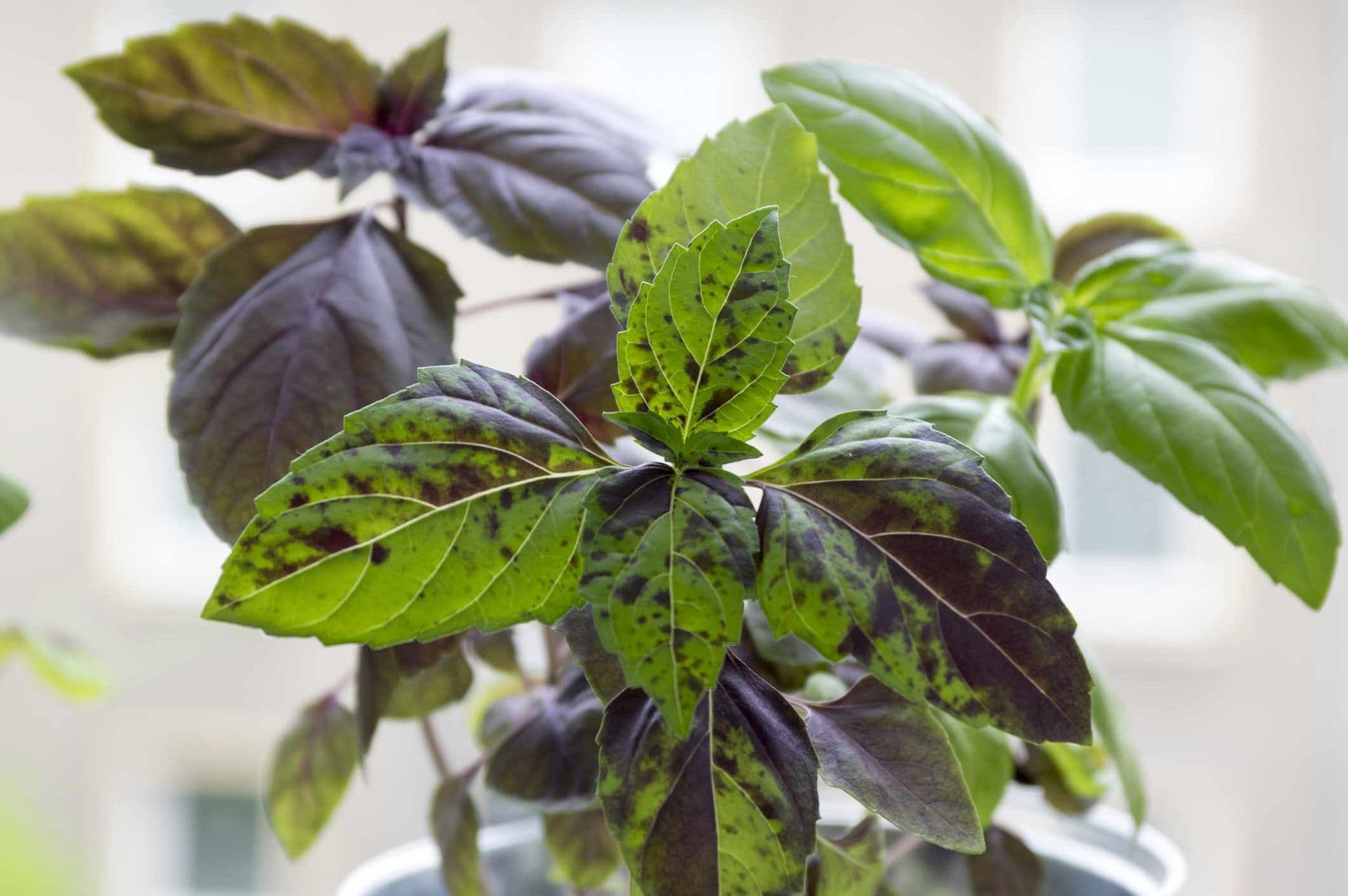
Basil downy mildew is characterized by yellow patches, black specks on the upper surface, and grey fuzz on the underside. Cercospora leaf spot causes water-soaked, round, dark-brown spots with a grayish center. The spots merge, and leaves turn yellow over time.

Bacterial Leaf Spot
The bacterial infection that results in dark spots on basil is called bacterial leaf spot. It's also known as basil shoot blight and is caused by Pseudomonas cichorii.
It’s characterized by small, dark, and water-soaked round spots on both sides of the leaf that then dry out and crack. They often look angular or irregular, as if “trapped” between the veins. This, along with streaks on the stem, distinguishes bacterial leaf spot from most fungal infections.
It often spreads through infected seeds, splashes of water during rain or watering, other infected plants, or soil.
Overwatering and Poor Drainage
Basil isn’t a low-water plant. It requires watering every 3-4 days for potted indoor basil, but the devil is in the details. Its roots require a lot of oxygen. That’s why soil needs to be consistently moist, but never waterlogged.
When overwatered, roots start to rot, lose the ability to absorb oxygen, and fail to take up nutrients. That’s the perfect environment for fungal infections, too.
If overwatering is the case, the leaves will be the first to signal that. They usually start wilting and yellowing. Mushy, soft brown or black spots begin to develop and spread. Stems get mushy and dark, too, while the soil itself starts smelling musty.
Pest Damage
The most common basil pests include beetles, aphids, spider mites, four-lined plant bugs, thrips, and whiteflies. They all can cause dark spots in one way or another.
For example, aphids and whiteflies excrete honeydew, which creates a perfect environment for sooty mold.
Spider mites, four-lined plant bugs, and thrips pierce plant cells and suck out the sap, damaging the surface. Damaged parts appear as discolored spots first and then darken over time.

-1.png&w=2880&q=75)
Identify Your Plant's Issues
Scan with Botan and get result with 98%+ accuracy
Indoor vs Outdoor Basil: Why Black Spots May Appear Differently
The main difference between these two categories is the primary risks for the plant. Unlike in-ground basil, indoor basil is protected from soil pathogens and pests but often suffers from overwatering and poor drainage.
Here is what the most common scenarios look like:
Growing Condition | Primary Risks | Most Common Cause of Black Spots | What to Do |
Indoor | High humidity, low airflow, poor or absent drainage | Root rot, fungal infections (specifically downy mildew) | Remove infected plants (for downy mildew), cut off infected leaves, stop overwatering, get a pot with a drainage hole |
In-Ground | Soil pathogens & pests, cold & sun damage | Fungal & bacterial infections, aphids, spider mites, and other pests | Remove infected leaves and stems, water at the base, sanitize garden tools, use insecticidal soap spray for pests |
Note that these are general scenarios. In every case, you’ll need to investigate the reason why black spots appeared first.
How to Treat Black Spots
Let’s say you’ve noticed black spots on basil leaves. Here’s exactly what you can do to address the problem:
- Identify the reason. Check if the spots are on edges only and whether they spread. If they are dry and localized, that could be temperature damage. If there’s underside fuzz, that’s likely mildew. If spots are dark and wet, this is likely a bacterial or fungal infection. If there are tiny scattered spots, that might be pests.
- Remove all damaged leaves. Regardless of the reason, that’s the first thing to do. If you suspect mildew or infection, or if all leaves are visibly damaged, consider removing the entire plant.
- Check the roots. Unpot the plant to see whether the roots are dark and mushy. If yes, this is likely overwatering. Remove damaged parts and let them dry.
- Check for pests. If they are the cause, apply insecticidal soap and ensure you’ve sprayed both sides of the leaves.
- Isolate your plant if it’s an infection. Disinfect your tools to prevent further spread. Also, use copper-based fungicide if it’s cercospora leaf spot.
- Adjust your watering schedule. To prevent bacteria from spreading, water only at the base. Also, use the finger test — water only when the top 1-2 inches of soil feel dry.
- Adjust the environment. If you believe it's due to cold damage, move the plant indoors at night. Move it to a shadier spot if sunburn is the cause. Find a place with better airflow if fungus is a problem.
So, identification is key. It might not be easy for a beginner to assess the spots: their locations, wetness levels, and other details. But practice and patience make perfect.
Still, if you want to simplify the process, you can use the Botan leaf identifier. Just take a picture of the plant, and the scanner will analyze dozens of criteria for you, giving you an accurate diagnosis and a step-by-step treatment plan.

How to Prevent Black Spots from Coming Back
If you don’t want to ask “Why does my basil have black spots?” ever again, follow these simple recommendations:
- Buy only certified, 100% pathogen-free seeds.
- Always water at the base.
- Ensure the temperature remains above 50°F (10°C).
- Place your plants at least 11 inches (30 cm) apart.
- Improve air circulation around the plant.
- Use a pot with proper drainage.
- Monitor for pests every 2 weeks.
To minimize future problems, consider choosing one of the disease-resistant basil varieties, such as Rutgers Devotion DMR, Rutgers Obsession DMR, or Amazel Basil.
FAQ
It depends on the cause. If spots are caused by low temperatures and the leaves still smell fresh, basil is edible. However, if you notice spots on a living plant, they may indicate a bacterial or fungal infection. In this case, and/or if the herb is slimy and moldy, eating it is not recommended.
Dariia Plaksina
Botanist
5 years of botanical research experience
Dariia Plaksina is a biologist, botanist, and writer of informational articles with over 5 years of experience exploring the world of plants, nature, and biology. She studied at Taras Shevchenko National University of Kyiv, Educational and Scientific Center “Institute of Biology and Medicine,” where she built a strong scientific foundation for her future work.
For Dariia, writing is a hobby, a calling, and a way to make reliable knowledge easier to understand. Her articles focus on plant care, plant health, and natural processes, helping readers learn more about the living world through clear, accessible, and science-based explanations.
Related Articles
5 min read · 16 Sept 2026
How to Keep Cats Away From Plants: 7 Safe and Effective Methods
Cats may dig in potting soil, chew leaves, or knock containers over. These seven methods combine safer placement, physical protection, a suitable chewing alternative, and play to help protect your plants without putting your cat at risk.
5 min read · 7 Sept 2026
Overwatering vs Underwatering: How to Tell the Difference
Overwatering and underwatering can look almost identical, so they're easy to confuse. In this guide, we'll cover the signs of each, simple ways to tell them apart, and how to treat your plant once you know what's wrong.
7 min read · 26 Aug 2026
Brown Spots on Basil Leaves: Causes and How to Fix Them
Brown spots can appear after watering mistakes or disease. Cold exposure and pests leave a distinct pattern too. Learn how to diagnose damaged basil and prevent new marks.
Explore Plants by Care Needs
Identify the plant and problem. Help your plant recover
Identify plant problems early, understand what's wrong, and get clear care guidance. Botan helps you turn guesswork into confident plant care