Money Tree Root Rot: Signs, Causes, and How to Save Your Plant
Root rot money tree trouble is one of the most common reasons a plant drops leaves and wilts fast. In this guide, you'll learn about the warning signs, causes, and an easy way to restore a sick Pachira.

On this page
- What Is Money Tree Root Rot and Why Does It Happen?
- How to Identify Money Tree Root Problems: Early Signs
- Four Steps to Save a Money Tree With Root Rot
- Step 1: Remove the Plant and Inspect the Roots
- Step 2: Trim Away Rotten Roots
- Step 3: Repot in Fresh Soil
- Step 4: Adjust Watering During Recovery
- When a Money Tree Can't Be Saved
- How to Prevent Root Rot – 5 Simple Rules
Your money tree is looking bad, and you're wondering if it might be root rot. Money tree root rot typically starts underground, long before the leaves turn yellow. So, by the time you notice a problem above ground, the situation below is already more serious.
However, if you detect the disease early, it's often treatable. A plant app like Botan can help you distinguish root rot from similar issues. Let's look at how to recognize it in a money tree, why it occurs, and what to do about it.

What Is Money Tree Root Rot and Why Does It Happen?
Root rot in the money tree is a condition in which the plant's underground part remains in wet soil for an extended period, suffocating and beginning to rot. The money tree, or Pachira aquatica, grows in swamps in the wild, so people assume it thrives in overwatered pots. This is not true — the plant needs air.
When the soil remains wet, the tiny crevices that hold oxygen fill with water. Deprived of air, the root tips of overwatered indoor plants die. Then, fungi and bacteria already living in the soil penetrate and feed on the dead tissue, which accelerates the decomposition process.
Here are some common reasons why rot often occurs in money tree pots:
- Too much water. Excess water that the soil cannot drain leads to rot, and this is the main cause.
- Lack of drainage holes. Water accumulates at the bottom with nowhere to go, so the lower roots remain wet for several days.
- The pot is too large. Excess soil holds excess water, and the plant can't absorb it quickly enough.
- Cool, dim locations. The plant slows down its growth and uses less water, so soil that was good in the summer remains moist for much longer in the winter.
According to experts at the Missouri Botanical Garden, this plant thrives in moderate, evenly moist soil, rather than in constantly waterlogged conditions. One strange characteristic of rot: a diseased money tree often appears thirsty even when the soil is moist, because the damaged roots are unable to deliver water to the leaves.


Identify Your Plant
Scan the plant and get a result with 98% accuracy
How to Identify Money Tree Root Problems: Early Signs
Detecting an issue early makes it much easier to resolve. The difficulty is that rot hides beneath the surface, and the first signs are very similar to other problems: insufficient light, inadequate care, etc. That's where a tool like Botan may help significantly. Take a photo, use its scanner for quick tree identification, and you'll immediately find the likely cause as soon as symptoms appear.
However, the most reliable test is to dig up the plant and examine its underground part yourself. Here's a healthy money tree next to a rotten one:
Healthy Money Tree | Money Tree With Root Rot |
Firm, green leaves | Yellow leaves, often from the bottom up |
White or pale tan roots | Brown or black roots |
Crisp, snappy roots | Soft, mushy roots that break easily |
Plain soil smell | Sour, swampy odor from the pot |
Steady new growth | Stalled growth, droopy stems |
Four Steps to Save a Money Tree With Root Rot
Money tree treatment comes down to quick action and careful handling of the remaining healthy roots. Before you begin, it's important to accurately determine the cause so you can combat the real rot, not pests or some watering myth you read online. Here’s how to save a money tree from root rot step by step by using different solutions.
Step 1: Remove the Plant and Inspect the Roots
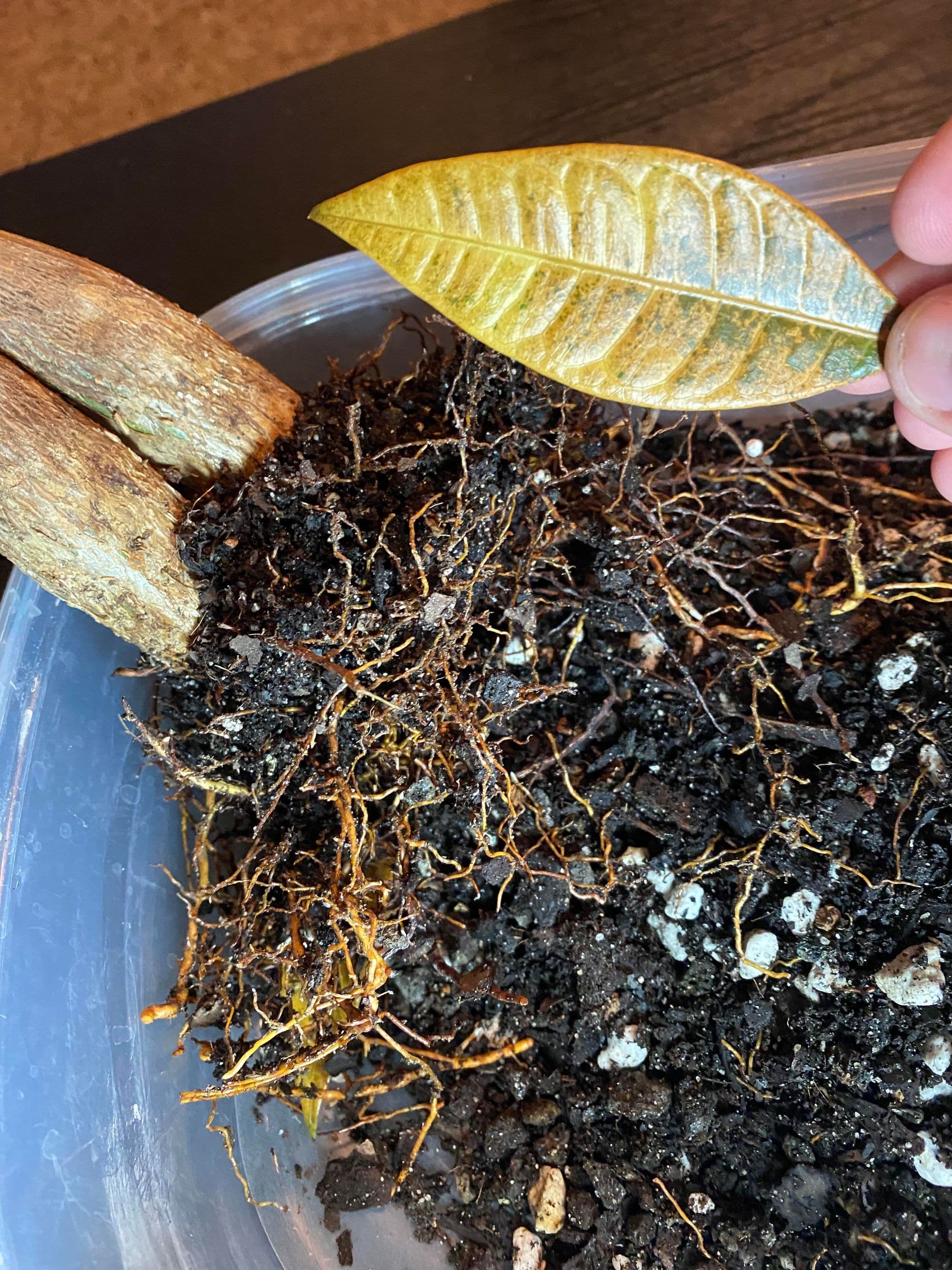
Tilt the pot on its side and slowly pull the plant out by the base. If it doesn't come out, first run a knife around the inside edge of the pot. Bring the roots to a sink or trash bag and rinse the old soil with a slow stream of warm water until they are exposed. Lay them out and inspect them. Healthy roots are pale and firm; rotten ones are dark, slimy, and smelly.
Step 2: Trim Away Rotten Roots
Take clean, sharp scissors or pruners and wipe the blades with rubbing alcohol to prevent smearing. Trim away all soft, black, brown, or loose parts, cutting down to the firm, light-colored tissue.
Be thorough — a single rotten root left behind will restart the problem. The plant can regrow from just a few healthy ones. Wipe the blades again between large cuts.
Step 3: Repot in Fresh Soil
Don't reuse old soil; it's full of whatever caused the rot. Fresh soil is half the cure for money tree root rot, so use a fast-draining mix, ideally with perlite or bark mulch to create air pockets.
Choose a pot with drainage holes that's slightly larger than the trimmed roots, as a larger pot will hold too much water. Place the plant, spread the underground part, and fill in the soil around it without compacting. Once the plant is established, your finger is the best detector, so check the soil this way before each subsequent watering.
Step 4: Adjust Watering During Recovery
Water the fresh soil once to settle it, then reduce watering. The pruned plant has far fewer roots than before, so it requires much less water. Wait until the top few inches of soil are dry before watering again, and test the moisture level with your finger, rather than guessing.
Also, avoid fertilizing solutions; weak roots won't tolerate them, and fertilizers will likely burn a plant. Keep the plant in bright, indirect light, away from cold drafts, and then leave it mostly alone. New roots develop over weeks, and trying to strengthen them won't speed up the process.

When a Money Tree Can't Be Saved
Sometimes, it can be impossible to save a money tree with root rot. The plant's chances of survival depend on how many healthy roots remain. Here are a few signs:
- Almost all roots are dead. If more than 50% of the plant is affected, the chances of recovery are minimal.
- The trunk is soft. A soft base means the rot has reached the core, and there's little left to save.
- A sour odor that persists after pruning. Rot is still spreading internally, so the chances of recovery are minimal.
If the roots are mostly dense or less than half rotted, it's worth trying to save the plant. Otherwise, it's better to start over with a new plant than to spend a month caring for a dead one and hoping it will recover.
How to Prevent Root Rot – 5 Simple Rules
Preventing rot is much easier than saving a plant from it. It basically comes down to two things: how you water and what you grow the plant in, and both are easy to do correctly. Take care of Pachira aquatica properly and incorporate the following into your daily routine:
- Water only when the top layer of soil is dry. Test the soil moisture with your finger (at a depth of about 2-2.5 cm) each time, rather than watering according to a set schedule.
- Use a pot with drainage holes. A container with a working drainage hole prevents water stagnation in the lower roots.
- Empty the tray. Don't let the pot stand in a puddle of drained water.
- Prune plants in winter. Growth slows during the colder months, and the plant drinks less water, so water less frequently.
- Use loose, well-drained soil. A mixture with perlite or bark allows air to reach the roots.
Follow these recommendations, and rot will occur very rarely, if at all.
FAQ
Give it some time; it takes weeks for new roots to form. If leaves continue to fall off and the trunk softens after a month, dig it up again and see if there are any healthy roots left.
Dariia Plaksina
Botanist
5 years of botanical research experience
Dariia Plaksina is a biologist, botanist, and writer of informational articles with over 5 years of experience exploring the world of plants, nature, and biology. She studied at Taras Shevchenko National University of Kyiv, Educational and Scientific Center “Institute of Biology and Medicine,” where she built a strong scientific foundation for her future work.
For Dariia, writing is a hobby, a calling, and a way to make reliable knowledge easier to understand. Her articles focus on plant care, plant health, and natural processes, helping readers learn more about the living world through clear, accessible, and science-based explanations.
Related Articles
8 min read · 1 Oct 2026
Lemon Tree Leaves Turning Yellow: Causes and How to Fix It
Yellow leaves are one of the most common lemon tree problems. This guide explains eight causes of lemon tree leaves turning yellow, from overwatering to root rot, with a fix for each.

5 min read · 16 Sept 2026
How to Keep Cats Away From Plants: 7 Safe and Effective Methods
Cats may dig in potting soil, chew leaves, or knock containers over. These seven methods combine safer placement, physical protection, a suitable chewing alternative, and play to help protect your plants without putting your cat at risk.
5 min read · 7 Sept 2026
Overwatering vs Underwatering: How to Tell the Difference
Overwatering and underwatering can look almost identical, so they're easy to confuse. In this guide, we'll cover the signs of each, simple ways to tell them apart, and how to treat your plant once you know what's wrong.
Explore Plants by Care Needs
Identify the plant and problem. Help your plant recover
Identify plant problems early, understand what's wrong, and get clear care guidance. Botan helps you turn guesswork into confident plant care