Why Roses Get Black Spots and How to Stop the Disease
Black spots on roses can indicate fungal disease, sunburn, pests, or other issues. Learn how to easily tell them apart, identify the actual problem, and help your plant recover in just a few weeks.

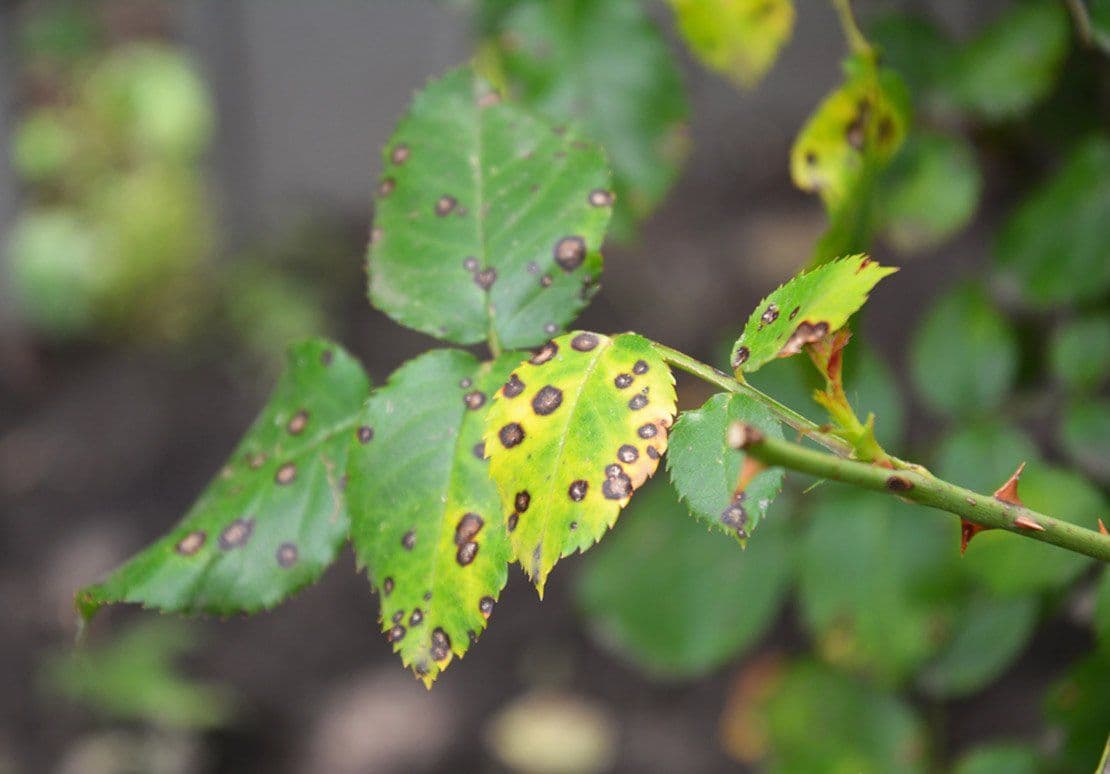
If you notice dark spots on rose leaves, don’t panic. Your plant is just telling you something is wrong. Usually, the reason is black spot disease, pests, or environmental damage.
If you correctly identify the cause, the plant will recover, and the new growth will be perfectly healthy. Read on to learn how to do that easily, get a step-by-step guide on treating black spot on roses, and find out how to prevent similar issues in the future.

What Causes Black Spots on Roses
Black spots on rose leaves are just a symptom. Most frequently, they’re caused by the fungal disease literally called “Black spot” or “Diplocarpon rosae”.
It was first reported in 1815 in Sweden and began spreading across the globe, becoming the most common and damaging condition for the entire genus.
The likelihood that you’re facing this specific problem is very high, so let’s discuss exactly how the disease develops, spreads, and affects the plant.
Black Spot Disease Explained
The disease is caused by Diplocarpon rosae, a fungal pathogen that spreads via tiny spores landing on the plant’s leaves. Those usually survive in fallen leaves or canes and are carried by splashes from rain or sprinkler irrigation. If leaves are wet for at least 6 hours, spores will germinate.
Then the pathogen begins feeding on the rose, acting as a parasite. Within 72 hours, you may start noticing the symptoms.
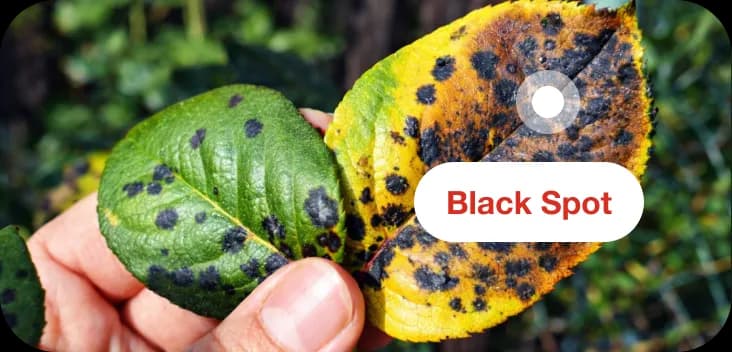
First, the disease affects leaves. You may see black spots with feathery edges on them. Additional symptoms include fewer and paler flowers, gradual defoliation, and small black or purple-red blotches on stems.
Note that other conditions may cause different kinds of black spots on leaves, and we’ll compare them below.

Conditions That Help the Disease Spread
Besides wet leaves, fungi need these favorable conditions:
- Temperature: from 72°F to 86°F (22°C to 30°C). This is ideal warmth, but sometimes, pathogens can also spread at temperatures as low as 59°F (15°C).
- Humidity: high levels of 70%+.
- Air circulation: poor; space between roses is less than 3-4 feet.
- Lighting: roses are in full or partial shade for too long.
Prevention works better than any rose black spot treatment. So, if you want to avoid problems in the future, you’ll need to ensure that pathogens won’t have such a perfect environment in your garden.
Identify Your Plant's Issues Early
Identify plant problems before they spread
How to Identify Black Spot on Roses
Before you take any action, you need to ensure that you’re dealing with black spot disease and not one of the other factors, such as nutrient deficiencies, sunburn, or insect damage.
Take a closer look at the spots and other symptoms to identify the cause.
Symptom | Black Spot | Nutrient Deficiency | Insect Damage | Burn (from sun, frost, or fertilizer) |
Key spot characteristics | Dark black, quite soft spots with feathery margins & a yellow halo | Flat, yellow, or light green (varies by nutrient), but turning dark in severe cases | Sticky residue that dries black, or tiny dark dots from bites | Dry, crispy, dark & soggy, turning from tan to brown/black |
Spot location | All over the surface | Often marginal or between veins | Irregular, often tightly clustered | Leaf margins and tips |
Spot size | Up to ½ inch in diameter | Small and less defined | The tiniest | Depends on the damage |
Leaf condition | Turning yellow before dropping | Turning light green, then dropping | Leaf remains green, looks “dirty” rather than sick | Aside from the dark, crispy zone, the leaf remains undamaged |
Stems condition | Develop dark or purple-red irregular blotches | Stunted & fewer | Small dark spots | Not affected |
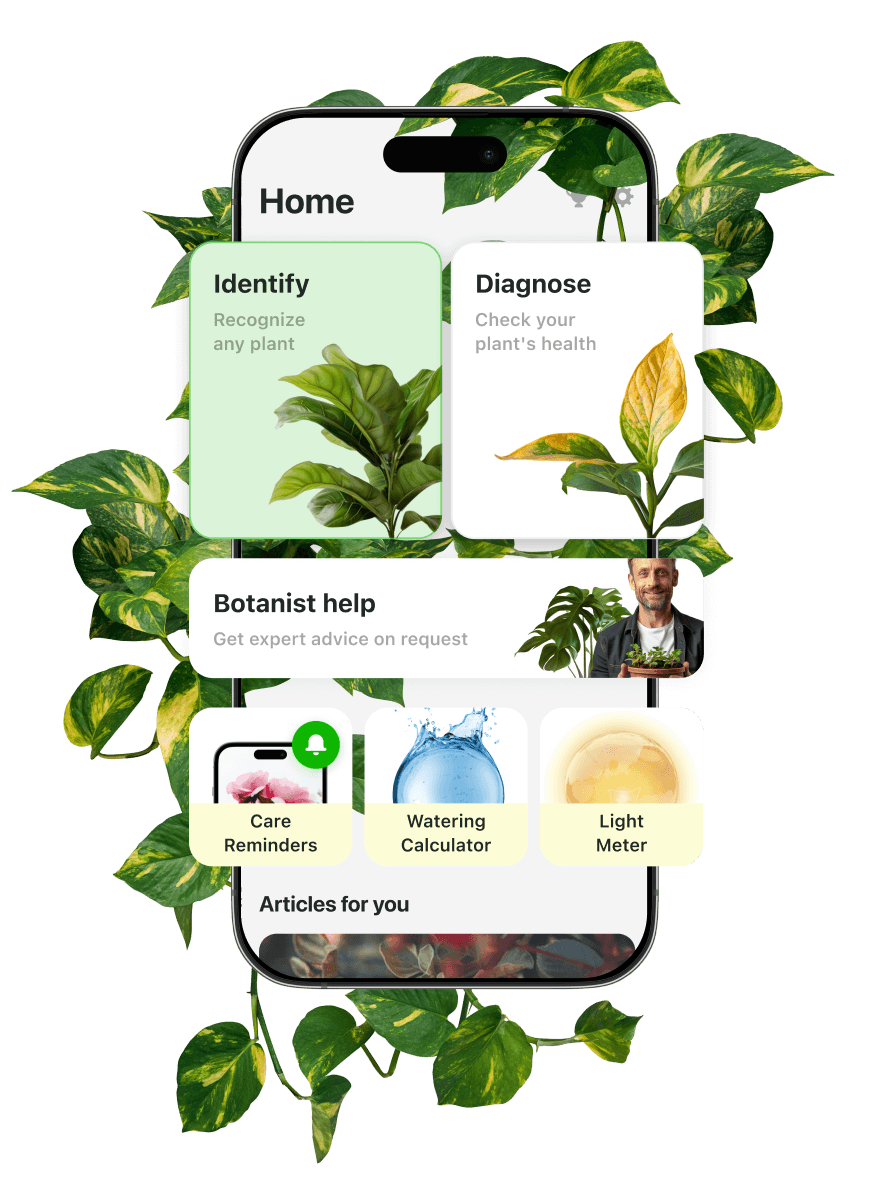
If you want to find out the diagnosis and, for example, learn how to treat black spot on roses in your specific case, you can do it instantly with the Botan app.
It’s not only effective for shrub identification: if you take a photo of the damaged leaves, the detector will also identify the specific disease or condition that affects the plant in 3-5 seconds. After that, you automatically receive a science-based, step-by-step treatment plan, along with recovery time estimates.

How to Treat Black Spot on Roses
Most gardeners confirm the same diagnosis: fungal infection. Effective black spot rose treatment should include the following steps:
- Remove all infected material. Strip all damaged leaves and canes. They won’t recover.
- Don’t compost. Bag everything and throw it away from your garden.
- Start fungicide. Begin treatment immediately after removal. Choose a solution with systemic formulas (like propiconazole) for longer-lasting effect, contact sprays (like mancozeb or chlorothalonil) for cheaper, broader-spectrum coverage, or organic options (like copper or sulfur) for lower toxicity. Contact and organic ones may need more frequent application.
- Stick to the schedule. If you’re using systemic fungicides, apply every 2-3 weeks. If you choose organic or contact solutions, apply every 7-14 days. Apply an extra dose if it has rained recently.
- Water at the base only. Stop overhead watering to prevent the spread of the disease.
- Rotate solutions if necessary. If one doesn’t seem to work properly, switch to a product with another active ingredient.
That’s how to stop Black Spot on roses, but again, ensure that you’re not dealing with one of the pest or environmental types of damage.
If that’s the case, take corresponding actions: apply insecticides or fertilizers, move the plant away from too-hot or too-cold spots, etc. You can always take a photo, identify a specific condition, and get a treatment plan in seconds with Botan.
How to Prevent Black Spot from Returning
It’s much easier to prevent the problem than to address it, especially considering there are no complex steps to take:
- Choose more resistant varieties. Selection won’t be intuitive. For example, the Desert Rose succulent, which isn’t even a rose in the classic sense, is still vulnerable. Check the specific varieties in the PNPM textbook and choose the one that fits you best.
- Space and prune roses. There must be a good airflow, so the leaves dry out much faster.
- Keep watering at the base. It’s a universal rule. Stick to it before the issue arises or when it’s already gone.
- Apply fungicide preventively. Do it at bud break in spring, and a few more times as the leaves grow.
- Clean up all fallen foliage yearly. Do it in winter, and again, don’t compost. Get rid of all leaves and canes that may help fungi survive the season.
Also, water in the morning and avoid overwatering in general. All fungi love excessive moisture, so don’t let them spread.
Common Mistakes That Make Black Spot Worse
Forewarned is forearmed. Here are some of the most important dos and don’ts when it comes to rose treatment:
- Don’t wait until symptoms get very serious and leaves start to fall off.
- Spray when the humidity is high and fungi are most active.
- Don’t use a gentle, preventive fungicide when the disease is already there.
- Always disinfect your tools between cuts. Applies to all plants, not just roses.
- Don’t prune when it’s wet. Do it only when the weather is dry.
Also, don’t try to speed up the process. In most cases, recovery takes around 3 weeks, and that’s perfectly normal.
FAQ
Yes, but technically, it doesn’t survive in bare soil. Fungi overwinter in fallen leaves, plant debris, and infected canes, then spread in wet, warm environments.
Dariia Plaksina
Botanist
5 years of botanical research experience
Dariia Plaksina is a biologist, botanist, and writer of informational articles with over 5 years of experience exploring the world of plants, nature, and biology. She studied at Taras Shevchenko National University of Kyiv, Educational and Scientific Center “Institute of Biology and Medicine,” where she built a strong scientific foundation for her future work.
For Dariia, writing is a hobby, a calling, and a way to make reliable knowledge easier to understand. Her articles focus on plant care, plant health, and natural processes, helping readers learn more about the living world through clear, accessible, and science-based explanations.
Related Articles
8 min read · 1 Oct 2026
Lemon Tree Leaves Turning Yellow: Causes and How to Fix It
Yellow leaves are one of the most common lemon tree problems. This guide explains eight causes of lemon tree leaves turning yellow, from overwatering to root rot, with a fix for each.
5 min read · 16 Sept 2026
How to Keep Cats Away From Plants: 7 Safe and Effective Methods
Cats may dig in potting soil, chew leaves, or knock containers over. These seven methods combine safer placement, physical protection, a suitable chewing alternative, and play to help protect your plants without putting your cat at risk.
5 min read · 7 Sept 2026
Overwatering vs Underwatering: How to Tell the Difference
Overwatering and underwatering can look almost identical, so they're easy to confuse. In this guide, we'll cover the signs of each, simple ways to tell them apart, and how to treat your plant once you know what's wrong.
Explore Plants by Care Needs

Identify the plant and problem. Help your plant recover
Identify plant problems early, understand what's wrong, and get clear care guidance. Botan helps you turn guesswork into confident plant care