Shallow potting depth
Position the tubers just below the surface in a shallow container so emerging roots and new tubers can spread horizontally without rotting in deep, cold media.

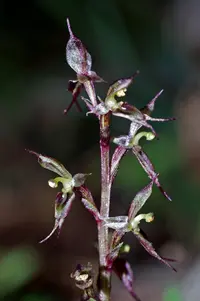
The large mosquito-orchid, Acianthus exsertus, is a small terrestrial orchid native to eastern Australia. It typically grows in colonies on the forest floor among leaf litter and moss. This species forms a single, heart-shaped leaf close to the ground, with slender stems carrying delicate, translucent flowers that resemble tiny insects. The flowers appear in the cooler months and give the plant a fine, airy look. Large mosquito-orchid prefers shaded woodland conditions, cool to mild temperatures, and consistently moist but well-drained, humus-rich soil. In cultivation, it can be somewhat challenging, so learning how to care for large mosquito-orchid is important for long-term success.

Care Difficulty
Hard Care

Light Preference
Partial Shade

Water Requirements
Keep Soil Moist

Temperature Preference
Cool Climate

Hardiness Zone
9–11

Soil Texture
Loamy, Peaty, Organic-rich

Soil pH
Strongly acidic (4.5–5.5), Acidic (5.5–6.5)

Soil Drainage
Moist but well-drained

Fertilization
Minimal (feed rarely)
Scan your plant to receive care tips personalized for your specific plant
Available on iOS and Android
This terrestrial orchid prefers soft, filtered light similar to bright forest shade.
This species prefers consistently lightly moist but never waterlogged soil during active growth.
This cool- to mild-climate orchid is adapted to sheltered woodland temperatures.
This terrestrial orchid prefers moderately moist air but tolerates typical household conditions if soil moisture is stable.
This species prefers a loose, humus-rich, sharply drained mix that mimics leaf-litter forest floors.
This species can grow in containers if the pot and medium are managed to prevent waterlogging around its fine roots.
This terrestrial orchid prefers lean conditions and only light feeding in cultivation.
Pruning needs for Acianthus exsertus are minimal and focus on hygiene rather than shaping.
This small terrestrial orchid dislikes disturbance, so transplanting should be infrequent and gentle.
Propagation of Acianthus exsertus is specialized and usually left to experienced growers or conservationists.
This species is cool-tolerant but the underground tubers benefit from basic winter protection in colder areas.

Plant Health Check
Not sure what's wrong with your plant? Check your plant's health inside the app.
The flowers are small, translucent, and reddish to brownish, with long, projecting column structures that give a delicate, insect-like look, which inspired the common name large mosquito-orchid.
This species is a terrestrial orchid that produces its single, heart-shaped leaf and flowers mainly in the cooler months, entering a resting phase during the warmer part of the year in its native range.
In the wild it usually grows in leaf litter on shaded forest floors or on sheltered rock ledges in eastern Australia, where consistent moisture and cool, still air support its fine roots and seasonal growth cycle.
This species often fails to flower if it has been recently disturbed, divided, or kept too warm in summer. It also needs a cool, dryish rest after the leaf phase. Avoid repotting frequently and mimic a seasonal temperature drop.
Keep your plants happy and healthy with plant identification, disease detection, and easy care guidance.