Sturdy staking
Install discreet stakes or a low ring support early in the season so the tall, airy stems stay upright and do not snap in wind or heavy rain.

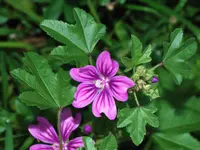
High mallow, Malva sylvestris, is a herbaceous perennial often grown as a short-lived ornamental or cottage garden plant. It forms upright clumps with branched stems and rounded, slightly toothed leaves.
The plant is best known for its showy, pink-purple, veined flowers that appear over a long season and attract bees and other pollinators. It typically occurs in meadows, roadsides, and disturbed soils across Europe and western Asia, and has naturalized in parts of North America.
Malva sylvestris is generally easy to grow, adapting to a range of garden soils if drainage is good. This species prefers full sun, moderate moisture, and benefits from simple, regular care for high mallow.

Care Difficulty
Easy Care

Light Preference
Full Sun

Water Requirements
Moderate Water

Temperature Preference
Cold Hardy

Hardiness Zone
4–8

Soil Texture
Sandy, Loamy, Clay

Soil pH
Slightly acidic (6.5–7.0), Neutral (7.0)

Soil Drainage
Well-drained

Fertilization
Minimal (feed rarely)
Scan your plant to receive care tips personalized for your specific plant
Available on iOS and Android
Malva sylvestris performs best in bright outdoor conditions with several hours of direct sun each day.
This plant prefers moderate, consistent moisture in well-drained soil rather than constant wetness.
This species grows reliably in temperate climates with moderate warmth and reasonable cold tolerance.
This species handles a wide humidity range and rarely needs special humidity management outdoors or in typical homes.
This species prefers moderately fertile, well-drained mineral soil for reliable growth and flowering.
This species can be grown successfully in containers when provided with adequate root depth and drainage.
Malva sylvestris grows well in modestly fertile soil, but light feeding supports stronger flowering.
Thoughtful pruning helps Malva sylvestris stay compact, healthy, and floriferous.
This species is more often grown in beds than in pots, so focus on careful transplanting of young plants.
Malva sylvestris is most commonly propagated from seed, with cuttings as a secondary method.
Established plants are generally cold hardy in temperate climates and need only modest winter attention.

Plant Health Check
Not sure what's wrong with your plant? Check your plant's health inside the app.
The showy purple flowers contain abundant mucilage, a slippery plant polysaccharide that helps retain moisture and protects tissues from dehydration and mechanical damage.
Its mildly flavored petals are commonly used fresh in salads or as a natural garnish, and they safely impart a soft texture and color without a strong taste when harvested from unsprayed plants.
In many temperate regions it functions as a nectar and pollen source for bees, hoverflies, and some butterflies, and its leaves can host caterpillars of certain moth species, contributing to local food webs.

In parts of Europe and North Africa, long-established garden and roadside populations of Malva sylvestris have become so common that they now form characteristic components of traditional village and farmyard floras, marking disturbed, nutrient-rich soils around human settlements for centuries.
This species establishes quickly in suitable conditions. Seedlings often flower in their first year, and plants can reach close to full height within one growing season when given adequate light, water, and moderately fertile soil.
Keep your plants happy and healthy with plant identification, disease detection, and easy care guidance.