eastern bluestar Care (Amsonia tabernaemontana)

Also known as: bluestar
eastern bluestar

About eastern bluestar

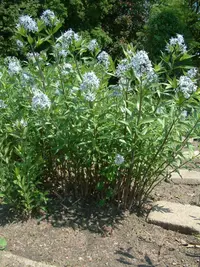
Eastern bluestar, Amsonia tabernaemontana, is a long-lived perennial grown mainly for its soft blue star-shaped spring flowers and tidy, bushy form. It typically forms rounded clumps of narrow, willow-like leaves that turn attractive golden-yellow in fall, adding multi-season interest to mixed borders or naturalistic plantings. Native to moist meadows and open woodlands in eastern and central North America, it is adapted to a range of garden conditions and is generally low-maintenance once established. Its deep root system and sturdy stems make it durable and wind-resistant, which simplifies how to care for eastern bluestar in most temperate gardens. It prefers sun to light shade and moderately moist, well-drained soil.

Main Plant Requirements

Care Difficulty

Easy Care

Light Preference

Full Sun

Water Requirements

Moderate Water

Temperature Preference

Cold Hardy

Hardiness Zone

3–9

Soil Texture

Sandy, Loamy, Clay

Soil pH

Acidic (5.5–6.5), Slightly acidic (6.5–7.0)

Soil Drainage

Moist but well-drained

Fertilization

Minimal (feed rarely)

Get Personalized Care Plan

Scan your plant to receive care tips personalized for your specific plant

Available on iOS and Android

How to Care for the eastern bluestar

This plant prefers bright outdoor conditions with moderate direct sun for strongest growth.

  • Provide 4–6 hours of direct sun daily, ideally morning sun with light afternoon shade to protect leaves from scorching in hot climates.
  • Eastern bluestar grows well in full sun but also tolerates light to partial shade, though flowering and compactness decrease under less than 3–4 hours of sun.
  • In hotter regions, use filtered light or dappled shade during peak afternoon hours in summer, while in cooler climates full sun all day is usually safe.

This perennial prefers evenly moist but not waterlogged soil, especially during establishment.

  • Water when the top 3–5 cm of soil feels dry, aiming for deep soaking rather than frequent shallow watering to encourage a deep root system.
  • In spring and early summer, monitor rainfall; established Amsonia tabernaemontana often needs supplemental water only during dry spells or heat waves.
  • Watch for yellowing, soft stems or standing water as signs of overwatering, and for wilting or crisp leaf tips as indicators that the soil is staying too dry.

This hardy perennial tolerates a wide temperature range once established.

  • Active growth is strongest around 65–80°F (18–27°C), typical of late spring and early summer conditions in many temperate regions.
  • Dormant roots usually survive winter down to about -20°F (-29°C) when planted in the ground with good drainage and a light mulch layer.
  • The plant handles typical summer heat up to about 90°F (32°C), but prolonged hotter periods increase water demand and may cause temporary leaf stress or earlier dormancy.

Humidity is rarely a concern for Amsonia tabernaemontana in typical outdoor conditions.

Amsonia tabernaemontana prefers deep, moisture-retentive but well-drained soil for long-lived clumps.

  • Use a loamy soil with moderate organic matter so roots stay evenly moist without becoming waterlogged.
  • Aim for neutral to slightly acidic pH around 6.0–7.0, which suits most garden loams and composts.
  • Improve drainage and aeration in heavy clay by mixing in coarse sand and well-rotted compost before planting.
  • Avoid very compacted, poorly drained, or extremely sandy soil that dries out rapidly between waterings.

This species can be grown in large containers if the pot is deep and stable.

  • Select a tall, heavy container so the mature, bushy top growth does not tip the pot in wind.
  • Use a potting mix that holds moisture yet drains freely, as containers dry faster than garden beds.
  • Choose a light-colored pot in full sun locations to reduce overheating and root stress in summer.

This native perennial needs only light feeding in most garden soils, especially when established.

  • Apply a thin layer of compost around plants in early spring to support steady growth.
  • If soil is poor, use a balanced slow-release fertilizer (such as 10-10-10) once in spring at label rate.
  • For container-grown eastern bluestar, use a half-strength balanced liquid feed every 4–6 weeks in the growing season.
  • Stop feeding in late summer so new growth can harden before winter dormancy.

Pruning Amsonia tabernaemontana is minimal and mainly used to tidy plants and manage size.

  • Cut back flower stems by about one-third in late spring to early summer to keep a compact, bushy shape.
  • Remove dead, damaged, or crossing stems at ground level in late fall or very early spring.
  • Use clean, sharp hand pruners to avoid tearing stems and to reduce disease risk.
  • Shear old foliage to several cm above ground in late winter if a neater look is desired.

This perennial is usually grown in the ground and prefers not to be moved often once established.

  • Plan any transplanting for early spring or early fall, when temperatures are mild and soil is workable.
  • Move plants only when growth declines, clumps become crowded, or a better site with more light or drainage is available.
  • Dig a wide root ball, disturb roots as little as possible, and replant at the same depth in well-drained soil.
  • Water deeply after transplanting, then keep soil evenly moist for several weeks to limit transplant shock.

Amsonia tabernaemontana is most often propagated by division but can also be grown from seed with patience.

  • Divide mature clumps in early spring or early fall, cutting the root mass into several firm sections with buds.
  • Replant divisions immediately in well-drained soil, water thoroughly, and keep evenly moist until established.
  • Sow fresh seeds outdoors in fall or in pots left outside for natural winter chilling, which improves germination.
  • Provide bright light and moderate moisture for young plants, avoiding waterlogged conditions that can rot roots.

This species is cold hardy in most temperate climates and usually needs little special winter care.

  • Allow top growth to die back naturally after frost; stems can be cut down in late fall or late winter.
  • Apply a 5–7 cm mulch layer around the root zone in colder areas to moderate freeze–thaw cycles.
  • In containers, move pots to a sheltered, unheated but frost-free or slightly protected spot to prevent root damage.

Care Tips

Early clump division

Every 5–7 years, lift and divide overgrown clumps in early spring before new growth fully emerges to maintain vigorous flowering and prevent the center from thinning out.

Support in windy sites

In exposed or windy gardens, install low, discreet ring stakes or a short peony hoop around the clump in spring to keep tall stems upright and prevent storm damage later in the season.

Strategic companion planting

Plant sturdy late-emerging perennials such as asters, coneflowers, or ornamental grasses just in front of the clump to help support stems, shade the crown, and create a cleaner transition as foliage yellows in autumn.

Seed pod management

If self-sowing is not desired, remove the narrow seed pods once they start to form after flowering, which directs more energy to root and crown strength instead of seed production.

Autumn foliage handling

Allow the foliage to fully yellow in fall before cutting back, then remove spent stems to ground level to reduce overwintering pests and keep the crown open and healthy for growing eastern bluestar the following season.

Common Pests and Diseases

Rust

This disease causes small orange to rust-brown pustules on leaves, often leading to early yellowing and drop of the affected foliage.

Solution

Remove and discard heavily spotted leaves, avoid overhead watering, and increase air circulation around clumps; in persistent cases, apply a sulfur or chlorothalonil-based fungicide labeled for ornamental perennials at the first sign of spots.

Leaf spot

This disease produces irregular tan to dark-brown lesions on leaves, sometimes with a yellow halo, which can make foliage look tattered by late season.

Solution

Trim and dispose of affected leaves, thin crowded stems to improve airflow, water at soil level, and if spotting recurs yearly, use a preventative fungicide spray in spring according to label directions.

Aphids

These insects cluster on tender shoots and undersides of leaves, sucking sap and causing distorted growth and sticky honeydew deposits.

Solution

Spray colonies off with a strong stream of water, encourage or introduce natural predators such as lady beetles, and if populations remain high, treat new growth with insecticidal soap or a light horticultural oil, coating all leaf surfaces.

Spider mites

These pests feed on underside of leaves, causing fine stippling, dull foliage, and in heavy infestations, fine webbing between stems and leaves.

Solution

Rinse foliage thoroughly, focusing on leaf undersides, increase ambient humidity around plants, and use insecticidal soap or horticultural oil at 5–7 day intervals until new growth appears clean and evenly green.

Interesting Facts

True milkweed relative

This species belongs to the dogbane family (Apocynaceae) and is closely related to milkweeds, which is why its stems exude a milky latex sap when cut.

Naturally flood tolerant

In the wild, it often grows along streams and in moist woodland edges in eastern North America, showing good tolerance to periodic flooding and wet spring soils.

Distinctive star-shaped blossoms

Its pale blue flowers are made of 5 narrow, fused petals arranged in a star shape, forming loose clusters that provide an early nectar source for native bees and butterflies.

Botan icon

Did you know?

The species name tabernaemontana honors the 16th‑century German physician and botanist Jakob Theodor, also known as Tabernaemontanus, reflecting a historical tradition of commemorating early botanists in plant nomenclature.

FAQs about eastern bluestar

Yes, this species is very attractive to early-season pollinators. The star-shaped blue flowers provide nectar for native bees, small wasps, and butterflies. Planting it in groups increases visibility and foraging efficiency for beneficial insects.

Grow Healthy Plants with Botan Care

Keep your plants happy and healthy with plant identification, disease detection, and easy care guidance.

Botan plant care app — identify plants on mobile

Explore More Plants