Select Suitable Hosts
Establish this hemiparasitic species only on compatible native host conifers from its natural range, and avoid introducing it to ornamental or timber trees that could suffer serious, unmanaged decline.

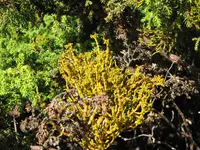
Azores dwarf-mistletoe, Arceuthobium azoricum, is a tiny parasitic flowering plant that lives directly on the branches of host trees, mainly native conifers. It forms compact, broom-like clusters of short, green to yellowish shoots that emerge from the host bark rather than from soil.
This species is endemic to the Azores, where it naturally occurs in cool, moist forest habitats. Its survival depends on tapping water and nutrients from its host, which makes it difficult to cultivate in typical garden or indoor settings.
Anyone wanting to learn how to care for Azores Dwarf-Mistletoe should understand that it is best left in its natural ecosystem, where light, humidity, and host availability occur in a balanced way.

Care Difficulty
Hard Care

Light Preference
Full Sun

Water Requirements
Moderate Water

Temperature Preference
Cool Climate

Hardiness Zone
Unknown

Soil Texture
Loamy, Rocky, Organic-rich

Soil pH
Acidic (5.5–6.5)

Soil Drainage
Well-drained

Fertilization
Minimal (feed rarely)
Scan your plant to receive care tips personalized for your specific plant
Available on iOS and Android
This parasitic shrub depends on the host tree’s canopy light conditions rather than direct light to its own tissues.
This hemiparasitic species draws most of its water from the living host rather than from soil contact.
This mistletoe is adapted to mild, oceanic climates with limited temperature extremes.
Humidity is not a practical care lever for this parasitic species, which depends entirely on its living host tissue for water balance.
Soil conditions matter only for establishing and sustaining suitable host trees, since Arceuthobium azoricum itself taps host tissues rather than rooting in soil.
This species is not suitable for container growing because it is an obligate parasite that requires established living host trees rather than its own potting environment.
This parasitic species grows on host trees and does not benefit from supplemental fertilizer in cultivation.
Pruning Arceuthobium azoricum focuses on managing host tree health rather than shaping the mistletoe itself.
This species is not suited to container culture; management focuses on the host tree rather than repotting the mistletoe.
Intentional propagation of Arceuthobium azoricum is rarely recommended because it is a parasitic species with high host impact.
This species is adapted to cool, oceanic climates and typically requires no special winter care beyond normal host tree management.

Plant Health Check
Not sure what's wrong with your plant? Check your plant's health inside the app.
This dwarf mistletoe is endemic to the Azores archipelago and naturally occurs only on a few of the islands, mainly at mid- to high-elevation forests with native conifers.
It parasitizes native Azorean pine species, especially Pinus pinaster subsp. azorica, inserting specialized structures called haustoria into host tissues to draw water and nutrients while remaining largely embedded in the host.
Due to its very restricted range and dependence on declining native host trees, it is considered a species of conservation concern, and changes in Azorean forest management can strongly affect its long-term survival.
This species spreads efficiently on suitable conifer hosts through explosive seed dispersal. Infestations can expand patch by patch over years, gradually weakening host branches. Forestry managers usually monitor and remove heavily infected trees to limit spread.
Keep your plants happy and healthy with plant identification, disease detection, and easy care guidance.