Mimic crevice habitats
Plant in a deep, narrow container or between stable rocks so the roots are cool and shaded while fronds have access to light, closely mimicking the limestone crevices this species prefers in nature.

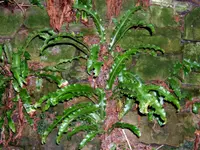
Hart's-tongue fern, Asplenium scolopendrium, is an evergreen fern known for its smooth, strap-shaped fronds that resemble a tongue. The fronds form a neat, upright rosette that brings strong texture and clean lines to shaded spaces.
This species is native to Europe and parts of North America, where it grows on moist, shaded limestone rocks, woodland banks, and walls. It prefers cool, humid conditions and consistently moist, well-drained, humus-rich soil.
Growth is slow to moderate, but the plant is long-lived and stable once established. Understanding how to care for hart's-tongue fern mainly involves providing shade, steady moisture, and protection from extreme heat or drought.

Care Difficulty
Moderate Care

Light Preference
Partial Shade

Water Requirements
Keep Soil Moist

Temperature Preference
Cool Climate

Hardiness Zone
5–9

Soil Texture
Loamy, Peaty, Organic-rich

Soil pH
Acidic (5.5–6.5), Slightly acidic (6.5–7.0)

Soil Drainage
Moist but well-drained

Fertilization
Minimal (feed rarely)
Scan your plant to receive care tips personalized for your specific plant
Available on iOS and Android
This fern prefers low to moderate light that mimics a shaded woodland floor.
This species needs consistently moist but not waterlogged soil to maintain healthy fronds.
This fern is hardy and tolerates cool climates but grows best in mild, stable temperatures.
This fern prefers consistently moist air and reacts quickly to dry indoor conditions.
This species grows best in cool, moisture-retentive but airy soil that mimics leaf litter over limestone rock.
This fern is well suited to container growing outdoors or in sheltered spots.
This fern is light-feeding and only needs modest nutrition for steady, healthy growth.
Asplenium scolopendrium needs only light pruning to maintain tidy, healthy fronds.
This fern prefers stable conditions and benefits from infrequent, careful repotting or transplanting.
Asplenium scolopendrium is usually propagated by division, while spore propagation is possible but more technical.
This fern is cold hardy in much of the US and usually needs only light winter care in the ground.

Plant Health Check
Not sure what's wrong with your plant? Check your plant's health inside the app.
Unlike most ferns with divided leaves, this species forms simple, undivided strap-like fronds that can twist slightly as they age, giving the rosette a distinctive, almost tongue-like appearance.
In the wild it is strongly associated with calcareous habitats such as limestone cliffs, shaded rocky crevices, and mortared walls, reflecting its preference for alkaline substrates rich in calcium carbonate.
The fern’s long, paired sori (spore-bearing structures) run in rows along the underside of the fronds and resemble a centipede, which is the origin of its species name scolopendrium, from the centipede genus Scolopendra.

In some parts of Europe, stable populations of this fern are used as indicators of ancient woodland continuity, because the species tends to persist for long periods only where undisturbed, humid, shaded forest or rock habitats have been present for centuries.
This species is a true fern and does not bloom or produce flowers. Instead, it forms spores in brown lines on the undersides of mature fronds. These spores function as its reproductive structures, replacing flowers and seeds.
Keep your plants happy and healthy with plant identification, disease detection, and easy care guidance.