inland club-rush Care (Bolboschoenus laticarpus)

inland club-rush

About inland club-rush

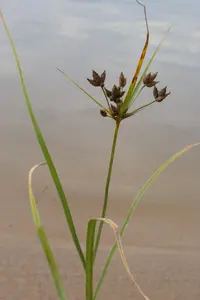
Inland club-rush, Bolboschoenus laticarpus, is a wetland sedge that forms dense clumps of upright, grassy stems topped with tight, rounded clusters of spikelets. It grows from thick, tuber-bearing rhizomes, which help it spread and stabilize muddy or periodically flooded soils.

This species is native to freshwater shores, river margins, and marshes in parts of North America, often where water levels fluctuate. Its preference for consistently moist to wet conditions is the main factor that influences how easy it is to grow.

Gardeners who want to care for inland club-rush should be ready to provide a reliably damp site, full sun to light shade, and soil that never dries out completely.


Main Plant Requirements

Care Difficulty

Moderate Care

Light Preference

Full Sun

Water Requirements

Aquatic

Temperature Preference

Cold Hardy

Hardiness Zone

4–9

Soil Texture

Sandy, Loamy, Silty

Soil pH

Slightly acidic (6.5–7.0), Neutral (7.0)

Soil Drainage

Waterlogged tolerant

Fertilization

Minimal (feed rarely)

Get Personalized Care Plan

Scan your plant to receive care tips personalized for your specific plant

Available on iOS and Android

How to Care for the inland club-rush

This wetland sedge thrives in bright, open conditions with ample direct sun.

  • Provide 6–8 hours of direct sun daily; full sun promotes sturdy stems and dense clumps for inland club-rush.
  • Tolerates light afternoon shade, especially in hotter regions, but dense shade leads to weak, elongated growth and reduced flowering.
  • In summer, ensure water levels stay high so strong sun does not dry the root zone; in cooler seasons, the plant still benefits from unshaded exposure.

This species prefers consistently saturated conditions and tolerates standing water.

  • Maintain soil that is always wet; in natural or constructed wetlands, water can cover the crown by 5–15 cm without stressing Bolboschoenus laticarpus.
  • If grown in garden soil, never allow the top 2–3 cm to dry; leaves curling, browning at tips, or collapsing indicate insufficient moisture.
  • Yellowing, soft stems and foul odor from the root zone suggest prolonged stagnation without oxygen; use mud-rich but not foul, anaerobic conditions.

This hardy rush-like sedge is adapted to temperate climates with cold winters and warm summers.

  • Active growth occurs around 60–80°F (16–27°C); warm conditions plus high moisture support rapid shoot and rhizome development.
  • Dormant rhizomes tolerate winter lows near 0–10°F (-18 to -12°C) under insulating water or soil, but new spring shoots are vulnerable to hard frost.
  • In hot spells above 90°F (32°C), deeper water or saturated soil buffers heat stress and prevents desiccation of shallow roots and stems.

This wetland sedge prefers very high humidity and saturated conditions rather than typical indoor air.

  • Aim for 70–100% humidity, ideally with the crown at or just above standing water or very wet substrate.
  • Dry air and drying soil cause browning leaf tips, yellowing, and crispy foliage in inland club-rush.
  • Maintain humidity by using water trays, bog-style planters, or shallow water basins that keep the root zone constantly wet.

This species thrives in heavy, waterlogged substrates that mimic marsh or pond-edge conditions.

  • Use a dense mix such as 2 parts clay or heavy loam to 1 part composted organic matter, with minimal coarse drainage materials.
  • Allow slow drainage or no drainage, keeping the root zone saturated or consistently muddy for Bolboschoenus laticarpus.
  • Target pH around 6.0–7.5, avoiding very acidic or alkaline conditions that limit nutrient availability.
  • Avoid light, fast-draining, sandy or peat-only mixes that dry out quickly and reduce root anchoring in wet containers.

This sedge is suitable for containers when grown in deep, stable pots designed to hold saturated or shallowly flooded soil.

  • Select a wide, heavy container to prevent tipping as tall stems and dense clumps catch wind near water edges.
  • If using drainage holes, place the pot in a non-draining outer basin so water can stand several cm above the soil surface.
  • Use a trough or tub at least 30–40 cm deep to provide enough submerged root space and stable temperature in the saturated zone.

This wetland sedge grows well in reasonably fertile, moist soil and usually needs only light feeding.

  • In poor or soilless container mixes, use a balanced NPK fertilizer at half strength during the active growing season.
  • Apply every 4–6 weeks from mid-spring to late summer for inland club-rush, avoiding dry or heat-stressed periods.
  • Stop feeding in fall and winter when growth slows or top growth dies back.
  • Organic compost or a slow-release aquatic plant tablet can be worked into or placed near the root zone.

Pruning Bolboschoenus laticarpus is mainly hygiene and stand management rather than detailed shaping.

  • Best timing is late fall or very early spring, once stems have browned and growth has stopped.
  • Cut dead, broken, or weak stems at their base to keep clumps tidy and reduce disease habitat.
  • Thin crowded shoots to improve light and air movement, encouraging stronger, more upright new growth.
  • Use clean hand pruners or sharp shears and disinfect blades if working in multiple water or ditch sites.

This species is usually grown in ground or in wetland cells, so management focuses on transplanting clumps.

  • Transplant when clumps become crowded, growth slows, or stems emerge tightly packed and thin.
  • Plan moves for early spring, just as new shoots emerge, or early fall while soil is still warm.
  • Typical intervals are every 3–5 years in constructed wetlands or containers with limited space.
  • Lift clumps with a spade or fork, keep roots moist, replant at the same depth, and water thoroughly to settle soil and reduce stress.

Bolboschoenus laticarpus is most reliably propagated by division, with seed used mainly in restoration projects.

  • Divide mature clumps in early spring when new shoots are just emerging and soil is workable.
  • Lift the clump and separate sections by hand or with a clean knife, ensuring each division has roots and several buds.
  • Replant divisions immediately into saturated soil or shallow water, keeping crowns at original depth.
  • For seed, sow fresh into trays of wet, fine substrate and maintain cool, consistently damp conditions for gradual germination.

This hardy wetland sedge tolerates typical winter conditions across much of its native range and usually needs minimal care.

  • In cold climates, top growth often dies back naturally while rhizomes overwinter below the frost line.
  • In exposed sites, a light mulch over the root zone can moderate freeze–thaw cycles without smothering crowns.
  • Container-grown plants in very cold regions should be sunk into the ground or moved to an unheated, frost-free space.

Care Tips

Water Level Management

Grow this species in a container without drainage holes set in a larger watertight tray, and adjust the water depth seasonally by raising or lowering the inner pot so the rhizomes stay just moist while the lower roots remain submerged.

Rhizome Containment

Use a wide, shallow pond basket or root-control bag in the ground to confine the spreading rhizomes, which makes long-term maintenance and division easier without the plant taking over a wet area.

Flow And Oxygenation

Position plants where there is gentle water movement or add a small circulation pump in pond settings to reduce stagnation, discourage algae buildup, and improve root oxygen availability.

Winter Hardiness Support

In cold regions, sink containers into the ground or move them into an unheated but protected area so that the root zone stays below the ice line, which preserves viable rhizomes for spring regrowth.

Wildlife And Debris Management

Install a low border mesh or edging around the planting zone to trap floating debris and reduce trampling by waterfowl, which helps maintain upright stems and cleaner conditions when growing inland club-rush.

Common Pests and Diseases

Leaf-feeding caterpillars

This pest chews long, irregular holes and notches along the leaf blades, often cutting young shoots of this emergent sedge. Damage can be patchy but heavy feeding quickly reduces photosynthetic area in dense stands.

Solution

Hand-pick caterpillars in small plantings and remove heavily chewed stems to encourage new growth. For larger stands, encourage predators such as birds and predatory beetles, and where allowed use a targeted biological product containing Bacillus thuringiensis (Bt) applied in the evening to leaf surfaces while avoiding drift into non-target habitats.

Aphids

These insects cluster on tender stems and bases of emerging shoots, sucking sap and causing distortion, yellowing, and sticky honeydew that can lead to sooty mold on culms and leaves. Colonies may build up quickly on inland club-rush in sheltered, nutrient-rich wetland margins or container culture.

Solution

Rinse colonies off with a firm stream of water and prune heavily infested shoots. When needed, apply insecticidal soap or light horticultural oil, directed mainly to the lower stems and shoot bases, and repeat at 5–7 day intervals while monitoring beneficial insects such as lady beetles.

Rust

This disease causes orange to brown powdery pustules on leaves and stems, sometimes coalescing into large patches that reduce vigor and early-senesce foliage. Symptoms include weakened stands and reduced shoot density in warm, humid conditions with poor air movement.

Solution

Cut and remove infected foliage at ground level and dispose of it away from the water body to reduce spore load. Improve spacing and water movement around clumps, avoid high-nitrogen fertilization, and if the plant is in a managed wetland bed use crop rotation or seasonal cutting to break the rust life cycle.

Leaf spot

This disease produces small, dark, water-soaked or tan lesions on leaves that may enlarge and merge, giving a scorched or speckled appearance. Symptoms include premature dieback of older leaves, especially in dense, slow-moving water or where foliage stays wet for long periods.

Solution

Remove and discard affected leaves and any dense thatch at the base of plants to improve airflow and drying. Avoid overhead irrigation in managed plantings, thin crowded clumps, and in severe or recurring cases consider relocating some plants to sites with better circulation and less leaf wetness.

Interesting Facts

Specialist river-sand sedge

This species occurs primarily on periodically flooded river sandbars and low banks in central North America, showing a strong preference for dynamic, scouring river systems rather than stable wetlands.

Distinctive broad achenes

Its fruits (achenes) are notably broad and lens-shaped compared with closely related bulrush species, a key feature botanists use to separate it from similar Bolboschoenus taxa.

Indicator of river dynamics

Populations often track changes in river regulation, channelization, and dam construction, so shifts in its distribution can reflect alterations in natural flooding and sediment-deposition patterns.

FAQs about inland club-rush

This species spreads by thick rhizomes and tubers, so it can form dense colonies in wet soils. In small ponds or rain gardens, use containers or root barriers and remove unwanted shoots regularly to prevent uncontrolled expansion.

Grow Healthy Plants with Botan Care

Keep your plants happy and healthy with plant identification, disease detection, and easy care guidance.

Botan plant care app — identify plants on mobile

Explore More Plants