Deep root establishment
During the first growing season, give fewer but very deep irrigations and keep the soil loose around the crown so roots penetrate 20–30 cm, which improves long-term drought tolerance and flowering performance.

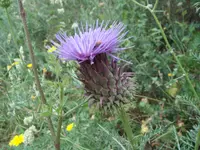
Wild thistle, Cynara humilis, is a perennial thistle from the Mediterranean region, especially North Africa and southern Europe. It belongs to the same group as artichokes and cardoons.
The plant forms robust clumps with deeply divided, spiny leaves and stout flower stems. Showy purple flower heads attract pollinators and add strong structure to dry landscapes.
Cynara humilis is adapted to sunny, open habitats with poor, well-drained soils and seasonal drought. Its tough foliage and deep roots make it relatively undemanding once established.
Understanding how to care for wild thistle mainly involves providing strong light, avoiding heavy, waterlogged soils, and allowing relatively dry conditions between waterings.

Care Difficulty
Moderate Care

Light Preference
Full Sun

Water Requirements
Low Water

Temperature Preference
Warm Climate

Hardiness Zone
8–10

Soil Texture
Sandy, Loamy, Rocky

Soil pH
Slightly acidic (6.5–7.0), Slightly alkaline (7.0–7.5)

Soil Drainage
Well-drained

Fertilization
Minimal (feed rarely)
Scan your plant to receive care tips personalized for your specific plant
Available on iOS and Android
Cynara humilis thrives in bright, open sites with strong sun exposure.
Cynara humilis prefers deep, infrequent watering once established in the ground.
This Mediterranean thistle handles heat well but dislikes prolonged hard frost.
This Mediterranean thistle tolerates a wide humidity range and rarely needs special humidity management indoors or outdoors.
Cynara humilis prefers mineral, sharply drained soil that prevents waterlogging yet still anchors its deep root system.
This species can be grown in containers, but only in large, stable pots that mimic its deep, free-draining native soils.
Cynara humilis benefits from light feeding but performs well in moderately fertile soil, similar to many wild thistle species.
Pruning Cynara humilis is mainly done to keep plants tidy and to support strong flowering.
This species is usually grown in the ground, so focus on careful transplanting rather than frequent repotting.
Propagation of Cynara humilis is usually done from seed, with division used where clumps are well established.
Cynara humilis is moderately hardy but benefits from simple winter protection in colder regions.

Plant Health Check
Not sure what's wrong with your plant? Check your plant's health inside the app.
The fleshy flower bases and young receptacles of Cynara humilis are locally eaten in parts of the western Mediterranean, similar to small artichokes but less commonly cultivated and mostly gathered from the wild.
Dried flower buds of Cynara humilis contain aspartic proteases that can coagulate milk, and they are traditionally used in some regions to make vegetarian rennet for artisanal sheep and goat cheeses.
This species is native to dry, rocky habitats in the western Mediterranean, where its deep root system and tough, spiny leaves help it survive long summer droughts and nutrient-poor soils.

In some traditional cheesemaking areas of Portugal and Spain, Cynara humilis is cultivated or protected near grazing lands specifically as a plant-based rennet source, giving local ewe and goat cheeses a distinctive texture and mild, slightly herbal flavor profile compared with cheeses made using animal rennet.
Many parts are edible when harvested young. Traditionally, flower stalks, leaf midribs, and immature flower heads are eaten cooked. Always remove sharp spines, and avoid roadside or contaminated sites where heavy metals or pesticides may accumulate.
Keep your plants happy and healthy with plant identification, disease detection, and easy care guidance.