Offset management
Gently remove and replant offsets once they have at least 5–6 mature leaves and visible roots, which prevents crowding in the mother rosette and keeps air moving between plants to reduce rot risk.

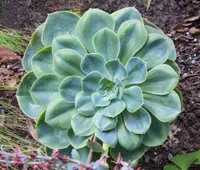
Blue echeveria (Echeveria secunda) is a compact, rosette-forming succulent prized for its symmetrical shape and cool blue to blue-green leaves. The foliage often has a powdery coating that helps reduce water loss and gives the plant a soft, matte look.
This species comes from dry, rocky regions of Mexico, so it is adapted to strong light, brief rain, and well-drained soils. These traits make it relatively forgiving and suitable for containers, rock gardens, and indoor windowsills.
For those learning how to care for blue echeveria, its main needs are bright light, infrequent but thorough watering, and a gritty, fast-draining potting mix.

Care Difficulty
Easy Care

Light Preference
Full Sun

Water Requirements
Low Water

Temperature Preference
Tropical / Frost Sensitive

Hardiness Zone
9–11

Soil Texture
Sandy, Loamy, Rocky

Soil pH
Slightly acidic (6.5–7.0), Neutral (7.0)

Soil Drainage
Well-drained

Fertilization
Minimal (feed rarely)
Scan your plant to receive care tips personalized for your specific plant
Available on iOS and Android
This compact rosette succulent thrives in bright, mostly direct sun with some protection from harsh extremes.
This drought-tolerant succulent prefers deep, infrequent watering and very fast-draining soil.
This species prefers warm, dry conditions and dislikes prolonged cold or excessive humidity.
This species prefers dry household air and does best at 30–50% humidity.
Echeveria secunda needs a very fast-draining, mineral-rich substrate to prevent root and stem rot.
This succulent is very suitable for container growing, both outdoors in mild climates and indoors in bright light.
This succulent has modest nutrient needs but responds well to light feeding during active growth.
Pruning Echeveria secunda focuses on cleanliness and rosette quality rather than size control.
Repotting is mainly needed when the plant outgrows its container or soil degrades.
This species is commonly propagated to create new plants and refresh aging rosettes.
Winter care is essential in cold climates, as this succulent is not reliably hardy below freezing.

Plant Health Check
Not sure what's wrong with your plant? Check your plant's health inside the app.
This species is native to high-altitude regions of central Mexico, where it grows on rocky slopes and open, well-drained sites exposed to strong sun and large temperature swings between day and night.
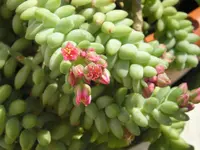
Unlike many solitary echeverias, it offsets freely from the base and can form dense, rounded colonies of many small rosettes that stabilize shallow, stony soils in its native habitat.
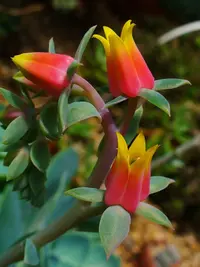
Its arching flower stalks carry red to coral tubular flowers with yellow interiors, a color and shape combination that is strongly associated with hummingbird pollination in its native range.

This species was one of the early echeverias formally described from Mexico in the 19th century, and its compact, uniform rosettes made it a model plant in early succulent collections that helped popularize the entire genus in European horticulture.
Leggy growth usually indicates insufficient light. The rosette stretches toward the brightest source, leaving gaps between leaves. Rotate the pot regularly and move it to a brighter location to encourage compact, symmetrical growth when caring for blue echeveria.
Keep your plants happy and healthy with plant identification, disease detection, and easy care guidance.