Red Abyssinian Banana Care (Ensete ventricosum 'Maurelii')

Also known as: Abyssinian Banana, False Banana, Wild Banana
Red Abyssinian Banana

About Red Abyssinian Banana

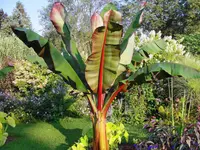
Red Abyssinian banana, Ensete ventricosum 'Maurelii', is a fast-growing tropical ornamental grown for its large paddle-shaped leaves flushed with deep red and bronze tones. It forms a dramatic, upright clump rather than producing edible bananas.

This species is native to highland regions of East Africa, where it grows in warm, moist conditions with rich, well-drained soil. In temperate climates it is usually grown outdoors in summer or as a large container specimen.

Its strong growth, large size, and need for consistent warmth and moisture make it impressive but slightly more demanding than many common houseplants. Understanding how to care for Red Abyssinian Banana helps keep foliage lush and avoid stress in cooler or drier homes.

Main Plant Requirements

Care Difficulty

Moderate Care

Light Preference

Full Sun

Water Requirements

Keep Soil Moist

Temperature Preference

Tropical / Frost Sensitive

Hardiness Zone

10–11

Soil Texture

Loamy, Silty, Organic-rich

Soil pH

Acidic (5.5–6.5), Slightly acidic (6.5–7.0)

Soil Drainage

Moist but well-drained

Fertilization

Heavy (weekly, diluted)

Get Personalized Care Plan

Scan your plant to receive care tips personalized for your specific plant

Available on iOS and Android

How to Care for the Red Abyssinian Banana

This plant develops its best color and growth in strong, consistent light.

  • Provide 6–8 hours of direct sun daily outdoors, ideally with morning sun and light afternoon shade to protect leaves.
  • In hotter regions, give filtered or dappled light after 1–2 pm to prevent leaf scorch on Red Abyssinian Banana.
  • In fall and winter, accept 4–6 hours of weaker sun, but avoid deep shade, which leads to pale, stretched foliage and slower growth.

This plant prefers steadily moist but not waterlogged soil during the growing season.

  • Water when the top 3–5 cm of soil feels dry, soaking the root zone and allowing excess to drain away fully.
  • In summer, check moisture every 1–2 days; in cooler months, allow the top layer to dry more and reduce frequency as growth slows in Ensete ventricosum 'Maurelii'.
  • Watch for drooping, dry-edged leaves as a sign of underwatering, and yellowing lower leaves or a sour soil smell as possible overwatering indicators.

This tropical species grows best in consistently warm, frost-free conditions.

  • Aim for 70–85°F (21–29°C) for active growth, with good airflow to prevent heat stress and fungal issues.
  • Protect the plant whenever temperatures approach 40°F (4°C), since tissue damage can occur and prolonged exposure below 32°F (0°C) is often fatal.
  • In very hot spells above 95°F (35°C), increase shade and soil moisture, and avoid strong, drying winds that can tear and scorch leaves.

This species prefers moderate humidity but usually adapts to typical indoor levels if other care is stable.

  • Aim for 40–60% humidity; brief drops lower are tolerated if watering and light are appropriate.
  • Dry air may cause browning or crisp leaf edges and slower growth, especially near heating or cooling vents.
  • Increase humidity by grouping plants, using a pebble tray with water below the pot base, or running a nearby humidifier.

Ensete ventricosum 'Maurelii' grows best in deep, moisture-retentive yet fast-draining soil rich in organic matter.

  • Use a loamy mix of roughly 50% high-organic potting soil, 30% compost, and 20% drainage material such as perlite or coarse sand.
  • Aim for slightly acidic to neutral pH, around 6.0–7.0, which supports nutrient uptake and root health.
  • Improve aeration by incorporating chunky materials like bark chips or coarse perlite to prevent compaction around the thick roots.
  • Avoid heavy clay, constantly wet substrates, or poorly drained areas, which encourage root rot and pseudostem collapse.

This species is suitable for container growing when the pot is chosen to support its fast growth and heavy top.

  • Select a wide, deep container to allow the thick, fleshy roots to anchor and support the tall pseudostem.
  • Choose a heavy or weighted pot, such as ceramic or stone, to reduce tipping risk in wind or on balconies.
  • Raise the container slightly on pot feet so excess water clears quickly and drainage holes do not stay blocked by the ground surface.

Ensete ventricosum 'Maurelii' responds well to consistent feeding during its warm growing season.

  • Use a balanced liquid fertilizer (around 10-10-10 or 20-20-20) at 1/2 strength every 2 weeks in spring–summer.
  • Apply a slow-release fertilizer or rich compost on the soil surface at the start of the growing season.
  • Pause or reduce feeding to once every 6–8 weeks at 1/4 strength in fall–winter when growth slows.
  • When caring for Red Abyssinian Banana, always water before applying fertilizer to reduce root burn risk.

Pruning Ensete ventricosum 'Maurelii' focuses on removing damaged tissue rather than reshaping the plant.

  • Best time is late spring through summer, when the plant is actively growing and heals fastest.
  • Use clean, sharp pruners or a knife to remove dead, yellowing, or torn leaves close to the pseudostem.
  • Cut away any diseased or rotting tissue promptly to maintain strong growth and reduce infection spread.
  • Limit pruning to problem leaves; heavy cutting distorts the natural architectural form.

Container-grown plants benefit from thoughtful transplanting as they rapidly outgrow small spaces.

  • Check for roots circling the pot, pushing from drainage holes, or stalled growth as signs to transplant.
  • Plan to move Ensete ventricosum 'Maurelii' to a 1–2 in wider container or into the ground in late spring.
  • Transplant every 1–2 years into a free-draining, rich mix, keeping the root ball at the same depth.
  • Water thoroughly before and after moving, keep shaded for a few days, and avoid root disturbance to reduce stress.

Ensete ventricosum 'Maurelii' is usually propagated by seed and is not a quick home propagation project.

  • Sow fresh seeds in late winter–spring in a warm medium kept around 75–80°F for steady germination.
  • Scarify tough seed coats lightly and soak seeds 24 hours to improve water uptake.
  • Use a sterile, well-drained mix, keep evenly moist, and provide bright, indirect light for seedlings.
  • Division is rarely possible since this species seldom produces viable offsets under home conditions.

This plant is frost-tender and needs active winter protection in most temperate climates.

  • Avoid exposure below about 30°F; freezing can kill the pseudostem and damage roots.
  • In-ground plants in mild climates benefit from 7–10 cm of dry mulch over the root zone.
  • In colder areas, lift the plant, trim leaves, and store the corm in a cool, frost-free, slightly dry place.
  • Move container plants indoors to a bright, cool room and reduce watering to keep soil just barely moist.

Care Tips

Wind and weight support

Stake young plants with a sturdy bamboo cane or metal stake set just outside the root zone, then secure the pseudostem with soft ties in a loose figure-eight to prevent wind rock and snapping leaves as the canopy enlarges.

Mulch for root stability

Apply a 5–8 cm layer of coarse organic mulch around, but not touching, the pseudostem to buffer soil temperature, reduce moisture swings, and protect surface feeder roots that drive rapid leaf production.

Seasonal root pruning

In colder regions, root-prune in late summer by slicing a spade vertically in a circle 20–30 cm from the stem to create a compact root ball that is easier to lift and overwinter in a frost-free space.

Overwinter crown protection

For in-ground plants kept outside, cut back tattered leaves in late fall and build a breathable collar of wire mesh filled with dry straw or leaves around the pseudostem to insulate the growing point during brief cold spells.

Salt and chlorine avoidance

Use collected rainwater or dechlorinated tap water where possible, as this species is sensitive to chronic salt and chlorine buildup that can cause marginal leaf burn when caring for Red Abyssinian Banana.

Common Pests and Diseases

Banana weevil

This pest bores into the pseudostem and corm, causing tunneling that weakens the plant and can lead to wilting or snapping of the stem. Symptoms include yellowing, stunted growth, and internal galleries when the stem base is cut open.

Solution

Remove and destroy heavily infested plants and any old, rotting corm material that can harbor adults and larvae. Use clean, disease-free planting material, avoid leaving cut stem pieces on the ground, set simple pitfall or pseudostem traps to monitor and reduce adults, and in outdoor plantings consider soil-applied biological controls containing entomopathogenic nematodes according to label directions.

Panama disease

This disease is a soil-borne Fusarium wilt that blocks water transport in the plant, leading to one-sided yellowing, wilting, and eventual collapse of leaves. Symptoms include brown streaking in the vascular tissue when the pseudostem or corm is cut lengthwise.

Solution

Remove and destroy infected plants including as much of the corm and surrounding roots as possible, and do not replant banana relatives in the same soil. Disinfect tools and footwear, improve drainage, and source clean planting stock; container-grown plants are best kept in fresh, sterile potting mix to lower risk of infection.

Banana bunchy top

This disease is a viral infection that causes severe stunting, narrow upright leaves, and dark green streaks along leaf veins and petioles, giving the plant a bunchy appearance at the top. Symptoms include distorted young leaves that fail to unfurl properly.

Solution

Immediately remove and destroy symptomatic plants to prevent spread and do not share offshoots or divisions from suspect material. Control aphid vectors with regular inspection, washing foliage with water to dislodge insects, and, if needed, applying horticultural soap or oil, and always obtain new plants from certified virus-free sources to support Ensete ventricosum 'Maurelii' plant care.

Banana leaf spot (Sigatoka)

This disease causes elongated brown to black leaf spots that may develop yellow halos and slowly merge, reducing the green area of the leaves. Symptoms include premature leaf browning and tattered foliage in stressed plants, especially outdoors in warm, humid climates.

Solution

Remove and discard heavily spotted or dead leaves to reduce spore levels, keeping cuts clean and dry. Improve airflow around the plant, avoid overhead watering, keep foliage dry in the evening, and, for outdoor plants in high-pressure areas, use a registered fungicide labeled for banana leaf spot while rotating active ingredients to slow resistance.

Banana aphids

These insects cluster on young leaves and leaf stalks, sucking sap and causing curling, distortion, and sticky honeydew that can lead to sooty mold. This pest also acts as a vector for banana viruses, including bunchy top disease.

Solution

Rinse colonies off with a firm stream of water, focusing on leaf undersides and tight leaf bases, and repeat as needed. For persistent infestations, treat all infested areas with horticultural soap or neem oil, monitoring new growth regularly and removing heavily infested small leaves if practical to reduce virus transmission risk.

Interesting Facts

Sterile ornamental hybrid

This red form is a horticultural selection of the Ethiopian highland banana Ensete ventricosum and is generally sterile, so it is propagated vegetatively rather than from seed to maintain its distinctive coloration.

Pigment-rich foliage

The deep burgundy to bronze color in the leaves comes from high levels of anthocyanin pigments, which can help protect the foliage from intense light and ultraviolet radiation.

Massive pseudostem structure

Its thick trunk-like structure is actually a pseudostem made from tightly packed leaf bases, enabling the plant to support large leaves and store substantial water and nutrients compared with many other ornamental bananas.

Botan icon

Did you know?

In its wild green form, Ensete ventricosum is an important staple crop in parts of Ethiopia, where the starchy pseudostem and corm are fermented and processed into traditional foods, and the ornamental red cultivar descends from this agriculturally significant species.

FAQs about Red Abyssinian Banana

Brown, crispy edges usually come from low humidity, drying winds, or fertilizer salt buildup. Check for hot, dry air, avoid wind exposure, flush the soil occasionally, and trim only the dead tissue to prevent further tearing.

Grow Healthy Plants with Botan Care

Keep your plants happy and healthy with plant identification, disease detection, and easy care guidance.

Botan plant care app — identify plants on mobile

Explore More Plants