Support Arching Stems
Use low hooks, short stakes, or a shallow wire hoop in the pot to gently lift and guide arching stems so the foliage does not kink, break, or get crushed against tabletops or window frames.

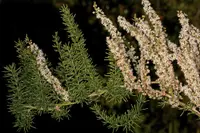
Sprenger's asparagus, Asparagus aethiopicus, is a perennial ornamental plant often grown in pots or hanging baskets for its soft, fern-like foliage. Despite the appearance, it is not a true fern but a member of the asparagus family.
It typically forms dense, arching mounds or trailing stems covered with fine needle-like cladodes, giving a feathery texture. Small white flowers may appear, followed by red berries in mature plants.
This species is native to South Africa, where it grows in relatively warm, bright environments. Its toughness, tolerance of brief neglect, and adaptability to indoor conditions make it popular, though it can be invasive outdoors in mild climates.
Those learning how to care for Sprenger's asparagus should know it prefers bright, indirect light, evenly moist but not soggy soil, and a well-draining potting mix.

Care Difficulty
Easy Care

Light Preference
Partial Shade

Water Requirements
Moderate Water

Temperature Preference
Tropical / Frost Sensitive

Hardiness Zone
9–11

Soil Texture
Sandy, Loamy, Organic-rich

Soil pH
Acidic (5.5–6.5), Slightly acidic (6.5–7.0)

Soil Drainage
Moist but well-drained

Fertilization
Light (every 4–6 weeks)
Scan your plant to receive care tips personalized for your specific plant
Available on iOS and Android
This plant thrives in bright, indirect light with some direct sun at lower intensities.
Asparagus aethiopicus prefers evenly moist but not saturated soil.
This species grows best in mild, frost-free conditions with moderate warmth.
This species manages well in typical indoor humidity but benefits from moderate moisture in the air.
Asparagus aethiopicus prefers a loose, airy mix that drains quickly but retains some moisture.
This species is well suited to container growing due to its fibrous roots and arching stems.
Asparagus aethiopicus responds well to light, consistent feeding during its active growing season.
Pruning Asparagus aethiopicus maintains a dense, tidy form and supports healthy new growth.
This species tolerates crowding but benefits from occasional repotting or transplanting when growth slows.
Asparagus aethiopicus is commonly propagated by division or seeds under warm, bright conditions.
Asparagus aethiopicus dislikes hard frost and needs simple winter protection in cooler climates.

Plant Health Check
Not sure what's wrong with your plant? Check your plant's health inside the app.
Despite the common name Sprenger's asparagus fern, this species is not a true fern but a flowering plant in the asparagus family that reproduces by seeds rather than spores.
Its trailing stems bear small, sharp spines that are partly concealed by dense, feathery cladodes, which are modified leaf-like stems rather than true leaves.
In parts of the southern United States, Australia, and other warm regions, this species has escaped cultivation and is listed as an invasive weed because it forms dense mats that displace native understory plants.

The bright red berries of this species are attractive to birds, which eat the fruits and spread the seeds over long distances, making birds a primary driver of its rapid naturalization outside its native range.
Yellowing is often caused by inconsistent watering, prolonged dryness, or sudden light changes. Check for soggy soil, compacted roots, or low light. Trim the worst fronds and adjust care gradually to stabilize new growth.
Keep your plants happy and healthy with plant identification, disease detection, and easy care guidance.