Control Spreading Rhizomes
Install a 15–20 cm deep root barrier or sink bottomless pots into the ground if you want to limit spreading, since this plant can slowly expand by underground stems and crowd smaller neighbors.

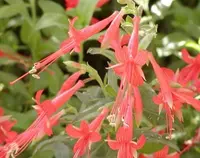
California fuchsia (Epilobium canum) is a low, spreading perennial shrub known for its bright tubular red to orange flowers. It is often used to add late-season color to dry gardens. The plant typically forms dense clumps of wiry stems with narrow, gray-green leaves, giving it a fine-textured, slightly silvery look. Flowers attract hummingbirds and other pollinators. Epilobium canum is native to dry slopes and open areas of California and parts of the western United States. It evolved for hot, sunny, low-water conditions, which makes it well suited to drought-tolerant and low-maintenance landscapes. Light, quick-draining soil and moderate watering help when learning how to care for California fuchsia.

Care Difficulty
Easy Care

Light Preference
Full Sun

Water Requirements
Low Water

Temperature Preference
Cold Hardy

Hardiness Zone
7–10

Soil Texture
Sandy, Loamy, Rocky

Soil pH
Slightly acidic (6.5–7.0), Neutral (7.0)

Soil Drainage
Well-drained

Fertilization
Minimal (feed rarely)
Scan your plant to receive care tips personalized for your specific plant
Available on iOS and Android
This drought-adapted perennial thrives in strong light and is well suited to hot, sunny sites.
This species prefers infrequent, deep watering once established, with time to dry between soakings.
This hardy perennial tolerates a wide temperature range but performs best in mild, dry conditions.
This drought-adapted shrub tolerates low humidity and usually needs no special humidity management.
This species performs best in lean, fast-draining ground that mimics rocky, dry slopes.
This plant can grow successfully in containers if the setup avoids prolonged root wetness.
Epilobium canum is a low-nutrient, drought-adapted perennial that needs only light feeding in most garden soils.
Epilobium canum responds well to light, timely pruning that maintains a compact, floriferous plant.
This species is usually grown in the ground, so focus on careful transplanting rather than frequent repotting.
This plant is commonly propagated by division, semi-ripe cuttings, and sometimes seed to expand drought-tolerant plantings.
This species is generally cold hardy in much of its range and needs minimal winter care in well-drained soil.

Plant Health Check
Not sure what's wrong with your plant? Check your plant's health inside the app.
The bright tubular flowers are morphologically adapted for hummingbird pollination, with nectar held deep in the tube so that visiting birds reliably brush against the anthers and stigma.
This species naturally reduces growth or can go semi-dormant in hot, dry summers, an adaptation to California’s Mediterranean climate that allows it to survive extended drought with minimal water.
In its native habitats, it often appears or becomes more abundant after wildfires, taking advantage of increased light and reduced competition in post-fire landscapes.

Genetic and field studies have shown that populations previously split into several different genera and species (including Zauschneria) were reclassified under Epilobium canum after botanists recognized that the showy, orange-red, “fuchsia-like” plants belonged within the willowherb lineage rather than forming a separate genus.
Lack of flowers usually comes from too much shade, excess watering, or very rich, nitrogen-heavy soil. Old, woody stems also bloom poorly. Provide strong light, avoid overfertilizing, and lightly prune after flowering to encourage next season’s buds.
Keep your plants happy and healthy with plant identification, disease detection, and easy care guidance.