Seedling Containment
Sow seeds in shallow trays or contained beds to keep the plant from scrambling over nearby crops, then transplant or thin seedlings before they develop long, clinging stems.

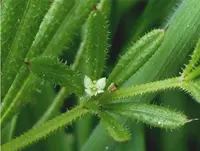
Goosegrass, or Galium aparine, is an annual herb known for its clinging stems and rough, hook-like hairs that stick to clothing, fur, and nearby plants. It forms scrambling mats that can quickly cover surrounding vegetation.
This species is native to Europe and parts of Asia but now grows widely in fields, gardens, and disturbed soils across many temperate regions. It prefers moist, fertile, lightly shaded sites but tolerates a range of conditions, which makes how to care for Goosegrass relatively straightforward where it is allowed to grow.
Its rapid growth and prolific seed production mean it can behave as a weed in garden beds and lawns. Good site awareness is important, as it can compete strongly with young or small plants.

Care Difficulty
Easy Care

Light Preference
Partial Shade

Water Requirements
Moderate Water

Temperature Preference
Cold Hardy

Hardiness Zone
3–9

Soil Texture
Sandy, Loamy, Clay

Soil pH
Acidic (5.5–6.5), Slightly acidic (6.5–7.0)

Soil Drainage
Moist but well-drained

Fertilization
Minimal (feed rarely)
Scan your plant to receive care tips personalized for your specific plant
Available on iOS and Android
This scrambling annual prefers cool, softly lit conditions rather than intense, direct sun.
This species prefers consistently moist soil but does not tolerate waterlogged conditions.
This cool-season annual thrives in mild conditions and declines naturally in heat.
This species is flexible about humidity and usually does not need special moisture control.
This sprawling annual prefers loose, moderately moist soil with plenty of organic matter.
This species can be grown in containers, though it is usually better suited to open ground.
Galium aparine is an annual that grows vigorously in average soils and usually needs minimal feeding.
Pruning Galium aparine is mainly about keeping growth in check and tidying spent plants.
This species is usually managed in the ground, so focus on transplanting rather than container repotting.
Galium aparine is most commonly propagated by seed, as it self-sows freely in suitable conditions.
Goosegrass is a hardy cool-season annual that usually requires no special winter care in most temperate climates.

Plant Health Check
Not sure what's wrong with your plant? Check your plant's health inside the app.
The stems and leaves are covered in tiny backward-facing hooks that latch onto neighboring plants, fences, and animal fur, allowing the weak, scrambling stems to climb without investing in strong supportive tissue.
The dry fruits are covered in hooked bristles that cling to animal fur and clothing, so the species spreads efficiently by hitchhiking on moving hosts rather than relying only on wind or gravity.
This plant commonly thrives in nitrogen-rich, disturbed soils such as field margins, compost heaps, and livestock areas, so its presence often indicates nutrient-enriched ground with high available nitrate.

In arable farming systems of Europe and North America, this species has become one of the most problematic broadleaf weeds in cereal crops because its clinging stems tangle in machinery and its seeds can contaminate harvested grain, leading to strict monitoring and management in integrated weed control programs.
This species spreads very quickly by seed and by its clinging stems that hook onto fur, clothing, and other plants. In gardens it often behaves as a weed and usually needs regular pulling before seed set.
Keep your plants happy and healthy with plant identification, disease detection, and easy care guidance.