BotaN logo

Bigroot geranium Care (Geranium macrorrhizum)

Also known as: cranesbill, Rock Crane's-bill
Bigroot geranium

About Bigroot geranium

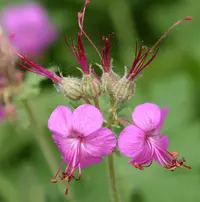
Bigroot geranium (Geranium macrorrhizum) is a hardy, semi-evergreen perennial often used as a groundcover. It forms low, spreading clumps with thick rhizomes and dense foliage.

The leaves are aromatic when rubbed and can show attractive red or bronze tones in cooler weather. In late spring to early summer, it produces clusters of small pink to magenta flowers on short stems.

This species occurs naturally in southeastern Europe, where it grows on rocky slopes and open woodland edges. Its toughness, weed-suppressing habit, and tolerance of a range of soils make it straightforward to care for Bigroot geranium in most gardens.

It generally prefers light shade to sun, moderately moist but well-drained soil, and copes well with urban conditions once established.

Main Plant Requirements

Care Difficulty

Easy Care

Light Preference

Partial Shade

Water Requirements

Moderate Water

Temperature Preference

Cold Hardy

Hardiness Zone

3–8

Soil Texture

Sandy, Loamy, Organic-rich

Soil pH

Acidic (5.5–6.5), Slightly acidic (6.5–7.0)

Soil Drainage

Moist but well-drained

Fertilization

Minimal (feed rarely)

Get Personalized Care Plan

Scan your plant to receive care tips personalized for your specific plant

Available on iOS and Android

How to Care for the Bigroot geranium

This hardy perennial grows best in sites with moderate sun exposure and some daily shade.

  • Provide 4–6 hours of direct sun, ideally morning sun with afternoon shade, to support dense foliage and flowering in Bigroot geranium.
  • Tolerates partial shade, especially under open trees or on the north or east side of buildings, but very deep shade reduces flowers and causes leggy growth.
  • In hot summers, protect from strong afternoon sun to prevent leaf scorch and dry, pale foliage, especially in shallow or fast-draining soils.

This species prefers evenly moist but never waterlogged soil once established in the garden.

  • Water when the top 3–5 cm of soil feels dry, aiming for consistently moist soil during the first growing season while roots spread.
  • Use well-drained soil; persistent sogginess, yellowing leaves, or a musty smell indicate overwatering and risk of root rot, especially in heavy clay.
  • In established Geranium macrorrhizum, reduce watering in cool, rainy seasons and increase during hot, dry spells if leaves wilt or lose turgor by midday.

This groundcover geranium tolerates a wide range of outdoor temperatures in temperate climates.

  • Active growth is strongest in cool to mild conditions around 60–75°F (16–24°C), with best performance in spring and early summer.
  • The plant is cold hardy and can survive down to about -20°F (-29°C) once established, though foliage may die back and re-sprout in spring.
  • Tolerates summer heat up to about 85–90°F (29–32°C) if soil stays slightly moist and the plant receives some afternoon shade to avoid stress.

This species handles a wide humidity range and rarely needs special humidity management outdoors or in typical homes.

  • Target 30–60% humidity; avoid prolonged air below 25% if plants are in warm, sunny, enclosed spots.
  • Leaves curling inward or browning at edges can indicate very dry air combined with heat stress.
  • If air is extremely dry, group pots together or place near other vegetation rather than using misting.

Geranium macrorrhizum prefers loose, well‑drained, moderately fertile soil that does not stay waterlogged.

  • Use a loamy mix with visible structure: 40–50% garden loam or topsoil, 30–40% compost, and 10–20% coarse sand or fine grit for drainage.
  • Aim for slightly acidic to neutral pH, around 6.0–7.2, which supports nutrient availability and root health.
  • Improve aeration in heavy clay by incorporating coarse sand or fine gravel through the top 15–20 cm, not just on the surface.
  • Avoid compacted, sticky, or boggy spots, since constant saturation favors root rot and reduces plant longevity.

This species grows well in containers on patios, balconies, or as a groundcover effect in wide, shallow pots.

  • Choose a broad, low container so the spreading rhizomes can colonize the surface without becoming root‑bound in depth.
  • Select a heavier material like ceramic or clay to counteract top weight and prevent wind from shifting or tipping the pot.
  • Raise the pot on small feet or spacers so drainage holes clear quickly and the base does not sit in standing water.

This groundcover geranium needs modest feeding, especially in poor soils.

  • Apply a light layer of garden compost or well-rotted manure around plants in early spring.
  • In lean soils, use a balanced slow-release fertilizer (around 10-10-10) once at the start of the growing season.
  • If using liquid feed, dilute to half strength and apply no more than every 4–6 weeks in active growth.
  • Stop feeding Bigroot geranium in late summer to avoid soft, frost-prone growth.

Pruning helps Geranium macrorrhizum maintain a dense, tidy mat and encourages fresh foliage.

  • Shear back spent flower stems and scruffy foliage in late spring to early summer after blooming.
  • Remove dead, damaged, or diseased leaves and stems whenever noticed to reduce disease pressure.
  • Thin congested patches lightly to keep airflow and prevent the clump from becoming too dense.
  • Use clean, sharp hand pruners or shears, cutting just above healthy foliage or branching points.

This species is usually grown as a hardy groundcover and benefits more from transplanting than repotting.

  • Plan major moves for early spring or early fall, when soil is moist and temperatures are mild.
  • Lift and divide congested clumps every 3–5 years, replanting vigorous outer sections at the same depth.
  • In containers, repot only if roots circle the pot, growth slows, or soil dries very quickly.
  • Water thoroughly after transplanting, then keep soil evenly moist and shaded for 3–5 days to limit root stress.

Geranium macrorrhizum is commonly propagated by division or short stem sections rather than seed.

  • Divide mature clumps in early spring or early fall, replanting vigorous rhizome pieces with several shoots.
  • For cuttings, take 5–8 cm non-flowering shoots in spring, trim lower leaves, and insert into moist, well-drained mix.
  • Maintain bright, indirect light and lightly moist substrate at 60–70°F to encourage quick rooting.
  • Seed propagation is possible but slow; sow fresh seed in a cool frame and expect variable traits.

This hardy perennial tolerates typical winters in most temperate regions and usually needs minimal winter care.

  • In cold climates, apply a 3–5 cm mulch layer over the root zone after the ground cools but before deep freeze.
  • Leave most foliage over winter to help insulate crowns, cutting back only dead or collapsed stems.
  • Move container-grown plants into a sheltered, unheated space where soil does not freeze solid.

Care Tips

Rhizome Division Timing

Lift and divide the thick rhizomes every 3–5 years in early spring or early fall to keep clumps vigorous and prevent them from becoming woody and sparse in the center.

Living Weed Barrier

Plant in a continuous band around shrubs or along borders, spacing clumps 25–35 cm apart, so the dense, scented foliage suppresses weeds and reduces the need for frequent hand weeding.

Dry-Slope Stabilizer

Use this plant on gentle slopes or banks, setting divisions in a staggered pattern, to create a mat of roots and rhizomes that helps stabilize soil and reduces erosion in dry areas.

Scent-Based Pest Check

Rub a leaf between your fingers during routine garden walks; a weaker scent or limp foliage can signal root stress or vine weevil damage, prompting closer inspection of the root zone.

Winter Leaf Management

In late winter, rake or gently pull away flattened, old foliage to expose the buds and allow new growth to emerge cleanly, which improves air movement and overall vigor when caring for Bigroot geranium.

Common Pests and Diseases

Powdery mildew

This disease appears as a white to gray powdery coating on leaves, often in shaded, crowded plantings. Symptoms include distorted foliage and reduced vigor in humid, stagnant conditions.

Solution

Improve air circulation by thinning or dividing dense clumps and avoid overhead watering. Remove and discard heavily infected leaves, and if needed apply a sulfur or potassium bicarbonate fungicide labeled for ornamental perennials according to the product directions.

Leaf spot

This disease causes small, dark, often circular spots on leaves that may merge into larger blotches, especially during prolonged wet weather. Symptoms include premature yellowing and shedding of older foliage in the center of established clumps.

Solution

Remove and dispose of affected leaves to reduce spore spread and water at soil level to keep foliage dry. If leaf spot recurs, use a copper-based or chlorothalonil fungicide labeled for ornamental plants, applied at the first signs of spotting.

Vine weevil

This pest chews irregular notches in leaf margins, while the larvae feed on roots and rhizomes, potentially causing wilting in containers or newly planted divisions. This issue is more common in shaded, moist sites and in potted plants.

Solution

Hand-pick adult beetles at night from foliage and discard. For larvae, use entomopathogenic nematodes (such as Steinernema species) mixed with water and applied to moist soil in late summer or early fall following label instructions.

Slugs and snails

These pests create ragged holes in leaves, often on young growth at ground level, and leave silvery slime trails. Damage is most noticeable in damp, shaded positions and during mild, wet periods.

Solution

Reduce hiding places by clearing dense debris and mulch close to the crown, and water in the morning so surfaces dry by night. Use iron phosphate slug pellets, beer traps, or barriers such as copper tape around containers to limit feeding.

Rust

This disease produces small orange to brown pustules on the undersides of leaves, sometimes with yellowing on the upper surface. Symptoms include gradual thinning of foliage and reduced flowering in crowded or shaded beds.

Solution

Remove and destroy affected leaves as soon as pustules are noticed and avoid wetting foliage when watering. In persistent cases, apply a systemic rust-effective fungicide labeled for ornamental garden plants and increase spacing or divide clumps to improve airflow.

Interesting Facts

Strong aromatic foliage

The leaves release a strong resinous scent when touched or bruised, produced by essential oil glands on the leaf surface that help deter many herbivores.

Rhizome-based groundcover

This species spreads via thick, branching rhizomes just below the soil surface, forming dense, weed-suppressing mats that stabilize soil on slopes and dry sites.

Cold and drought tolerant

It remains hardy in cold temperate climates and can survive periods of summer drought, thanks to its fleshy rhizomes that store water and nutrients.

Botan icon

Did you know?

In parts of central and southeastern Europe, this species is a characteristic plant of dry, rocky oak and beech woodlands, where its dense rhizome network helps define the structure of the herb layer and supports a distinct community of woodland invertebrates.

FAQs about Bigroot geranium

This species spreads steadily by thick rhizomes, forming dense ground-covering clumps over time. It is usually considered well-behaved, but in rich soil it can edge into nearby spaces, so occasional division or edging keeps it contained.

Grow Healthy Plants with Botan Care

Keep your plants happy and healthy with plant identification, disease detection, and easy care guidance.

Botan plant care app — identify plants on mobile

Explore More Plants