Staking Tall Stems
Install low, unobtrusive stakes or a circular support ring in early summer so the tall, flexible stems stay upright and resist wind damage as the flower heads develop.

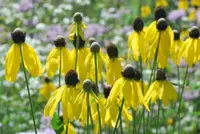
Pinnate prairie coneflower (Ratibida pinnata) is a hardy, long-lived perennial native to North American prairies and open meadows. It forms upright clumps topped with distinctive drooping yellow petals around a tall central cone. The foliage is finely divided and airy, giving the plant a light, graceful look even when not in bloom. Plants often self-seed and slowly spread in suitable conditions.
In the wild, it grows in sunny, well-drained prairie soils that range from moderately dry to seasonally moist. This adaptability, along with strong drought tolerance once established, makes it relatively easy to grow in low-maintenance gardens. Those learning how to care for pinnate prairie coneflower mainly need to provide full sun and avoid consistently wet, poorly drained soil.

Care Difficulty
Easy Care

Light Preference
Full Sun

Water Requirements
Low Water

Temperature Preference
Cold Hardy

Hardiness Zone
3–8

Soil Texture
Sandy, Loamy, Clay

Soil pH
Slightly acidic (6.5–7.0), Slightly alkaline (7.0–7.5)

Soil Drainage
Well-drained

Fertilization
Minimal (feed rarely)
Scan your plant to receive care tips personalized for your specific plant
Available on iOS and Android
This prairie perennial thrives in open, sunny conditions but tolerates some light shade.
This species prefers moderately dry conditions once established and is sensitive to poorly drained soil.
This hardy prairie plant is adapted to continental climates with cold winters and warm summers.
Humidity is not a significant factor for Ratibida pinnata, which thrives in typical outdoor air.
Ratibida pinnata prefers moderately fertile, well-drained soils that do not stay waterlogged.
This species can be grown in containers if the pot is deep and drainage is carefully managed.
This North American prairie perennial adapts to lean soils and usually needs only minimal feeding.
Pruning Ratibida pinnata is mainly used to manage flowering and maintain a tidy clump.
This deep-rooted prairie perennial is best grown in the ground, with transplanting done sparingly.
Ratibida pinnata is most commonly propagated from seeds, with division used for established clumps.
This species is cold hardy across most temperate regions and needs little winter care once established.

Plant Health Check
Not sure what's wrong with your plant? Check your plant's health inside the app.
Its yellow ray florets naturally droop downward as the central cone elongates, which exposes more of the disk florets to pollinators and may help shed rain from the reproductive structures.
Mature plants develop a deep, fibrous root system typical of tallgrass prairie forbs, which helps them access moisture during drought and stabilizes soil against erosion.
This species is strongly associated with tallgrass prairie and prairie-savanna communities in central North America and is commonly used in restoration projects to help re-create native prairie structure and diversity.

Pinnate prairie coneflower often hosts specialist insect herbivores, including certain leaf beetles and caterpillars that preferentially feed on this species, making it a small but important component of native prairie food webs.
Yes, this species is highly attractive to native bees, honeybees, butterflies, and some beetles. Its open, raised cone and accessible pollen make it a valuable nectar and pollen source in prairie-style and pollinator gardens.
Keep your plants happy and healthy with plant identification, disease detection, and easy care guidance.