Bulb Rotation
When shoots first emerge, gently rotate pots 90° every 3–4 days so growth stays upright and even, preventing the stalks from leaning toward a single light source.

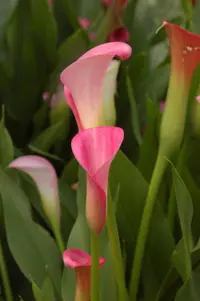
Pink calla lily, Zantedeschia rehmannii, is a compact, tuberous perennial grown mainly for its smooth, funnel-shaped pink spathes and upright foliage. It is often used as a decorative potted plant or seasonal bedding plant rather than a long-term houseplant.
This species comes from southern Africa, where it grows in mild, frost-free conditions with moist but not waterlogged soil. In cultivation it prefers bright, indirect light, evenly moist substrate, and good drainage.
Its tuberous growth habit and short natural rest period mean it can be slightly demanding for beginners, especially when keeping it for several years. Understanding how to care for pink calla lily during and after flowering makes long-term success more likely.

Care Difficulty
Moderate Care

Light Preference
Partial Sun

Water Requirements
Keep Soil Moist

Temperature Preference
Tropical / Frost Sensitive

Hardiness Zone
8–11

Soil Texture
Loamy, Silty, Organic-rich

Soil pH
Acidic (5.5–6.5), Slightly acidic (6.5–7.0)

Soil Drainage
Moist but well-drained

Fertilization
Moderate (every 2–4 weeks)
Scan your plant to receive care tips personalized for your specific plant
Available on iOS and Android
Zantedeschia rehmannii grows best with bright, gentle light that balances flowering and foliage health.
Zantedeschia rehmannii prefers consistently moist, but not waterlogged, soil during active growth.
This plant is a tender perennial that thrives in mild, frost-free conditions.
This species prefers moderate air moisture, but typical home humidity is usually sufficient.
This plant grows best in loose, moisture-retentive but well-draining soil.
This species is well suited to container growing for controlled moisture and display.
Zantedeschia rehmannii responds well to moderate, consistent feeding during active growth for strong foliage and flowering.
Pruning Zantedeschia rehmannii focuses on hygiene and extending bloom performance rather than shaping.
Container-grown plants benefit from periodic repotting to refresh soil and give rhizomes more room.
Division is the most reliable method for increasing plants from Zantedeschia rehmannii rhizomes.
This plant is frost-tender and needs specific winter care, especially in cooler climates.

Plant Health Check
Not sure what's wrong with your plant? Check your plant's health inside the app.
This species is one of the few calla lilies with a naturally soft to deep pink spathe, rather than white or yellow, and the color can intensify in cooler, bright conditions due to higher pigment (anthocyanin) expression.
It is native to summer-rainfall grasslands in South Africa and Swaziland, where it actively grows during the warm, wet season and survives the dry season as a resting underground rhizome.
Compared with many other calla species and hybrids, this plant has noticeably narrower, more grasslike leaves that reflect its adaptation to open grassland habitats with strong light and periodic drying.

In some of its native South African habitats, this species can form loose natural colonies where individual plants resprout year after year from long-lived rhizomes, creating visually striking bands of pink among the surrounding grasses during the summer flowering season.
Lack of flowers usually comes from insufficient light, too much nitrogen fertilizer, or crowded, old rhizomes. Ensure bright, indirect light, use a balanced fertilizer, and divide or repot congested clumps to restore flowering.
Keep your plants happy and healthy with plant identification, disease detection, and easy care guidance.

-1-200x133.webp)