Spring clump division
Every 3–4 years, lift and divide crowded clumps in early spring just as new shoots emerge, replanting outer vigorous sections at the same depth to maintain flowering and reduce disease build‑up.

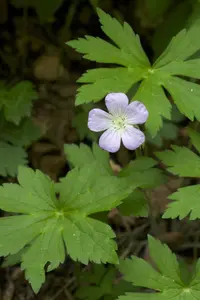
Wild geranium (Geranium maculatum) is a hardy, clump-forming woodland perennial native to eastern North America. It typically grows in loose mounds with deeply lobed leaves and soft pink to lavender spring flowers.
In nature it occurs in open woods, shaded slopes, and forest edges, where it enjoys filtered light and evenly moist, well-drained soil. Its durability, cold tolerance, and modest growth rate make it relatively easy to establish in gardens, and these same traits guide how to care for wild geranium in typical home landscapes.

Care Difficulty
Easy Care

Light Preference
Partial Shade

Water Requirements
Moderate Water

Temperature Preference
Cold Hardy

Hardiness Zone
3–8

Soil Texture
Loamy, Silty, Organic-rich

Soil pH
Acidic (5.5–6.5), Slightly acidic (6.5–7.0)

Soil Drainage
Moist but well-drained

Fertilization
Minimal (feed rarely)
Scan your plant to receive care tips personalized for your specific plant
Available on iOS and Android
Geranium maculatum prefers bright but gentle outdoor light that mimics dappled woodland conditions.
Geranium maculatum prefers consistently moist, but not saturated, soil in the ground.
Stable cool to mild temperatures support strong growth and flowering in this woodland perennial.
This species handles typical indoor humidity well and rarely needs special adjustments.
This woodland perennial prefers moist, loose, and nutrient-rich soil that drains freely.
This species can grow in containers if the potting setup prevents waterlogging and root overheating.
Geranium maculatum benefits from light feeding but performs well in reasonably fertile garden soil.
Geranium maculatum responds well to light, timely pruning that maintains a compact, flowering clump.
This species is most often grown in the ground, so focus on thoughtful transplanting rather than frequent repotting.
Geranium maculatum is commonly propagated by division, with seed and cuttings as secondary options.
This hardy perennial usually needs minimal winter care in most temperate climates.

Plant Health Check
Not sure what's wrong with your plant? Check your plant's health inside the app.
This species is native to eastern North American deciduous forests and is most often found in light-dappled woodland edges, clearings, and along trails where spring light reaches the ground before trees fully leaf out.
Its seeds are distributed by a mechanism called myxospermy, where the seed coat becomes sticky when wet so seeds can adhere to passing animals or soil particles, helping them move short distances from the parent plant.
The species name maculatum refers to the faintly blotched or mottled appearance of the leaves, which often show subtle spots or zoning, especially in younger foliage or plants growing in brighter light.

Early American botanists and herbalists documented this plant extensively in the 18th and 19th centuries, so it appears under several historical common names in botanical literature, including spotted geranium and wild cranesbill, reflecting its long recognition as a characteristic understory wildflower of eastern North American forests.
This species spreads slowly by short rhizomes and self-seeding, forming loose clumps rather than dense mats. It is not usually considered aggressive and is often used as a polite woodland or border companion plant.
Keep your plants happy and healthy with plant identification, disease detection, and easy care guidance.