Rotate For Symmetry
Rotate the pot 90° every 1–2 weeks so new leaves orient evenly to the light, which keeps the plant compact and prevents leaning or lopsided growth when growing Goeppertia sanderiana.

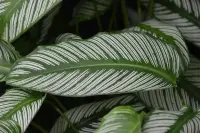
Goeppertia sanderiana, often called the pinstripe plant, is a tropical, evergreen houseplant grown mainly for its patterned foliage. It belongs to the prayer plant group, which gently raises and lowers its leaves between day and night.
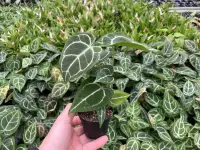
This species has narrow, lance-shaped leaves with dark green surfaces marked by fine pink or white lines and deep purple undersides. It naturally occurs in warm, shaded understories of tropical South America.
The plant can be moderately demanding, as it reacts quickly to dry air, irregular watering, and strong direct sun. Those learning how to care for Goeppertia sanderiana should aim for bright, filtered light, evenly moist soil, and stable warmth with no drafts.

Care Difficulty
Hard Care

Light Preference
Bright Indirect Light

Water Requirements
Keep Soil Moist

Temperature Preference
Tropical / Frost Sensitive

Hardiness Zone
11–12

Soil Texture
Loamy, Organic-rich

Soil pH
Acidic (5.5–6.5), Slightly acidic (6.5–7.0)

Soil Drainage
Moist but well-drained

Fertilization
Moderate (every 2–4 weeks)
Scan your plant to receive care tips personalized for your specific plant
Available on iOS and Android
This species prefers bright, filtered light that mimics the dappled shade of a forest understory.
Watering should keep the root zone consistently moist but never saturated.
Stable, warm temperatures support healthy foliage and root activity for this tropical species.
This species needs elevated humidity to maintain healthy foliage.
Goeppertia sanderiana prefers a loose, airy, organic-rich substrate that drains freely but does not dry out too fast.
This species is well suited to container growing due to its compact, clumping root system.
Consistent, light feeding supports steady foliage growth for Goeppertia sanderiana without overwhelming its roots.
Pruning is mainly cosmetic and health-focused for Goeppertia sanderiana rather than for size control.
Container-grown plants appreciate gentle, infrequent repotting to refresh substrate and give roots space.
New plants are usually produced by division rather than by seed or stem cuttings for this species.
This tropical species needs warm, frost-free conditions and must not be exposed to freezing temperatures.

Plant Health Check
Not sure what's wrong with your plant? Check your plant's health inside the app.
This species is recognized by its narrow, elliptic leaves with distinct light green to pinkish stripes that run almost parallel to the midrib, unlike the broader, more blotched patterns of many related prayer plants.
Like other members of Marantaceae, it performs nyctinasty, a daily leaf movement controlled by a pulvinus joint at the base of the leaf, but in this species the slender leaves fold quite upright at night, creating a more columnar appearance.
Originally described in the genus Calathea, this species was moved to Goeppertia after molecular phylogenetic studies showed that the former Calathea group contained several distinct evolutionary lineages.
This species performs best indoors in stable, warm, humid conditions with filtered light. Outdoors it only suits frost-free, tropical or subtropical climates, in shaded, sheltered spots. For most households, Goeppertia sanderiana indoor care offers the most reliable results.
Keep your plants happy and healthy with plant identification, disease detection, and easy care guidance.