BotaN logo

shrubby St. Johnswort Care (Hypericum prolificum)

shrubby St. Johnswort

About shrubby St. Johnswort

Shrubby St. Johnswort (Hypericum prolificum) is a compact, deciduous shrub valued for its bright summer flowers and tidy structure. It typically forms a rounded mound with many upright stems and fine-textured foliage.

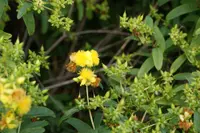
In summer it carries clusters of golden yellow, star-shaped flowers with prominent stamens, followed by small seed capsules. The plant is native to central and eastern North America, often found on rocky slopes, open woods, and stream banks.

It is generally easy to grow, tolerating a range of soils, drought once established, and urban conditions. Good light and well-drained soil are the main things to focus on when learning how to care for shrubby St. Johnswort.

Main Plant Requirements

Care Difficulty

Easy Care

Light Preference

Full Sun

Water Requirements

Low Water

Temperature Preference

Cold Hardy

Hardiness Zone

4–8

Soil Texture

Sandy, Loamy, Clay

Soil pH

Acidic (5.5–6.5), Slightly acidic (6.5–7.0)

Soil Drainage

Well-drained

Fertilization

Minimal (feed rarely)

Get Personalized Care Plan

Scan your plant to receive care tips personalized for your specific plant

Available on iOS and Android

How to Care for the shrubby St. Johnswort

Hypericum prolificum flowers best in consistent sun but tolerates some shade.

  • Provide 6–8 hours of direct sun daily; morning sun with light afternoon shade is ideal in hot summers.
  • Plant in an open site; light or dappled shade is acceptable, but dense shade reduces flowering and causes lanky growth.
  • In southern climates, protect from harsh late-afternoon sun to limit leaf scorch, while in cooler regions full sun all day supports compact, floriferous shrubby St. Johnswort.

This species prefers moderately moist, well-drained soil and is quite drought tolerant once established.

  • Allow the top 3–5 cm of soil to dry between waterings; the plant should not sit in soggy ground.
  • In the first growing season, water deeply when foliage starts to lose firmness or curl slightly; reduce frequency in cool or rainy periods.
  • Watch for yellowing, soft leaves as a sign of overwatering and crisp, browning leaf edges as an indicator that Hypericum prolificum is staying too dry.

This hardy shrub tolerates a wide temperature range typical of many temperate climates.

  • Active growth and flowering are strongest around 65–80°F (18–27°C) during late spring and summer.
  • Established plants typically survive down to about -20°F (-29°C), with top growth dying back but roots overwintering in colder areas.
  • Heat tolerance is good up to about 90–95°F (32–35°C) if soil is not waterlogged, but extended extreme heat or sudden hard frosts can damage new shoots.

Hypericum prolificum tolerates a wide humidity range and usually needs no special humidity management outdoors.

Hypericum prolificum prefers freely draining, moderately fertile soil that does not stay waterlogged.

  • Use a loamy or sandy soil with some organic matter so roots get both moisture and air space.
  • Aim for slightly acidic to neutral pH, roughly 6.0–7.5, which suits nutrient uptake for this shrub.
  • Mix in coarse sand or fine gravel in heavier soils to improve drainage and reduce root rot risk.
  • Avoid compacted clay or spots where water pools after rain, as persistent saturation stresses the plant.

This species can be grown in containers outdoors if the pot supports its shrubby, spreading habit.

  • Choose a wide, relatively deep container to accommodate its fibrous root system and maintain stability in wind.
  • Use a heavier material like ceramic or thick-walled plastic to prevent tipping as the shrub becomes top-heavy with growth and flowers.
  • Elevate the pot slightly on feet or bricks so drainage holes stay clear and excess water escapes quickly after rain or watering.

Hypericum prolificum is a tough native shrub that needs only modest feeding in most garden soils.

  • Apply a light layer of compost or well-rotted manure around the root zone once in spring if growth seems weak.
  • In lean or sandy soils, use a balanced slow-release fertilizer (such as 10-10-10) at label rates in early spring.
  • Avoid midsummer and late-fall feeding so new growth can harden before winter dormancy.
  • On young or container plants, use liquid balanced NPK at half strength every 4–6 weeks during the growing season.

Hypericum prolificum responds well to thoughtful pruning that maintains shape and flowering wood.

  • Use clean bypass pruners to remove dead, diseased, or storm-damaged stems at any time.
  • In late winter or very early spring, thin out the oldest, most crowded stems at the base to improve air flow.
  • Lightly shorten long or floppy shoots to keep a compact, rounded shrub and encourage new flowering growth.
  • After flowering, remove spent tips only if a neater outline is desired, avoiding heavy cuts into very old wood.

This shrub is most often grown in the ground, so care focuses on transplanting rather than frequent repotting.

  • Transplant shrubby St. Johnswort in early spring or early fall when temperatures are mild and soil is workable.
  • Move plants only every several years, when overcrowded, poorly placed, or showing decline despite good care.
  • Dig a wide root ball, keep roots shaded and moist, and replant at the same depth into a well-drained site.
  • Water deeply after transplanting and for the next 2–3 weeks to limit transplant shock and support new root growth.

Hypericum prolificum can be propagated by cuttings, seeds, or division, depending on the grower’s needs.

  • Take semi-ripe stem cuttings in mid to late summer, 10–15 cm long, and root in a sterile, moist, well-drained mix.
  • Provide bright shade, high humidity, and steady warmth around 68–75°F to support rooting of cuttings.
  • Sow fresh seeds in fall outdoors or use cold stratification, then germinate in lightly covered, moist seed mix.
  • Divide small, established clumps in early spring, replanting divisions promptly and watering well to settle soil.

Hypericum prolificum is cold hardy in much of the US and usually needs minimal winter care.

  • In zones near its hardiness limit, apply a 5–8 cm layer of mulch around the root zone after the ground cools.
  • Leave stems standing over winter in colder areas to help insulate the crown, cutting back in late winter if desired.
  • For container plants, move pots into a sheltered, unheated garage or against a protected wall to prevent root freeze.

Care Tips

Renewal thinning

Every 3–4 years, remove 1–3 of the oldest stems right at ground level in late winter to keep the shrub dense, encourage fresh flowering wood, and prevent the center from becoming woody and bare.

Seedhead management

If self-seeding is a problem, shear off the spent flower clusters before the seed capsules fully dry, leaving the foliage intact so the plant can keep photosynthesizing and storing energy.

Salt and road buffer

In regions where winter road salt is used, plant at least 90–120 cm back from driveways or roads and add a low edging or mulch berm to reduce salt splash on foliage and roots.

Drought hardening

In the second and third growing seasons, gradually extend the interval between deep waterings in late spring to train roots to explore deeper soil layers and improve long-term drought resilience.

Wildlife browsing control

In areas with heavy deer or rabbit pressure, use a 60–90 cm-tall wire mesh cylinder around young plants for the first 2–3 years so that caring for shrubby St. Johnswort does not involve repeated regrowth from severe browsing.

Common Pests and Diseases

Leaf spot

This disease causes small brown to black lesions on leaves that may merge into larger blotches and lead to premature leaf drop in wet weather.

Solution

Remove and discard affected leaves to reduce inoculum, avoid overhead watering, and ensure good air circulation around the shrub; in persistent, severe cases, apply a copper-based or chlorothalonil fungicide labeled for ornamental shrubs during prolonged wet periods.

Rust

This disease produces orange to brown powdery pustules on the undersides of leaves, sometimes with yellowing on the upper surface.

Solution

Prune out heavily affected shoots, collect and dispose of fallen leaves, then improve airflow by thinning crowded stems; if needed, use a sulfur or myclobutanil-based fungicide labeled for rust on ornamentals, applied according to label directions during humid weather.

Aphids

These insects cluster on young stems and flower buds, sucking sap and causing leaf curl, distortion, and sticky honeydew that can attract sooty mold.

Solution

Spray stems and undersides of leaves with a firm stream of water to dislodge colonies, then use insecticidal soap or a light horticultural oil, repeating at 5–7 day intervals until populations decline; encourage natural predators such as lady beetles by avoiding broad-spectrum insecticides nearby.

Leaf beetles

This pest chews small holes or notches in leaves, sometimes skeletonizing foliage when populations are high, but typically leaves stems intact.

Solution

Handpick adult beetles and larvae where practical and drop them into soapy water; if damage is significant, use a spinosad or pyrethrin product labeled for ornamental shrubs, applied in late day to limit impact on beneficial insects.

Scale insects

These insects appear as small, fixed bumps on stems or leaf veins and weaken plants by removing sap, sometimes leading to yellowing or dieback of twigs.

Solution

Prune out heavily infested twigs and wipe lighter infestations with a cloth dipped in dilute soapy water; for larger problems, apply horticultural oil during the dormant or early growing season to smother crawlers, and repeat as label directions recommend as part of broader Hypericum prolificum care.

Interesting Facts

Native streambank shrub

This species naturally occurs along streambanks, rocky outcrops, and open woods in the central and eastern US, where it tolerates periodic flooding yet also survives on well-drained, sometimes rocky soils.

Distinctive three-veined leaves

The leaves show a characteristic three-veined pattern, with one main midrib and two strong lateral veins, which helps distinguish it from several other North American Hypericum species.

Summer-long pollinator resource

It produces abundant yellow flowers over an extended summer period, providing nectar and pollen for native bees, small wasps, and some butterfly species during a time when other native shrubs may not be in peak bloom.

Botan icon

Did you know?

Hypericum prolificum often hybridizes in the wild with closely related Hypericum species, and these natural hybrids have contributed to confusion in its taxonomy and identification in parts of its native range.

FAQs about shrubby St. Johnswort

This shrub is moderately fast-growing, usually adding about 15–30 cm per year once established. Growth is quicker in full sun, with evenly moist but well-drained soil, and when mulch and light annual pruning are provided.

Grow Healthy Plants with Botan Care

Keep your plants happy and healthy with plant identification, disease detection, and easy care guidance.

Botan plant care app — identify plants on mobile

Explore More Plants