Deep root training
In the first year, water less often but deeply and gradually widen the dry zone around the plant so roots are encouraged to grow down rather than stay near the surface, which greatly improves drought tolerance and wind stability.

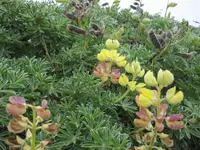
Yellow bush lupine, Lupinus arboreus, is a fast-growing evergreen shrub in the legume family. It forms a rounded, bushy shape with gray-green palmate leaves and tall spikes of soft yellow pea-like flowers.
This species is native to coastal California, where it often grows on dunes and sandy bluffs. It is adapted to poor, dry soils and windy, salty conditions, which makes it relatively easy to grow in similar climates.
A deep root system and drought tolerance are key traits, but it dislikes heavy, waterlogged soil. Understanding how to care for yellow bush lupine starts with providing sun, sharp drainage, and avoiding excessive summer watering.

Care Difficulty
Moderate Care

Light Preference
Full Sun

Water Requirements
Low Water

Temperature Preference
Warm Climate

Hardiness Zone
7–10

Soil Texture
Sandy, Loamy, Rocky

Soil pH
Slightly acidic (6.5–7.0), Neutral (7.0)

Soil Drainage
Well-drained

Fertilization
Minimal (feed rarely)
Scan your plant to receive care tips personalized for your specific plant
Available on iOS and Android
Lupinus arboreus thrives in open, bright locations with strong sun exposure.
Lupinus arboreus prefers deep, infrequent watering once established, with soil allowed to dry between soakings.
This coastal shrub prefers mild conditions but tolerates a fairly wide outdoor temperature range.
Humidity is rarely a concern for Lupinus arboreus, which prefers drier air.
Lupinus arboreus prefers freely draining, relatively poor, sandy soil with plenty of air around the roots.
This species can be grown in containers for a few years, but it is less stable and shorter-lived than in the ground.
Lupinus arboreus generally needs minimal feeding, especially in well-drained, low-nutrient soils.
Pruning Lupinus arboreus focuses on maintaining shape, vigor, and flowering performance.
This deep-rooted shrub is best established young in its final site, as it dislikes major root disturbance.
Lupinus arboreus is most commonly propagated from seeds, with cuttings used less often.
This shrub is moderately hardy but may need some help in colder or wetter winter climates outside its coastal range.

Plant Health Check
Not sure what's wrong with your plant? Check your plant's health inside the app.
This species is naturally adapted to sandy, nutrient-poor coastal dunes of California and Oregon, where its deep root system helps stabilize shifting sands and reduce erosion.
Lupinus arboreus forms nodules on its roots with Rhizobium bacteria, which convert atmospheric nitrogen into forms the plant can use, gradually enriching very poor soils.
When introduced to places like the British Isles and parts of New Zealand, yellow bush lupine has escaped cultivation, spread along coasts, and altered native dune plant communities by changing soil nutrients.

Yellow bush lupine can create a strong fire feedback: it adds biomass and enriches dune soils with nitrogen, which encourages more dense, flammable vegetation, so coastal areas dominated by this shrub may burn more frequently and intensely than they did before its introduction.
Lack of flowers often comes from too much shade, overly rich or wet soil, or young age. This shrub blooms best in lean, well-drained soil, full sun, and usually needs 2–3 years to flower strongly.
Keep your plants happy and healthy with plant identification, disease detection, and easy care guidance.