Use airy mounts
Mount plants on cork or hardwood with a thin pad of sphagnum around the roots to improve air movement and reduce the risk of root rot in warm, bright growing areas.

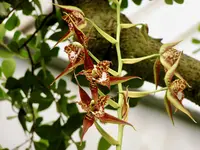
Rhynchostele cordata is an epiphytic orchid, usually found growing on trees in cool, moist cloud forests of Mexico and Central America. It forms compact clumps with pseudobulbs and narrow leaves, producing showy, often fragrant flowers on upright spikes. The blooms typically have patterned segments and a distinct lip, giving the plant high ornamental value for collectors. This species prefers bright but filtered light, high humidity, and good air movement, which can make it more demanding than common houseplants. Understanding how to care for Rhynchostele cordata helps reduce stress on the plant and maintain regular flowering under indoor or greenhouse conditions.

Care Difficulty
Hard Care

Light Preference
Bright Indirect Light

Water Requirements
Keep Soil Moist

Temperature Preference
Tropical / Frost Sensitive

Hardiness Zone
Unknown

Soil Texture
Peaty, Organic-rich

Soil pH
Acidic (5.5–6.5)

Soil Drainage
Moist but well-drained

Fertilization
Moderate (every 2–4 weeks)
Scan your plant to receive care tips personalized for your specific plant
Available on iOS and Android
This cloud-forest orchid prefers bright, gentle light that mimics filtered mountain sun.
This orchid needs consistent moisture around the roots but cannot tolerate waterlogged conditions.
This species prefers cool to intermediate conditions similar to high-elevation forest habitats.
This orchid needs consistently high humidity to thrive and flower well.
This species prefers a very airy, fast-draining orchid substrate rather than compact mineral soil.
This orchid is well suited to container growing when the pot and setup preserve root aeration.
Feeding supports steady growth and flowering for Rhynchostele cordata grown in containers or mounts.
Pruning needs are minimal and focus on keeping Rhynchostele cordata clean and healthy.
Repotting maintains aeration and prevents root decline in this epiphytic orchid.
Propagation of this orchid is usually done by careful division rather than by seed at home.
Cool-sensitive epiphytic orchids like this species need protection from freezing winter conditions.

Plant Health Check
Not sure what's wrong with your plant? Check your plant's health inside the app.
This species is native to cool, misty oak and pine-oak forests of Mexico and Central America, often growing as an epiphyte at higher elevations where nights are regularly cool and light is bright but filtered by forest canopy.
The species name cordata refers to its distinctly heart-shaped labellum (lip), a floral structure that helps guide pollinators toward the reproductive organs of the flower.
Mature plants produce showy, white to creamy flowers with contrasting purple or brown markings and a noticeable fragrance, an adaptation that improves attraction of specific pollinating insects in its native habitat.

This species has historically been placed in several different orchid genera (including Odontoglossum and Lemboglossum) because its floral morphology shows a mix of traits, and modern molecular studies helped confirm its current placement in the genus Rhynchostele.
Lack of flowering is usually caused by insufficient seasonal temperature drop at night, inadequate light intensity, or weak plant vigor. Provide a cool, drier rest after growth, maintain stable conditions, and avoid frequent disturbance or repotting before bloom.
Keep your plants happy and healthy with plant identification, disease detection, and easy care guidance.