Seasonal sowing rotation
Stagger sowing in 1–2 week intervals in late winter and early spring so flowering overlaps and bare patches are reduced as early cohorts finish their life cycle.

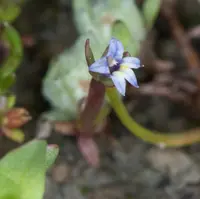
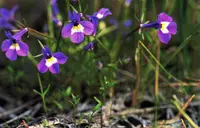
Dwarf calicoflower (Downingia pusilla) is a tiny, annual wildflower in the bellflower family, often forming low, scattered patches. It produces delicate, blue to violet, white-marked flowers held just above the ground, giving a fine, airy look.
This species is native to seasonally wet areas of western North America, especially California, where it grows in vernal pools and moist open ground. It can be challenging to grow because it depends on cool, wet conditions followed by a drying period, and dislikes disturbance. Gardeners who want to care for dwarf calicoflower need to mimic these natural cycles with damp, fine-textured soil and full sun to light shade.

Care Difficulty
Hard Care

Light Preference
Full Sun

Water Requirements
Aquatic

Temperature Preference
Cool Climate

Hardiness Zone
7–10

Soil Texture
Loamy, Silty, Organic-rich

Soil pH
Slightly acidic (6.5–7.0), Neutral (7.0)

Soil Drainage
Waterlogged tolerant

Fertilization
Minimal (feed rarely)
Scan your plant to receive care tips personalized for your specific plant
Available on iOS and Android
This annual prefers bright, open conditions that mimic moist seasonal meadows.
This small annual needs consistently moist soil during active growth and flowering.
This species is adapted to mild, seasonally wet climates with cool to warm temperatures.
Humidity is usually not a critical factor for Downingia pusilla when grown outdoors in its seasonal, moist habitat.
Downingia pusilla prefers moist, fine-textured soils that stay wet in the growing season but do not remain stagnant.
This species can be grown in shallow containers that allow controlled moisture for its seasonal wetland habit.
Downingia pusilla is an annual wildflower that generally requires minimal feeding in ordinary, not-overly-poor soil.
Downingia pusilla benefits from light, simple pruning focused on spent material rather than reshaping.
This species is usually grown as a seasonal bedding or wildflower, so transplanting is more relevant than long-term repotting.
For Downingia pusilla, propagation is typically done by seed rather than vegetative methods.
As a cool-season annual, Downingia pusilla generally needs little winter care in mild climates where it is adapted.

Plant Health Check
Not sure what's wrong with your plant? Check your plant's health inside the app.
This species is a very small, short-lived annual that completes its entire life cycle within a single wet season in temporary pools and vernal wetlands, then survives the dry season only as dormant seed in the soil.
It is closely associated with vernal pools and seasonally flooded depressions in California and parts of the western United States, making it sensitive to hydrology changes and habitat loss from land development and altered drainage.
The flowers have a characteristic bilabiate, or two-lipped, structure where the lower lip is typically more prominent and lobed, a form linked to bee and small insect pollination in the bellflower family Campanulaceae.

Downingia pusilla is considered a vernal pool indicator species in some conservation and botanical surveys, meaning its presence helps specialists identify and classify these highly specialized and increasingly threatened seasonal wetland ecosystems.
This species is typically an annual. It completes its life cycle from seed to flowering and seed set within one growing season, then dies back, relying on a new generation of seedlings each year.
Keep your plants happy and healthy with plant identification, disease detection, and easy care guidance.