Mounting orientation
Mount the plant slightly tilted or upside down so excess water drains quickly from the base, which helps prevent rot in the tight leaf rosette.

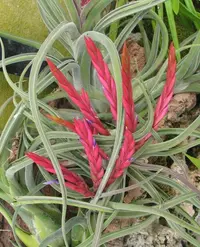
Tillandsia caput-medusae, commonly called Medusa's head, is an epiphytic air plant from dry forests and scrublands of Central America and southern Mexico. It naturally anchors to trees or rocks instead of growing in soil.
The plant forms a bulbous base with twisting, silver-green leaves that resemble the snakes of Medusa in Greek myth. Its leaves are covered in tiny scales that absorb water and nutrients from the air.
It is generally considered easy to grow indoors because it tolerates a range of indoor conditions, provided it gets bright light, regular moisture, and good air movement. Knowing how to care for Medusa's head mainly involves balancing light and watering so the plant can dry between soakings.

Care Difficulty
Moderate Care

Light Preference
Bright Indirect Light

Water Requirements
Low Water

Temperature Preference
Tropical / Frost Sensitive

Hardiness Zone
10–12

Soil Texture
Sandy, Rocky

Soil pH
Acidic (5.5–6.5), Slightly acidic (6.5–7.0)

Soil Drainage
Well-drained

Fertilization
Light (every 4–6 weeks)
Scan your plant to receive care tips personalized for your specific plant
Available on iOS and Android
This air plant prefers bright, indirect light that mimics filtered sun in its native habitat.
This species absorbs water mainly through its leaves and needs thorough but infrequent hydration.
This air plant prefers warm, stable conditions without frost or extreme temperature swings.
This air plant prefers moderate humidity but adapts to typical indoor levels if watering is adjusted.
Tillandsia caput-medusae is an epiphyte that does not grow in traditional potting soil and should stay soil-free.
This species is suitable for containers as a mounted or loose display rather than as a rooted potted plant.
This air plant benefits from light, occasional feeding rather than heavy fertilization.
Pruning needs for Tillandsia caput-medusae are minimal and focus on cleanliness and appearance.
This air plant is usually mounted or placed loosely rather than traditionally potted, so transplanting focuses on repositioning.
Propagation of Tillandsia caput-medusae is most reliable through offsets, known as pups.
This species is not frost tolerant and needs careful winter management in cooler climates.

Plant Health Check
Not sure what's wrong with your plant? Check your plant's health inside the app.
This species forms a distinct swollen base, or pseudobulb, that can trap debris and hold small amounts of water, helping the plant endure irregular rainfall in its native habitats of Mexico and Central America.
Its thick, twisting leaves naturally curl backward as they mature, increasing airflow around the plant surface and reducing the risk of water sitting too long and causing rot in its dense leaf bases.
In the wild, its tubular violet flowers and red to pink bracts are adapted for pollination by hummingbirds, which are attracted by the bright coloration and the flower shape suited to their long beaks and tongues.

This species is often found growing on exposed tree branches and even on cactus spines in seasonally dry forests, reflecting a strong adaptation to intense light, good air movement, and rapidly draining microhabitats in its native range.
This species often needs to reach mature size before flowering, which can take several years. Strong light, good air circulation, and consistent but not excessive watering help trigger blooms. Avoid heavy fertilizer, especially high-nitrogen products.
Keep your plants happy and healthy with plant identification, disease detection, and easy care guidance.