Early staking support
Install slim bamboo stakes or a light tomato cage when plants are 10–15 cm tall so stems grow upright and do not lodge or snap once pods and seed heads add weight.

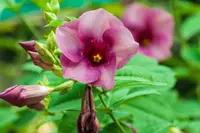
Musk okra, Abelmoschus moschatus, is a warm-season herbaceous plant grown for its fragrant seeds and attractive hibiscus-like flowers. It belongs to the mallow family, like okra and hibiscus.
Plants usually grow as bushy annuals or short-lived perennials, with broad, softly hairy leaves and showy yellow flowers with a dark center, followed by elongated seed pods. In the wild it occurs in tropical and subtropical regions of Asia and northern Australia, often in warm, open habitats.
It is considered fairly easy to grow where summers are warm, as long as it receives plenty of sun, regular moisture, and well-drained soil. Gardeners who understand how to care for musk okra often grow it for both ornamental and aromatic uses.

Care Difficulty
Moderate Care

Light Preference
Full Sun

Water Requirements
Regular Water

Temperature Preference
Tropical / Frost Sensitive

Hardiness Zone
9–11

Soil Texture
Sandy, Loamy, Organic-rich

Soil pH
Acidic (5.5–6.5), Slightly acidic (6.5–7.0)

Soil Drainage
Moist but well-drained

Fertilization
Light (every 4–6 weeks)
Scan your plant to receive care tips personalized for your specific plant
Available on iOS and Android
This species prefers strong light similar to other sun-loving annuals from warm regions.
Abelmoschus moschatus responds best to consistently moist but not saturated soil.
This warm-season plant thrives in stable, moderately hot conditions.
This species prefers moderately humid air but adapts to many home environments if extremes are avoided.
This species grows best in loose, fertile soil that drains freely yet retains some moisture.
This species is suitable for container growing when given enough depth and stable drainage.
This plant responds well to light, consistent feeding during its warm growing season.
Thoughtful pruning keeps Abelmoschus moschatus compact, branching, and floriferous.
This species is usually grown as a bedding or border plant, so transplanting is more common than long-term container culture.
Abelmoschus moschatus is most often propagated from seed for reliable, uniform plants.
This warm-season plant is frost-sensitive and needs protection in regions with cold winters.

Plant Health Check
Not sure what's wrong with your plant? Check your plant's health inside the app.
The mature seeds release a distinct musky, ambrette-like fragrance that has been used as a botanical alternative to animal musk in perfumery and incense.
This species belongs to the mallow family (Malvaceae) and is closely related to edible okra, sharing similar hibiscus-like flowers but being grown mainly for fragrance and ornamental value rather than as a vegetable.
Its seeds typically germinate best in consistently warm conditions, and the plant behaves as a short-lived perennial in frost-free climates but as an annual where winter temperatures drop below freezing.

The seed oil of this species, often called ambrette seed oil, has been highly valued in traditional perfumery because it can fix or stabilize other volatile aromas, helping complex fragrances last longer on the skin.
Flowering can fail if the plant is too shaded, overfertilized with high-nitrogen products, or stressed by irregular moisture. Ensure strong light, moderate feeding with balanced fertilizer, and consistent watering. Avoid pruning off developing flower buds.
Keep your plants happy and healthy with plant identification, disease detection, and easy care guidance.