spiny wattle Care (Acacia spinescens)

spiny wattle

About spiny wattle

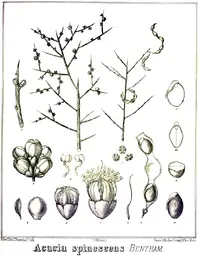
Spiny wattle, Acacia spinescens, is a compact, very thorny shrub native to dry regions of southeastern Australia. It typically forms dense, rounded clumps with rigid, spiny branches. Small, narrow leaf-like structures and yellow, ball-shaped flower clusters give it a fine, textured look when in bloom. In gardens, it is often used as a barrier or habitat plant for wildlife due to its dense, protective growth. This species is adapted to poor, well-drained soils and low to moderate rainfall, which makes it relatively tough once established. Understanding how to care for spiny wattle starts with providing strong light, good drainage, and avoiding long periods of waterlogged soil.

Main Plant Requirements

Care Difficulty

Moderate Care

Light Preference

Full Sun

Water Requirements

Low Water

Temperature Preference

Warm Climate

Hardiness Zone

9–11

Soil Texture

Sandy, Loamy, Rocky

Soil pH

Acidic (5.5–6.5), Slightly acidic (6.5–7.0)

Soil Drainage

Well-drained

Fertilization

Minimal (feed rarely)

Get Personalized Care Plan

Scan your plant to receive care tips personalized for your specific plant

Available on iOS and Android

How to Care for the spiny wattle

This drought-adapted shrub prefers bright, open sites with strong sun exposure.

  • Provide 6–8 hours of direct sun daily; in hotter inland areas, prioritize morning sun with light afternoon shade to reduce leaf scorch risk.
  • Spiny wattle tolerates light or dappled shade for part of the day, but dense shade leads to weak, sparse growth and fewer flowers.
  • Newly planted shrubs benefit from some protection from harsh summer sun for the first 1–2 seasons, then can handle full sun year-round in most climates.

This species is adapted to dry, well-drained conditions and is sensitive to prolonged soil moisture.

  • Allow the top 5–8 cm of soil to dry between waterings; in the ground, rely mostly on rainfall once plants are established.
  • During the first 1–2 growing seasons, water deeply but infrequently, ensuring excess water drains away quickly to prevent root rot.
  • Signs of overwatering include yellowing leaves and dieback from the base; curled, brittle leaves and rapid leaf drop suggest the soil has stayed dry for too long.

This shrub prefers warm, dry climates and copes better with heat than with cold.

  • Aim for active growth in 65–80°F (18–27°C); stable temperatures in this range support root development and flowering.
  • Mature plants tolerate short dips to about 25°F (-4°C), but repeated frosts or colder events can damage young stems and new growth.
  • Spells above 95°F (35°C) are usually tolerated if soil is not waterlogged; in very hot, dry winds, temporary shade and slightly increased watering help limit stress.

This species is naturally adapted to dry air, so humidity is rarely a concern indoors or outdoors.

Acacia spinescens prefers lean, sandy to gravelly soil that drains very quickly.

  • Use a mix of roughly 60–70% coarse sand or fine gravel with 30–40% loam-based potting mix.
  • Maintain slightly acidic to neutral pH, around 6.0–7.2, avoiding strongly acidic or alkaline substrates.
  • Incorporate mineral grit such as pumice or crushed granite to improve aeration and prevent compaction over time.
  • Avoid heavy clay or peat-rich mixes that stay wet, as prolonged saturation promotes root rot and weak growth.

This species can be grown in containers if the pot is configured to keep roots dry and stable.

  • Select a relatively deep, narrow pot that allows a strong taproot to develop without circling tightly near the base.
  • Choose a heavy, stable container material such as ceramic or clay to prevent tipping as woody stems and branches harden.
  • Raise the pot slightly on feet or bricks so drainage holes clear the ground and water evacuates quickly after rain or irrigation.

This tough Australian shrub is adapted to poor soils and usually needs little feeding in gardens.

  • On very lean or sandy sites, apply a light dressing of compost or a low-rate slow-release native shrub fertilizer in early spring.
  • Use a low-phosphorus, balanced NPK product formulated for Australian natives to avoid root damage from excess phosphorus.
  • Feed once per growing season only; heavy or frequent fertilizing can cause weak, rank growth.
  • If grown in containers, use half-strength liquid native fertilizer every 6–8 weeks in spring–summer, then stop feeding in fall–winter.

Pruning Acacia spinescens is mainly done to maintain structure and remove problem wood.

  • Carry out main pruning in late winter to very early spring, before strong new growth starts.
  • Remove dead, damaged, crossing, or inward-growing branches first to improve air flow and plant health.
  • Lightly shorten overly long shoots to maintain a compact, bushy shape without cutting back into very old wood.
  • Use clean, sharp bypass pruners or loppers, making smooth cuts just above a bud or side branch.

This species is usually grown in the ground, so focus on careful transplanting rather than frequent repotting.

  • Transplant young plants in late winter or early spring when soil is moist and temperatures are mild.
  • Look for roots circling the container, poor drainage, or slowed growth as signs a nursery plant needs a larger hole or pot.
  • Move up only 1 pot size or plant into a hole just wider than the root ball, keeping the original soil level unchanged.
  • Handle the root ball gently, loosen only lightly around the edges, water thoroughly after planting, and mulch to reduce stress.

Spiny wattle is most commonly propagated from seed rather than cuttings.

  • Collect mature pods in late summer–fall, then dry and extract viable seeds.
  • Scarify hard seed coats by pouring hot (not boiling) water over seeds and soaking 12–24 hours to improve germination.
  • Sow pretreated seeds in a well-drained, sandy mix, keep lightly moist, and provide bright light with temperatures around 65–75°F.
  • Cuttings are possible but less reliable; use semi-hardwood material, rooting hormone, a free-draining medium, and high humidity.

This shrub is moderately frost tolerant and in mild-winter regions usually needs little specific winter care.

  • In areas with occasional light frost, a 5–8 cm mulch layer helps insulate the root zone without touching the stem.
  • Young or newly planted shrubs benefit from a breathable frost cloth cover during forecast freezes.
  • Container-grown plants in colder climates should be moved to a bright, frost-free, unheated space for the coldest weeks.

Care Tips

Site for air flow

Choose an exposed, airy position so foliage dries quickly after rain, which reduces fungal leaf spots that can occasionally trouble dense thickets.

Encourage bushy habit

Tip‑prune young shoots by 2–3 cm after flowering to encourage a dense, wildlife‑friendly shrub rather than a tall, open plant.

Establish root resilience

During the first 1–2 years, water less frequently but deeply to train roots to grow down, improving drought resilience and anchorage on windy, exposed sites.

Minimal disturbance zone

Avoid digging, cultivating, or heavy foot traffic within the dripline so the shallow feeder roots and nitrogen‑fixing nodules are not damaged.

Fuel‑reduction management

In bushfire‑prone areas, periodically thin out inner dead twigs and litter around the base to reduce fine fuel build‑up while still maintaining the shrub’s natural form when growing spiny wattle.

Common Pests and Diseases

Acacia psyllids

These insects feed on young foliage and shoots, causing cupped, distorted leaves and sticky honeydew that can lead to sooty mold growth.

Solution

Prune out heavily infested shoot tips and dispose of them, then hose down foliage to remove honeydew and insects; for persistent infestations, use a horticultural oil or insecticidal soap directed at the undersides of leaves while avoiding applications in very hot weather.

Galling scale

This pest forms hard, often rounded galls or crusts on stems and branches, which can weaken growth and reduce vigor over time.

Solution

Clip off and destroy small, localized galled twigs, then scrub remaining affected stems with a soft brush and soapy water; if needed, apply a lightweight horticultural oil during the crawler stage, and keep the plant well watered and unstressed to improve natural resistance when growing spiny wattle outdoors.

Armillaria root disease

This disease, caused by Armillaria fungi, leads to gradual decline, sparse foliage, yellowing leaves, and dieback, often in sites with a history of infected woody plants.

Solution

Remove and destroy severely affected plants, including as much of the root system as possible, and avoid replanting susceptible woody species in the same spot; improve drainage, reduce soil compaction, and avoid overwatering to limit fungal spread in nearby plantings.

Phytophthora collar rot

This disease attacks the root crown and lower stem in poorly drained or periodically waterlogged soils, leading to sudden wilting, darkened bark at the base, and plant collapse.

Solution

Improve drainage, raise planting beds, and reduce irrigation frequency, then remove and destroy severely affected plants; for high-value specimens in known Phytophthora areas, consider using resistant rootstocks or planting on mounded, free-draining sites only.

Leaf spot complex

Symptoms include small brown to dark spots on phyllodes and young shoots, sometimes merging into larger blotches that cause premature leaf drop in humid or crowded plantings.

Solution

Remove and discard fallen and heavily spotted foliage, improve air circulation by pruning congested branches, and avoid overhead watering; in regions with frequent outbreaks, a copper-based fungicide can be applied preventively at the start of warm, wet periods.

Interesting Facts

Dense spiny thicket

This species naturally forms compact, intricately branched, spiny shrubs that create dense thickets, providing important shelter for small birds and native mammals in southeastern Australia.

Specialist nitrogen fixer

Like many Australian acacias, it forms symbioses with root bacteria that fix atmospheric nitrogen, but A. spinescens is especially associated with poor, shallow soils where this ability gives it a strong competitive advantage.

Adapted to dry sandstone

In the wild it is strongly tied to dry sandstone or rocky slopes, where its deep root system and small, tough phyllodes help it withstand low nutrient availability and periodic drought.

FAQs about spiny wattle

Poor flowering often results from insufficient light, pruning at the wrong time, or nutrient imbalance, especially excess nitrogen. Check that the plant gets enough sun, avoid heavy pruning after bud formation, and use a low-phosphorus native-formula fertilizer.

Grow Healthy Plants with Botan Care

Keep your plants happy and healthy with plant identification, disease detection, and easy care guidance.

Botan plant care app — identify plants on mobile

Explore More Plants