bidgee-widgee Care (Acaena anserinifolia)

Also known as: Bronze Piri-piri-bur
bidgee-widgee

About bidgee-widgee

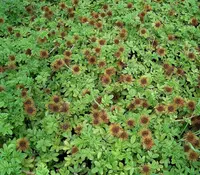
Bidgee-widgee, Acaena anserinifolia, is a low, mat-forming perennial often used as a groundcover. It spreads by creeping stems that root as they touch the soil. The foliage is finely divided and fern-like, creating a dense, textured carpet that can suppress many small weeds.

This species is native to New Zealand and parts of Australia, where it grows in open grasslands and coastal areas. In gardens it is valued for toughness, but the burr-like seed heads can cling to fur and clothing.

Acaena anserinifolia prefers sun to light shade, reasonably well-drained soil, and moderate moisture. Once established, it is fairly resilient, but understanding how to care for bidgee-widgee helps maintain an even, attractive groundcover.

Main Plant Requirements

Care Difficulty

Easy Care

Light Preference

Full Sun

Water Requirements

Moderate Water

Temperature Preference

Cold Hardy

Hardiness Zone

6–9

Soil Texture

Sandy, Loamy, Rocky

Soil pH

Acidic (5.5–6.5), Slightly acidic (6.5–7.0)

Soil Drainage

Well-drained

Fertilization

Minimal (feed rarely)

Get Personalized Care Plan

Scan your plant to receive care tips personalized for your specific plant

Available on iOS and Android

How to Care for the bidgee-widgee

Acaena anserinifolia grows best with bright outdoor light and some protection from harsh sun.

  • Provide 4–6 hours of sun daily, ideally morning sun with light afternoon shade, especially in hotter regions.
  • Tolerates partial shade, but very dense shade leads to thinner foliage and gaps in the mat-like growth of bidgee-widgee.
  • In hot summers, protect from intense afternoon sun to prevent leaf scorch; in cooler climates, slightly more sun improves color and compact growth.

This plant prefers evenly moist but well-drained soil rather than constant saturation.

  • Water when the top 2–3 cm of soil feels dry, aiming for consistently moist soil without puddling or mud.
  • Increase watering during hot, dry periods and reduce in cool, rainy seasons; established groundcover often relies mainly on natural rainfall.
  • Watch foliage for cues: yellowing, soft stems, or a sour soil smell suggest overwatering, while crisp, browning leaf tips and slow recovery after heat indicate underwatering.

This groundcover handles a wide temperature range but grows best in mild conditions.

  • Optimal growth occurs around 55–75°F (13–24°C), with strongest spread in cool to mild spring and fall weather.
  • Tolerates winter cold down to about 0°F (−18°C) once established, though foliage may brown or die back and then regrow from the crown.
  • Handles summer heat up to about 85–90°F (29–32°C) if soil stays slightly moist and the site has some afternoon shade, especially in exposed locations.

This species handles a wide humidity range and rarely needs special humidity management.

  • Target 40–60% humidity, which matches most heated and cooled homes.
  • Tolerates drier indoor air but prolonged very dry conditions may cause browning leaf edges and slower spread in bidgee-widgee.
  • If air is extremely dry, place the container on a pebble tray with water below the pot base to slightly raise local humidity.

Acaena anserinifolia prefers free-draining, moderately fertile soil that does not stay waterlogged.

  • Use a loose, sandy or loamy mix with plenty of grit or coarse sand to keep pore spaces open for root aeration.
  • Aim for slightly acidic to neutral pH, roughly 6.0–7.0, avoiding strongly alkaline substrates that may limit nutrient uptake.
  • Combine garden loam with 20–30% compost and 20–30% sharp sand or fine gravel to balance moisture retention and drainage.
  • Avoid compacted clay, heavy peat-based mixes without grit, or sites where water stands after rain, which encourages root decline.

This low-growing species is well suited to containers and troughs outdoors.

  • Choose a wide, shallow container that allows lateral spread of stems rather than deep root penetration.
  • Select a heavier material such as ceramic or stone to counteract the plant’s spreading habit and reduce tipping in wind.
  • Ensure large, unobstructed drainage holes so water exits rapidly and the mix returns to a slightly dry surface between waterings.

This hardy groundcover needs only modest feeding, as many bidgee-widgee plants thrive in lean soils.

  • Use a light application of balanced granular fertilizer (around 10-10-10) or a thin layer of compost in early spring.
  • Feed once more in mid-summer only if growth appears weak or foliage pale.
  • Apply at half the label rate to avoid soft, floppy growth and salt buildup.
  • Stop fertilizing in late summer so new growth can harden before winter dormancy.

Pruning Acaena anserinifolia is mainly for tidiness and to maintain a dense groundcover mat.

  • Trim back straggly or overlong runners in early spring to keep edges neat and encourage branching.
  • Remove dead, damaged, or diseased foliage whenever seen using clean, sharp handheld shears.
  • After flowering, lightly shear spent burrs if seed spread is not desired.
  • Avoid cutting into very old woody bases; focus on young, leafy sections to promote fresh growth.

This species is usually grown as a groundcover, so focus on careful transplanting rather than frequent repotting.

  • Transplant in early spring or early fall, when temperatures are mild and soil moisture is steady.
  • Move plants when clumps outgrow their space or when container roots circle the pot and growth slows.
  • Lift with a spade, keeping a generous soil ball around the shallow roots to limit shock.
  • Replant at the same depth in well-drained soil, water thoroughly, then shade lightly for a few days until settled.

Acaena anserinifolia is commonly propagated to expand groundcover areas or fill gaps in planting schemes.

  • Divide established clumps in early spring or early fall, ensuring each section has healthy shoots and roots.
  • Use surface runners that have rooted naturally, severing them from the parent and replanting immediately.
  • Sow fresh seed in trays of free-draining mix, kept cool and lightly moist, to support even germination.
  • Provide bright, indirect light and moderate humidity so new divisions or seedlings establish strong root systems.

This plant is generally cold hardy in temperate climates and needs only light winter care in the ground.

  • Tolerates moderate frosts once established, especially in well-drained soil.
  • Apply a 3–5 cm layer of mulch around the root zone in late fall, keeping it off the crowns.
  • In very cold or exposed sites, use a thin mulch of leaves or straw to buffer freeze–thaw cycles.
  • Container-grown plants in colder zones can be overwintered in a sheltered, frost-free but cool spot.

Care Tips

Contain Spreading Edges

Install an underground root barrier 10–15 cm deep or use edging stones to prevent this mat-forming plant from invading adjacent beds or lawns while still allowing it to form a dense groundcover in its designated area.

Weed-Suppressing Establishment

Plant young clumps at close spacing (20–25 cm apart) and lightly mulch only between them so the foliage can quickly knit together into a living mulch that suppresses weeds without smothering new growth.

Protective Foot-Traffic Use

If used between pavers or as a lawn substitute, limit foot traffic to stepping stones and avoid dragging furniture or tools across the foliage to prevent tearing stems and leaving open patches that weeds can colonize.

Burr Management Strategy

In late summer to early autumn, monitor for developing seed burrs and trim or shear flowering stems before burrs harden, especially along paths and pet routes, to reduce seed spread and attachment to fur or clothing when growing bidgee-widgee.

Slope and Erosion Control

On banks and slopes, plant in staggered rows across the contour and water deeply after planting so roots anchor into the soil, helping stabilize loose ground and reduce erosion over time.

Common Pests and Diseases

Aphids

This pest often clusters on young shoots and undersides of leaves, sucking sap and causing distortion and sticky honeydew on foliage. Symptoms include curling tips, reduced vigor, and occasional sooty mold growth on the honeydew surface.

Solution

Rinse foliage and stems with a firm stream of water to dislodge colonies, then spot-treat remaining clusters with insecticidal soap or a ready-to-use neem oil spray, repeating weekly until controlled. Encourage natural predators such as lady beetles by avoiding broad-spectrum insecticides and reducing high-nitrogen fertilization that promotes very soft new growth when growing bidgee-widgee.

Spider mites

These insects thrive in hot, dry weather on dense groundcover mats, causing fine speckling on leaves and a dull, gray-green cast to the foliage, sometimes with fine webbing. Symptoms include slowed growth and a dry, stressed appearance, especially in full-sun sites with reflected heat.

Solution

Increase humidity around the foliage with regular hosing, and thoroughly wash both sides of leaves every few days to break the mite cycle. For persistent infestations, use insecticidal soap or a horticultural oil labeled for mites, applied in the early morning or late afternoon to avoid leaf scorch, and thin overly dense patches to improve airflow.

Leaf spot

This disease shows as small brown, purple, or tan spots on leaves, sometimes with a darker border, which can merge to create larger dead patches in humid or poorly ventilated conditions. Symptoms include thinning foliage and an uneven, patchy look in affected areas of the mat.

Solution

Remove and discard affected leaves and any heavily damaged runners, then reduce overhead watering and avoid wetting foliage late in the day. Improve air circulation by gently thinning crowded areas, and if needed apply a fungicide labeled for ornamental leaf spots as a short-term measure while cultural conditions are corrected.

Crown rot

This disease develops where the base of the plant stays wet and poorly aerated, leading to browning at the crown, sudden collapse of shoots, and dieback of small sections within the mat. Symptoms include a mushy or discolored crown and an irregular pattern of dead patches in heavy or waterlogged soils.

Solution

Improve drainage by amending soil with coarse grit or compost and avoid letting the crown sit in standing water, especially in winter. Remove and discard affected clumps, replant healthy divisions in slightly raised or sloped positions, and reduce irrigation frequency so the topsoil dries lightly between waterings.

Interesting Facts

Hooked burr evolution

The plant produces small spherical burrs covered in stiff hooked spines that readily attach to animal fur, feathers, and clothing, an adaptation that allows its seeds to disperse long distances across open landscapes.

Low alpine specialist

In its native New Zealand, this species is especially common in montane to subalpine grasslands and open shrublands, showing good tolerance to wind, cool temperatures, and high light typical of exposed high-country habitats.

Soil-binding mat growth

Its creeping stems root at the nodes and form a dense, interlocking mat that helps stabilize thin or erodible soils while outcompeting many small weeds at ground level.

Botan icon

Did you know?

In some regions where it has been introduced, such as parts of the British Isles, the clinging burrs of this species have become a nuisance in sheep pastures because they tangle in wool and can reduce fleece quality, which has led to local control efforts despite the plant’s modest size.

FAQs about bidgee-widgee

This species forms a low, creeping mat and spreads by surface runners. In suitable conditions it can cover ground quickly and may edge into nearby beds, so use edging or regular trimming where tight control is needed.

Grow Healthy Plants with Botan Care

Keep your plants happy and healthy with plant identification, disease detection, and easy care guidance.

Botan plant care app — identify plants on mobile

Explore More Plants