Support Upright Stems
Install a low, sturdy stake or wire ring early in the season so the long, pendulous flowering stems stay upright and visible rather than flopping under their own weight or after heavy rain.

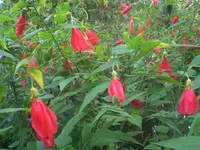
Mazapan, Malvaviscus penduliflorus, is a tropical flowering shrub in the mallow family, related to hibiscus. It is often grown as an ornamental in warm climates and sheltered patios.
Plants form a dense, bushy shape with arching stems and glossy green leaves, highlighted by dangling, partially open red flowers that resemble small lanterns. In mild regions it can bloom for long periods.
Mazapan is native to Mexico and Central America, where it grows in warm, humid habitats with regular moisture. In cultivation it prefers bright light, evenly moist but drained soil, and protection from frost, which influences how to care for mazapan successfully.

Care Difficulty
Moderate Care

Light Preference
Partial Sun

Water Requirements
Regular Water

Temperature Preference
Tropical / Frost Sensitive

Hardiness Zone
9–11

Soil Texture
Sandy, Loamy, Organic-rich

Soil pH
Acidic (5.5–6.5), Slightly acidic (6.5–7.0)

Soil Drainage
Moist but well-drained

Fertilization
Light (every 4–6 weeks)
Scan your plant to receive care tips personalized for your specific plant
Available on iOS and Android
This shrub prefers bright outdoor light and performs best in warm, frost-free regions.
This species prefers evenly moist, well-draining soil rather than extremes of drought or saturation.
This tropical shrub thrives in warm climates and does poorly in cold or frosty conditions.
This species handles a fairly wide humidity range but grows best with moderate ambient moisture.
Malvaviscus penduliflorus prefers a loose, moisture-retentive but free-draining substrate.
This shrub is suitable for container growing when the pot is chosen to support its woody root system and top growth.
Malvaviscus penduliflorus responds well to moderate feeding during its active growing season.
Pruning Malvaviscus penduliflorus helps maintain compact growth and encourages heavier flowering.
This shrub is often grown in the ground, but container plants or young nursery stock benefit from careful transplanting.
Malvaviscus penduliflorus is commonly propagated from semi-hardwood cuttings for reliable clones of favored plants.
This tropical shrub is frost sensitive and needs protection in regions with cold winters.

Plant Health Check
Not sure what's wrong with your plant? Check your plant's health inside the app.
This species produces elongated, drooping red flowers with overlapping petals that never fully open, giving rise to the common name sleeping or Turk’s cap mallow. The persistent tubular shape is highly efficient at presenting nectar to hummingbirds and long-tongued pollinators.
In frost-free climates, this shrub can flower almost year-round, with only brief pauses after pruning or environmental stress. The combination of long blooming and abundant nectar makes it a consistent resource for hummingbirds in gardens and naturalized areas.
Native to coastal and subtropical habitats, this plant shows good tolerance to heat, humidity, and moderate salt spray. These traits make Malvaviscus penduliflorus plant care comparatively forgiving in warm coastal landscapes.

In its native and naturalized range from Mexico through Central America and the Caribbean, this species is frequently used as a living hedge or informal border, where its dense branching and continuous red blooms function both as a privacy screen and as an important corridor for hummingbird movement across urban and rural areas.
Poor flowering usually comes from insufficient light, heavy pruning of new tips, or low nutrients. Ensure strong light, avoid cutting new growth before buds form, and feed moderately with a balanced fertilizer during the growing season.
Keep your plants happy and healthy with plant identification, disease detection, and easy care guidance.