Dimerandra emarginata Care

Dimerandra emarginata

About Dimerandra emarginata

Dimerandra emarginata is a small, epiphytic orchid that often grows on tree branches in warm, humid forests of Central and northern South America and the Caribbean. It usually forms slender, reed-like stems with narrow leaves and produces delicate, colorful flowers along the stems.

This species prefers bright, filtered light, good air movement, and evenly moist but not waterlogged roots. Its relatively compact size and tolerance of warm household conditions make it moderately easy for orchid growers who can provide stable humidity.

Beginners who learn how to care for Dimerandra emarginata often appreciate its regular blooming habit and adaptable growth, provided temperature and moisture remain consistent.

Main Plant Requirements

Care Difficulty

Moderate Care

Light Preference

Partial Shade

Water Requirements

Keep Soil Moist

Temperature Preference

Tropical / Frost Sensitive

Hardiness Zone

11–12

Soil Texture

Sandy, Organic-rich

Soil pH

Acidic (5.5–6.5)

Soil Drainage

Moist but well-drained

Fertilization

Moderate (every 2–4 weeks)

Get Personalized Care Plan

Scan your plant to receive care tips personalized for your specific plant

Available on iOS and Android

How to Care for the Dimerandra emarginata

This small orchid prefers bright, filtered light similar to bright forest edges.

  • Provide 4–6 hours of bright, indirect light daily, such as dappled sun under a shade cloth or tree canopy.
  • Allow gentle morning sun but protect from strong midday and afternoon sun, which can scorch leaves and cause yellow patches.
  • In shadier spots, flowering of Dimerandra emarginata may decrease; increase light gradually in late winter and early spring to support new growth.

This species prefers evenly moist conditions but does not tolerate stagnant, waterlogged roots.

  • Water when the top 1–2 cm of the medium feels just barely dry, using thorough soakings that fully moisten the root zone, then allow excess to drain away.
  • During active growth in spring and summer, expect to water more often, while in cooler or darker months extend the interval slightly as drying slows.
  • Signs of excess water include blackened, mushy roots and yellowing leaves; slight leaf wrinkling and very light pots suggest Dimerandra emarginata is too dry.

This orchid grows best in consistently warm, frost-free conditions.

  • Aim for 70–85°F (21–29°C) by day and 60–70°F (16–21°C) at night for steady growth and flowering.
  • Avoid temperatures below 55°F (13°C); brief drops to 50°F (10°C) may be tolerated but repeated cold stress weakens the plant and can damage new shoots.
  • In hotter weather above 90°F (32°C), increase air movement and humidity and prevent full sun exposure to reduce leaf scorch and heat stress.

This orchid prefers moderately humid air and reacts quickly to dry conditions.

  • Aim for 50–70% humidity, as consistently lower levels slow growth and shorten flower life.
  • Watch for wrinkled pseudobulbs, dull leaves, and stalled new roots as signs humidity is too low for Dimerandra emarginata.
  • Increase humidity with a pebble tray, grouped plants, or a nearby humidifier, but keep leaves well ventilated to prevent fungal issues.

This species prefers a very airy, fast-draining medium similar to other epiphytic orchids.

  • Use a coarse mix of medium bark, perlite, and a little sphagnum moss to balance drainage and moisture retention.
  • Ensure large air spaces in the mix so roots stay oxygenated and do not sit in compacted, soggy material.
  • Keep pH slightly acidic to neutral (pH 5.5–7.0), which supports nutrient uptake and root health in Dimerandra emarginata.
  • Avoid heavy garden soil, fine peat-based potting mixes, or containers without drainage, which cause waterlogging and root rot.

This orchid adapts well to container culture when given a stable, well-drained setup.

  • Choose a relatively narrow but deep pot or orchid basket so the fine roots can anchor while excess water drains freely.
  • Use slotted or mesh-style orchid pots to increase airflow around the roots and prevent stagnant moisture in the medium.
  • If grown tall or top-heavy, place the container in a heavier cachepot or on a stable surface to prevent tipping in strong air movement.

Moderate feeding supports healthy flowering and foliage without overwhelming Dimerandra emarginata.

  • Use a balanced water‑soluble fertilizer (around 20‑20‑20) at 1/4–1/2 strength during active growth.
  • Apply every 2–3 weeks in spring and summer when new roots and leaves are developing.
  • Reduce feeding to monthly or stop entirely in fall and winter when growth slows.
  • Avoid heavy compost or slow‑release pellets that can stay too wet around fine orchid roots.

Light, targeted pruning keeps Dimerandra emarginata tidy and flowering well.

  • Best time is after a flush of flowering, when new growths are starting.
  • Remove dead, damaged, or shriveled canes and spent, dry flower spikes with clean, sharp snips.
  • Leave healthy green canes intact, as they store energy and support future blooms.
  • Disinfect tools with alcohol between plants to limit spread of fungal or bacterial issues.

Occasional repotting prevents root congestion and breakdown of orchid media for this species.

  • Plan to repot every 2–3 years, or when roots circle the pot and mix becomes compacted.
  • Choose late winter to early spring, just before strong growth begins, to reduce stress.
  • Gently loosen roots, trim dead or mushy ones, and place in fresh, free‑draining orchid mix.
  • Water lightly for the first 1–2 weeks and keep in bright, indirect light to aid recovery.

Propagation of Dimerandra emarginata is possible but tends to be slow and best for patient growers.

  • Division is the most practical method; divide only robust clumps with at least 4–5 healthy canes.
  • Carry out division in spring, combining it with repotting to minimize disturbance.
  • Use a sterile knife to separate sections, keeping viable roots and new growth buds attached.
  • Replant divisions in small pots with fresh orchid mix, maintaining high humidity and gentle air movement.

This warm‑growing orchid is frost sensitive and needs protection in regions with cool winters.

  • Keep plants above 55°F, ideally 60–70°F, during winter nights.
  • Move containers indoors or into a heated greenhouse before the first light frost is forecast.
  • Reduce watering slightly in cooler months, allowing the mix to approach dryness between waterings.

Care Tips

Mounting strategy

Use a small cork slab or hardwood branch with a thin pad of long-fiber sphagnum around the roots to mimic its epiphytic habit and improve air movement around the root zone.

Flowering maintenance

After blooms fade, remove only the spent flowers and leave the green cane intact, as it can continue photosynthesis and support the next growth cycle.

Root health checks

Every few months gently lift the moss or potting mix to inspect roots; firm, green or white roots indicate good health, while brown, mushy roots signal the need to improve drainage or reduce moisture.

Light acclimation

If shifting to brighter light, increase exposure over 2–3 weeks by moving the plant closer to the window in small steps to avoid leaf scorch and stress.

Air movement planning

Provide gentle, continuous air circulation with a small fan set on low and not blowing directly at the plant to reduce fungal risk and keep leaf surfaces dry when caring for Dimerandra emarginata.

Common Pests and Diseases

Scale insects

This pest attaches firmly to pseudobulbs and leaf bases, sucking sap and causing yellowing, stunting, and sticky honeydew that encourages sooty mold. Infestations are common in warm, sheltered orchid collections where plants like Dimerandra emarginata are grown mounted or in small pots.

Solution

Physically remove visible scales with a cotton swab dipped in isopropyl alcohol, then wash the plant with lukewarm water and mild soap, rinsing thoroughly. Improve air movement and light, isolate the plant, and repeat alcohol or insecticidal soap spot-treatments weekly until new growth appears clean.

Spider mites

These insects thrive on thin orchid leaves in warm, dry, bright conditions, causing pale stippling, dull foliage, and fine webbing on the undersides of leaves. Symptoms include leaf bronzing and eventual leaf drop if the colony becomes heavy.

Solution

Shower the plant thoroughly, focusing on the undersides of leaves, and wipe foliage with a soft damp cloth to remove mites and webbing. Raise humidity to 50–70%, increase air circulation, and apply insecticidal soap or a horticultural oil labeled for mites every 5–7 days for several cycles to break their life cycle.

Soft rot

This disease, often bacterial (Erwinia spp.), produces rapidly spreading, water-soaked, foul-smelling lesions at the base of pseudobulbs or on leaves. Symptoms include tissue that turns mushy and collapses quickly, especially in hot, stagnant, very wet conditions.

Solution

Immediately cut away all affected tissue with a sterile blade, cutting back into firm, healthy tissue, and discard contaminated parts. Keep the plant drier at the base, improve airflow, avoid water sitting in leaf axils, and treat cut surfaces with a dusting of cinnamon or a labeled bactericide while keeping the plant under bright, indirect light until it recovers.

Leaf spot fungus

This disease causes small yellow or translucent spots on leaves that gradually turn brown or black and sometimes develop a yellow halo. Symptoms include scattered lesions that can merge, especially when foliage stays wet and air circulation is low.

Solution

Remove and discard heavily spotted leaves, and ensure no water remains on foliage for long periods by watering early in the day and directing water to the roots or mount. Improve spacing and airflow, and apply a broad-spectrum fungicide labeled for orchids according to directions if new spots continue to appear.

Aphids

These insects cluster on new growth and flower spikes, sucking sap and causing distorted leaves and deformed buds, while excreting sticky honeydew that can lead to sooty mold. This pest is especially attracted to tender, actively growing Dimerandra emarginata shoots and inflorescences.

Solution

Rinse the plant thoroughly with a firm stream of water to remove most aphids, then treat remaining colonies with insecticidal soap or neem oil, covering new shoots and the undersides of leaves. Repeat treatments every few days until no aphids are seen, and avoid overfertilizing with high nitrogen, which encourages soft, aphid-prone growth.

Interesting Facts

Cloud forest specialist

This orchid naturally occurs in lowland to lower-montane tropical forests, often at forest edges and clearings where it receives bright, filtered light and high year-round humidity.

Epiphyte with options

It usually grows as an epiphyte on tree branches, but can also be found on rocks or occasionally in leaf litter, showing physiological flexibility in how its roots attach and absorb moisture.

Sequential flowering habit

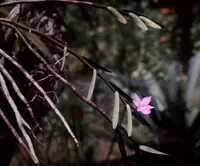
Its upright or arching inflorescences can produce several pink to lilac flowers in succession rather than all at once, extending the blooming display over time.

Botan icon

Did you know?

In some parts of its wide Neotropical range, this species naturally colonizes isolated fence posts and roadside trees, making it a conspicuous wild orchid in human-modified landscapes rather than being confined to undisturbed forests.

FAQs about Dimerandra emarginata

Lack of blooms usually comes from insufficient light, too little temperature drop between day and night, or low nutrition. Provide bright, filtered light, a slight night cool-down, and balanced fertilizer to support flowering over time.

Grow Healthy Plants with Botan Care

Keep your plants happy and healthy with plant identification, disease detection, and easy care guidance.


Botan plant care app — identify plants on mobile

Explore More Plants