Deep taproot space
Use a tall, deep container or an in-ground spot with at least 40–60 cm of loose soil so the strong taproot can develop properly without circling or hitting a hard barrier.

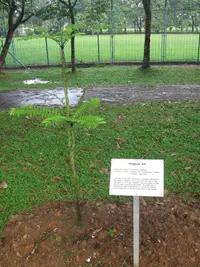
Tongkat ali, or Eurycoma longifolia, is a slow-growing tropical tree native to Southeast Asia, especially Malaysia and Indonesia. It is often grown for its slender trunk and long, divided leaves that give a sparse, upright look rather than dense foliage.
In the wild it occurs in lowland forests with warm temperatures and consistent moisture. It can be challenging to grow outside its natural climate because it dislikes cold, sudden changes, and waterlogged conditions.
Those who want to care for tongkat ali should know it prefers bright light, evenly moist but well-drained soil, and protection from strong winds and prolonged cool weather.

Care Difficulty
Hard Care

Light Preference
Full Sun

Water Requirements
Moderate Water

Temperature Preference
Tropical / Frost Sensitive

Hardiness Zone
12–13

Soil Texture
Sandy, Loamy, Organic-rich

Soil pH
Acidic (5.5–6.5), Slightly acidic (6.5–7.0)

Soil Drainage
Well-drained

Fertilization
Minimal (feed rarely)
Scan your plant to receive care tips personalized for your specific plant
Available on iOS and Android
This tropical species develops best with stable, bright outdoor light in warm climates.
Watering should keep the root zone slightly moist but never saturated.
This species thrives in consistently warm, frost‑free tropical or subtropical conditions.
This species prefers moderately humid air similar to a tropical understory.
This species needs fast-draining, slightly acidic, sandy to loamy soil to prevent root problems.
This species can be grown in containers if the pot is deep and drainage is well managed.
Eurycoma longifolia benefits from light, balanced feeding in containers but established in-ground plants often manage with nutrient-rich soil alone.
Eurycoma longifolia requires only light structural pruning to maintain a healthy, upright form.
Eurycoma longifolia is usually field-grown, so attention focuses on careful transplanting or occasional up-potting of young plants.
Eurycoma longifolia is most reliably propagated from seeds, though germination is often slow and uneven.
Eurycoma longifolia is a tropical species with low frost tolerance and needs protection in regions with cool winters.

Plant Health Check
Not sure what's wrong with your plant? Check your plant's health inside the app.
This species is a very slow-growing small tree native to lowland Southeast Asian rainforests, often taking many years to reach just a few meters in height under natural shade.
The roots and other tissues contain quassinoids such as eurycomanone, which are among the most bitter plant compounds known and help protect the plant against herbivores and pathogens.
It is typically dioecious, meaning male and female flowers grow on separate plants, with small, reddish-brown flowers arranged in branched clusters (panicles).

Genetic and ecological studies show that wild populations of Eurycoma longifolia are becoming locally depleted in parts of its native range due to intensive wild root harvesting, which has led to conservation concerns and the development of cultivation programs to reduce pressure on natural forests.
Growth is slow to moderate. Seedlings may reach 20–40 cm in the first 2–3 years, then gradually form a small tree over many years. Warm temperatures, bright light, and consistent moisture support better development.
Keep your plants happy and healthy with plant identification, disease detection, and easy care guidance.